
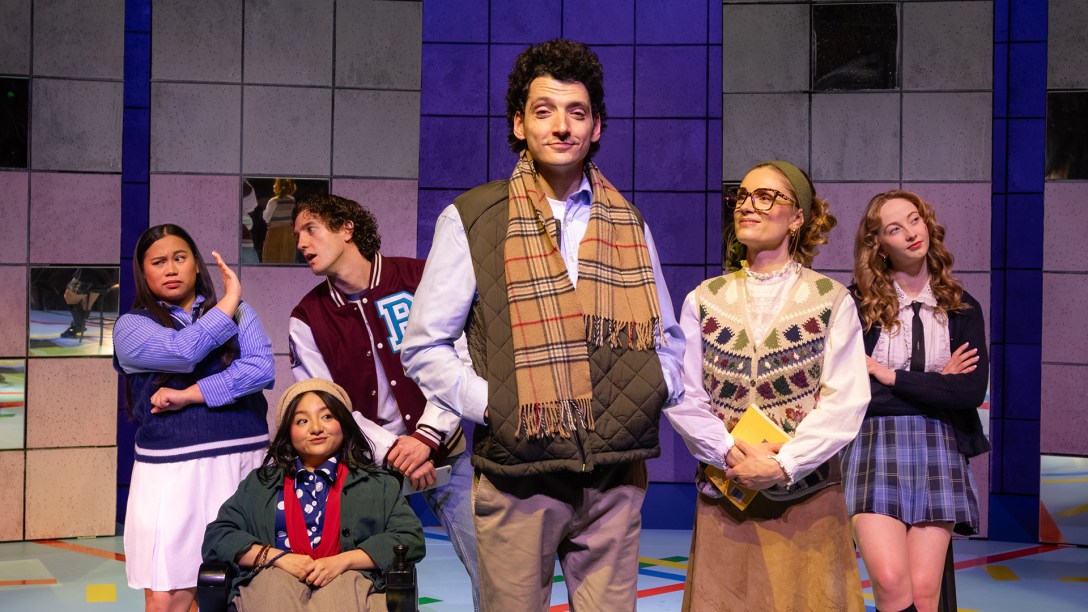
Erin Harrington reviews Teenage Dick, by Mike Lew, directed by Pelenakeke Brown, at the Court Theatre, Saturday 12 September 2026.
Richard III is one of Shakespeare’s great villains: a “deformed, unfinish’d” noble “not shaped for sportive tricks” who decides that if he can’t be the face then he’ll be the heel, and damn anyone who gets in his way. “I am determined to prove a villain”, he announces in his famous opening soliloquy, laying out his plan to lie, cheat, and manipulate his way to the throne. Mike Lew’s play Teenage Dick loosely adapts Shakespeare’s play, placing us in an American high school in 2016. Richard, an ambitious, mean-spirited outsider with cerebral palsy, is eyeing up an unexpected and unprecedented run for senior year class president against football star (and junior class president) Eddie and goody-good Clarissa. Gen Z zingers meet dirty politics, and Richard plays very dirty indeed.
The play marries the very familiar tropes of American teen film (by way of an Election-style social satire) and Shakespearean conventions (soliloquies, asides) with an ambivalent account of privilege and identity. Machiavelli’s The Prince is namechecked overtly in the play’s opening, as Richard, already an astute student of power, weighs up whether it’s better to be feared than loved – to just be the villain that others already think he is. Chicken, or egg? Do people dislike him because he’s disabled, or because he’s an asshole? What’s his ‘station’ in this highly structured world, and why should he be happy with it, and all those other systems that are built without him in mind? The bubble of high school, with all its social stratifications and power dynamics, is an ideal place to explore such hierarchies, as well as the complexity of disability politics. It’s very funny, until it’s not.
The six-strong cast are thoroughly attuned to one another. Joel Lago offers a magnetic performance as Richard, whose lizardy, slippery charm and charismatic cruelty at times falter to reveal deep vulnerability and pain. He grabs the audience immediately, cajoling us and challenging us with persuasive rhetoric. Doesn’t everyone love an underdog? His prickly, banter-filled relationship with occasional co-conspirator Barbara ‘Buck’ Buckingham (a brilliant Crystal Nguyen), a disabled, stylish artsy girl who uses a wheelchair, is the highlight of the production. Both are Court newcomers; let’s hope we see them again.
Jordi Rea, as Eddie, is a perfectly douchey jock, hooting football chants at the audience, and Reylene Rose Hilaga brings light and shade to ambitious Christian overachiever Clarissa, a character who could easily fall into caricature. Christy Sullivan also brings some thoughtful depth to quirky English teacher Miss York, who isn’t above trying to manipulate students for her own ends. The audience is deeply invested in Sophie Harris’ portrayal of Anne, a pretty dancer who starts off as the stereotype of an A-list cool girl. She is widely underestimated, though, and her kindness and openness are ultimately weaponised by Richard.
The action plays out in a stylised school gym, designed by Mark McIntyre. A bleacher offers height, as well as a physical representation of the social pecking order, and brightly coloured painted lines give a sense of tangled relationships, as well as some visual interest given action and blocking are frequently quite static. It’s bounded at the back by a long wheelchair-friendly curve that creates an additional, corridor-like playing space behind tall tiled and mirrored panels that allude to dance studios and locker rooms. I’ve previously heard director Pelenakeke Brown deliver a terrific keynote at performance festival Tiny Fest about dance movement, disability, the vā and theatrical space, and can clearly see her ideas at play. I also really appreciate seeing a different approach to colour than is normally seen at the Court. Linda Harris’ costume design also offers some subtle flourishes that connect the teen archetypes to wider power plays and Shakespearean references.
The first half of this production whips by; it’s tight and compelling, with a distinct sense of control and a thoughtful use of space. By the end, though, Teenage Dick is challenged by the weight of too many ideas, at the level of script and production. It is trying to do a great deal as it interrogates female agency, ableism, saviour complexes, what it means to be ‘good’, (in)accessibility, the power of social media, solidarity, self-interest, elitism, discomfort, assimilation, bullying, desire, sexuality, and cruelty. It’s doing this all while trying to balance Richard’s complex character arc, manage Ann’s place in the narrative (and her commentary about women’s roles in such stories, which overcomplicates the play further), maintain the work’s linguistic and dramaturgical Shakespearean conceits, and hit teen genre beats (all roads lead to prom)… A real ask. Later production elements, like projections across the uneven panels, and more overt sound and lighting design, also become distracting and busy.
It’s a challenge, by the end, in terms of pacing and engagement, but the characters are all beautifully drawn, and the relationships are rich and lived in. The opening night audience is enthusiastic. The play also offers a wider challenge to this end of the sector about the programming of work that centres disabled voices, stories, spaces and creatives. Teenage Dick is quite a different offering from the Court. It invites you in with catty bon mots and wicked schemes, then asks you to sit in the mess – and to think that that was your idea all along.
Teenage Dick runs until Saturday 10 October.


