
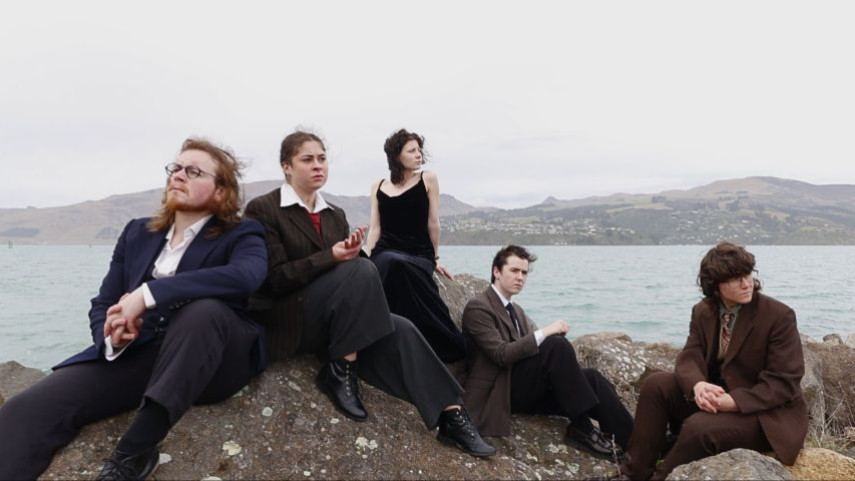
Jordon Jones reviews And Then There Were None, by Agatha Christie, directed by Rachel O’Brien Hamilton and Ben Moore, presented by the University of Canterbury Drama Society, at the Ngaio Marsh Theatre, Wednesday 9 September 2026.
And Then There Were None is one of Agatha Christie’s most enduring mysteries, sitting right up there with Murder On the Orient Express in terms of iconic premises. Ten strangers receive mysterious summons to an isolated island, where they are all accused of murder before being killed off one by one… It’s a fantastic thriller, and perfect for a stage adaptation, which Christie wrote herself in 1943. The play is so good, in fact, that this is the second time DramaSoc has performed And Then There Were None―the last staging was in 2017, a good couple of generations of students ago. I missed seeing the 2017 production, but I wasn’t going to miss it again!
The setting is a lonely, run-down seaside house, situated off the coast of Devon. The white expanse of the walls may initially seem at odds with the dark events of the play that unfold within them, but the bright colourlessness ties in well with the underlying motif of exposure―white offers no solace of concealment to those with secrets to hide. (More prosaically, the colour also feels appropriately beachy for what is presumably a summer home.) The set was, as of the dress rehearsal I attended, freshly assembled, and it did feel a little unfinished as a result. So long as the doors learn to behave themselves and moving parts are properly secured, though, I don’t think much is needed beyond some final tweaking.
Lighting and sound also had a big part of setting the scene, especially in terms of showing the passage of time and inclement weather. My favourite technique was a dappled lighting effect used as the storm blows in, and I wished there was more of it. I will also note that there is a single lightning flash directed at the audience during the second half; it works very well in the moment, but those who are sensitive to bright or flashing lights should be prepared.
You need a strong ensemble for And Then There Were None, and the best way I know how to introduce you to them is to follow the lead of the play itself. We begin with Mr and Mrs Rogers, the couple engaged as servants by the conspicuously absent Owenses. Liam Kean plays Mr Rogers, the surly but hard-working butler. Mrs Rogers is played by Francie Liebert, who gives the character a liveliness that contrasts well with Kean’s more even keel. The first guests to arrive are Vera Claythorne (Gray Dawson), Mrs Owens’ newly-appointed secretary, and ex-soldier Philip Lombard (Jack Riddell). I greatly enjoyed Dawson’s performance; they carried Vera’s complex layers and emotions (and her glamorous costumes) as though it was completely natural for them. As Lombard, Riddell was devilishly cavalier and charming, making him a pleasure to watch.
The rest of the guests arrive together: Anthony Marston (Oliver Keating), Justice Lawrence Wargrave (Iain Hannam-Williams), Miss Emily Brent (Lucy Corlett), Dr Edward Armstrong (Ella Butterworth), William Blore, alias “Davis” (Jordan James), and General John Mackenzie (Vivek Raj). Keating’s gay flippancy is the perfect touch for Marston, who refuses to take anything seriously, even death. In contrast, Justice Wargrave is played by Hannam-Williams with utter gravitas; they particularly impressed me with their commanding vocal performance. Corlett’s portrayal of the strict, upright Miss Brent was downright chilling in her apathy, though I was warmed by the sight of real knitting onstage (win!). As the anxious, alcohol-addicted Dr Armstrong, Butterworth contributes strongly to the uneasy tension that builds throughout the show. James had the added challenge of playing not just Blore, the untrusting policeman, but also his alias Mr Davis, a South African millionaire; learning one accent is tricky enough, but two is a big achievement, and I say kudos to them! Our final member of the ensemble, Raj, delivered a very thoughtful, world-weary performance as General Mackenzie that makes me want to see more from him.
Before we move on from the acting, I have a couple of general notes that speak to the skill of the directing team of Rachel O’Brien Hamilton and Ben Moore. Firstly, I was impressed by how well Hannam-Williams, Corlett, and Raj showed the signs of age in their roles; it is a challenge that often comes up in school or university productions, where young actors are called upon to play characters significantly older than they are. These actors bridged the discrepancy with a range of techniques that communicated this aspect of their characterisation well. Secondly, I appreciated that although the mics were a bit patchy (the joys of student theatre budgets), the cast was consistently able to project through the gaps, though admittedly I was not in the back of the theatre, which might be more of a struggle to reach clearly.
One major highlight of DramaSoc’s latest stab at And Then There Were None is how subtle this production is. There are a number of moments where items need to disappear, murders must be affected, and characters quietly expire right in the middle of the scene. Aside from a few technical hiccups (which were neatly adjusted for), these moments were smoothly plotted; even I, someone very familiar with the events of the story who was looking for them, didn’t catch everything. There was also some clever technical trickery at a pivotal moment that I’m not allowed to talk about, except to say that it was very effectively done.
It took a little while for the show to settle into itself (possibly due to the nature of being a dress rehearsal), but the performance got better and better as the tension built. The actors locked in―as I believe the youths say―and lifted their energy to match the focal intensity tightening around them like a noose. This production of And Then There Were None is cleverly wrought with a lot of creative thinking, and it features some stand-out performances, particularly from Gray Dawson and Lucy Corlett. I congratulate the whole team on their hard work, and wish them a successful season this week.
And Then There Were None runs until Saturday 12 September.


