
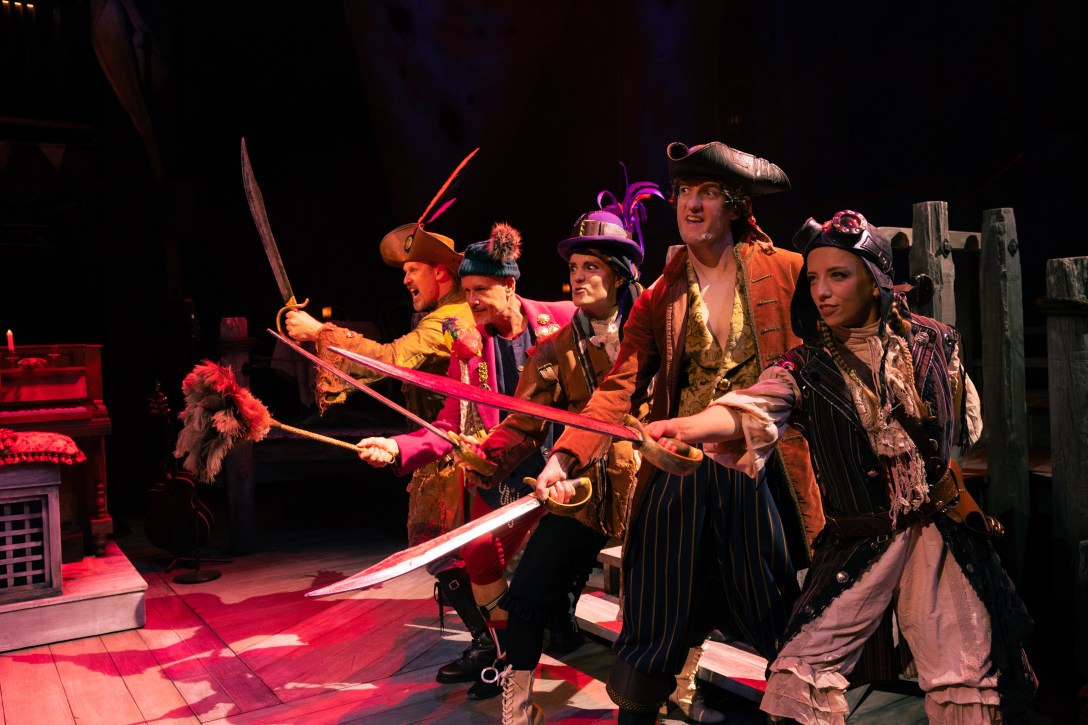
Erin Harrington reviews The Pirates of Penzance (or The Slave of Duty), adapted by Richard Carroll from the original by Gilbert and Sullivan, directed by Ross Gumbley, with musical direction by Michael Lee Porter, at the Court Theatre, Friday 20 November 2026.
The Court Theatre’s summer production of The Pirates of Penzance (or The Slave of Duty) is a big pirate party and everyone’s invited. A five-strong cast – Sarah Clare Judd, Christy Sullivan, Jordi Rea, Roy Snow and Michael Lee Porter (doing double duty as musical director) – are in full comic pirate kit complete with stuffed shoulder parrot as they welcome the audience into the space. They variously tease, cajole, comfort and befriend audience members, some of whom sit on or next to the stage with cabaret seating. There’s bunting, music, treats, cheering, song, jokes – and that’s before the show has even started. Buckle in.
Wide-eyed Frederic (Rea, a terrific leading man) is turning 21 – hence we, the crew, are assembled. This means his time with his swaggering nursemaid Ruth (Sullivan) and indentured to a gang of soft-hearted pirates led by the bombastic Pirate King (Snow) is coming to an end. He wants to make an honest man of himself, and his excessive sense of duty to his crew will become an excessive sense of duty as a gentleman. He’ll be guided by a big book of Victorian social mores, and perhaps committed to the extermination of those who have raised him. After various shenanigans he meets and falls in love with young Mabel (also Sullivan), daughter of a pirate-hating Major-General (Porter) in the British Army. Various revelations, surprises, fibs and paradoxical legal fishhooks make things remarkably complicated, and Frederic must decide where his loyalties lie.
This raucous new adaptation by Richard Carroll, first produced by Sydney’s Hayes Theatre Co in 2025, updates Gilbert and Sullivan’s beloved original comic opera, streamlining the cast and tweaking the plot, and cranking the sense of anarchy and absurdity up to 11. Carroll casts a satirical postcolonial eye across the work’s Victorian politics and humour. He keeps the best of the original’s many gags and barbs of social commentary, as well as the work’s sense of heart and playfulness. He then brings the book and references into the present day, sometimes explaining out-of-date jokes in droll meta-theatrical ways, drenching it all in a tongue-in-cheek, self-aware humour. Ross Gumbley’s high-octane production makes much of this juxtaposition, as the pirates lean joyfully into some comic Ocker stereotypes (tomato sauce bottles, shrimp on the makeshift barbie, tortured accents), and the imperial toffs totter around in whites and frills (also with tortured accents).
And boy is it entertaining. I’ve heard such tight casting described, in a few different contexts, as ‘cost of living’ theatre – that in times of artistic austerity shows’ casts are much smaller, and thus more affordable to human resources. The trade-off is that those performers in turn must be more and do more: sing, dance, act, improvise, play multiple instruments (sometimes at the same time as others, or with others), and undertake various feats of strength and flexibility. It’s enormously demanding and makes for quite the spectacle; I hope there are some frequent vocal rest days. This adaptation sees that constraint as an opportunity, and then says ‘hold my beer’ (VB, natch).
The five performers are outstanding, and clearly having the time of their lives as they switch quickly between characters, belt out musical numbers, hoon around the playing space as if their fortunes depend on it, comment on the action, and butter up the audience. Each performer is offered welcome moments of glory: Roy’s flourishes as Pirate King, Rea’s shifts between crooning matinee idol and petulant child, Judd’s song and dance number as a police officer with unexpected talents. Some of the work’s best-known songs, such as the pirates’ extremely loud account of very quiet burglary “With Cat-Like Tread”, are treated as moments of triumph.
Even in an evening of remarkable performances and frequent artistic surprises, which you will need to head along to catalogue, two things stand out. At the end of act one, Michael Lee Porter belts out an updated version of the Major-General’s iconic, satirical patter song while also playing the piano, which is in turn being spun around the stage by the rest of the cast. The number is notoriously difficult enough without the additional vertigo, and the flamboyant Elton John-style costume flourishes. Christy Sullivan also gives a barnstorming vocal performance as pirate nursemaid Ruth and ingenue Mabel, shifting from brassy Broadway belt, R&B runs, operatic coloratura and torch song throatiness, sometimes all within a few phrases.
These performances are supported and enhanced by some thoughtfully holistic design, from the ridiculous costumes and hairpieces, to the silly props and jokes in the set dressing, to some fun flourishes in the sound design. The dynamic lighting design offers some well-timed laughs of its own. The theatre space feels unified, and every corner used. A special mention to the off-stage dressers, who facilitate the swift character and costume changes.
It all helps that Harold Moot’s gorgeous set, which recalls the deck of a ship, extends the stage by thrusting out an apron that lies flush against the audience. There are lots of fine details and layered textures – a Union Jack timber inlay that also shapes strong diagonal blocking, tattered sails hanging from the ceiling, more bunting, one piano on a wheeled platform, another that flies in from the ceiling disguised as a crate of tea. The front bank of seats has been removed, and additional seating added up on the poop deck for those keen for a closer view and a bit of audience participation.
This option of a thrust configuration was mentioned by the organisation during previous public debates (and complaints) about the theatre’s seating and layout, and seeing it done, finally, and so well, is something of a revelation. It’s the first time since the new building opened that the space has made sense to me, and it feels like the Stewart Family Auditorium is finally living up to the theatre’s promises about engagement, design and intimacy. There are certainly some economic considerations, given the number of seats it wipes out, but as an audience member it’s worth it.
This adaptation may startle the purists; the couple next to me certainly came in with different expectations and left looking like they’d stuck their head out in a gale. But whether you’re a die-hard Gilbert and Sullivan lover, or your fandom tilts more towards Guybrush Threepwood and Our Flag Means Death, it’s very hard to fault this joyful, silly, stupid, clever and thoroughly well-made production. Get on board or walk the plank (taran-tara).
The Pirates of Penzance runs until Saturday 30 January 2027. Image credit: Charlie Rose Creative.


