
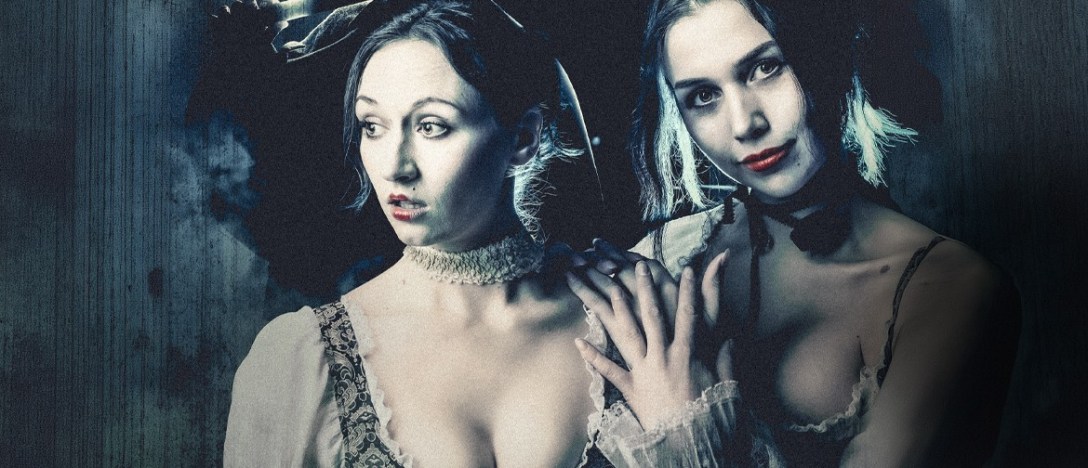
Erin Harrington reviews Bride of Hyde, written by Bryn Sparks, directed by Dan Bain, at Little Andromeda, Wednesday 28 October 2026.
The new play Bride of Hyde mashes together two classics, Robert Louis Stephenson’s The Strange Case of Dr Jekyll and Mr Hyde (and its various adaptations) and My Fair Lady (the best-known adaptation of George Bernard Shaw’s 1913 play Pygmalion), connecting these stories to other Victorian gothic horrors. Playwright Bryn Sparks is a sleep expert by day who chooses to explore the stuff of nightmares in his spare time – and creating and then staging new scripted work, let alone work in speculative genres, is hard. These efforts bear much (rotten) fruit, as this is a well-considered and well-acted production, underpinned by strong directorial and design choices, that really knows its genre.
Scientist and gentleman Dr Henry Jekyll (Sebastian Boyle), now living under the pseudonym Henry Higgins after ‘previous events’, attempts to maintain a sense of normalcy while his monstrous criminal alter-ego, Edward Hyde (James Kupa) prowls through the fog feeding his basest passions for sex and violence by night. The play opens with the two bickering; how is charismatic Hyde fulfilling blancmange Jekyll’s unmet repressed needs? How do they wish to live? Which of them is the real monster? Jekyll feels spurned by too many women and Hyde wants out of his box, so they settle on a plan: Hyde will take control, mostly, but needs a wife to cement his place in good society and serve his needs. They plot to find a ‘Whitechapel girl’, a lower-class sex worker, and feed her a new female version of Jekyll’s potion so that she will transform into something approximating a lady. Cockney woman Eliza Doolittle (Connie O’Callaghan) will do; she and her Irish sister, Mary (Caitlin Penhey) are looking for a way out of their precarious life. At first Eliza is thrilled with her new identity, but Mary is upset and suspicious about the whole racket, and to make things worse there’s something terrible happening to the women of Whitechapel…
This moody play builds well on the creative team’s production of Sparks’ excellent gothic horror Coffin Ship last year. It makes thoughtful use of the small theatre’s capacities, including its high end sound and lighting rig. The set is simple – a small riser, a wingback chair, a Tiffany lamp, and a screen that obscures the upstage entrance while allowing for some neat light work and shadow play. Director Dan Bain has also pulled out the back row of seats to create a path lit by gaslamps, and the characters move around behind the audience as they variously stalk, run and hide in the nighttime fog. This combines with a detailed and dramatic lighting plot, and atmospheric music and squelchy sound effects, to position the viewer within an immersive sense of gothic awfulness. This extra space also gives the actors much more room to play.
Boyle and Kupa’s tense dynamic feels natural and lived in as the pair bicker, negotiate and berate one another, exploring the original work’s questions about human nature and repression. Which of the two will prevail, and how? Questions of identity and desire then extend to the two women – the way they see themselves, and the way they are seen.
Enter the ‘man-made bride’ or ‘man-made woman’ plot – a long-standing trope, from religion and myth (as dramatized by Shaw in Pygmalion), literature (E. T. A. Hoffmann’s influential short story “The Sandman”), to early film (Metropolis, Bride of Frankenstein) and contemporary science fiction (Ex Machina), to modern day self-aware ‘incel horror’ (Obsession, Blick Twice). It’s another form of doubling that asks questions about power and gender. Here, Jekyll opens the play by complaining, to give it a gloss, that women don’t like him; he sees himself as entitled to female companionship. Monstrous Hyde is, perhaps, more realistic, happy to thunder around getting laid, but a wife wouldn’t be so bad. Eliza wants a way to move above her station and is at first very taken with her transformation, a willing participant (albeit one with few choices). However, as with many of those cultural precursors (including Eliza in My Fair Lady) soon realises that she is being trapped and controlled – never mind that the ‘secret ingredient’ in her potion also comes at a huge cost to others, and perhaps her sister. Mary also wants out, and is looking for passage to the colonies to build a new life and identity, but she becomes terrified for Eliza. The women have a rich and believable relationship; the stakes are high, and credible.
Parks’ script leverages the audience’s expectations of the precursor works and of genre (particularly the rich well of gothic horror), as well as some familiar themes, but combines them in new ways. The characters are well drawn, and the relationships are nuanced. The play’s twists are satisfying not because they are unexpected, but because we anticipate them and wait for their fallout. All that said, while the first half feels lean, the play’s climax is quite verbose – although staged, through lights and shadow play, in a manner that works hard to show as much as it tells. For all the strengths of the play I am also thoroughly unconvinced by the denouement. It rounds out the play’s interest in the women’s self-actualisation, but in a very on-the-nose, didactic manner that pulls me out of the action and atmosphere, even though Penhey certainly sells her character’s choices.
Bride of Hyde is nonetheless satisfying, and new scripted work that takes its stories and characters seriously, rather than defaulting to comedy, is very welcome. I’d say go book but it’s sold out, so you’ll have to get your spooky season fix elsewhere.
Bride of Hyde runs until Saturday 31 October.


