
Erin Harrington reviews Babyface, written and performed by Nick Tipa, directed by Sara Georgie, with music and sound design by Zac Nicholls, at Little Andromeda, Thursday 4 June 2026.
Kahu’s a Māori kid in a small rural town that can’t tap its ‘r’s. Professional wrestler Whiplash is the undisputed heavyweight champion of the world with some killer signature moves. They are two sides of Babyface – our good guy hero and the new kid in town just trying to figure stuff out. Ōtepoti-based Kāi Tahu performer Nick Tipa’s semi-autobiographical coming-of-age solo show is a charming and vulnerable take on how kids explore and understand the world. It’s about how we explore our identities, through imaginative play, drawing on fantasy worlds for comfort and strength at times of uncertainty. Also, wrestling is cool.
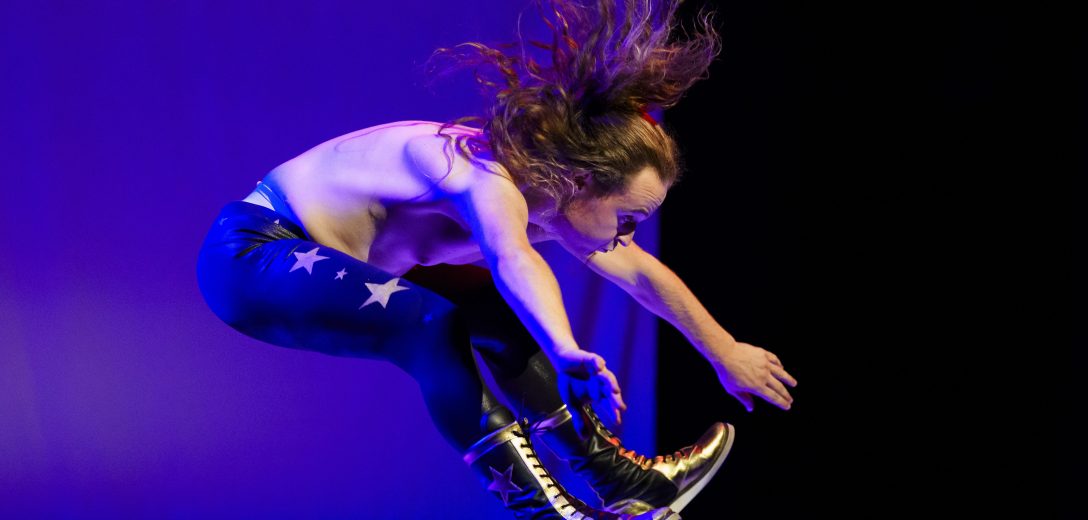
Tipa is alone, in some terrific black and gold wrestling ring gear, on a blue mat. Two fold-up chairs sit in the corner (ominous) next to a box of mementos. These items trigger a series of scenes that explore Kahu’s early adolescence, roughly ten through twelve, as he goes from new kid in a strange place to legend (or at least established local) before events conspire to take him away.
Tipa flicks rapidly between dozens of characters – classmates, buddies, parents, teachers, adults and some randoms – fleshing out Kahu’s world and relationships. It’s an intense time – figuring out the pecking order, crushing and being crushed on (in a non-wrestling sense), trying to fit in but be your own person, getting a glimpse into complex adult worlds that don’t make sense. Vignettes are broken up with fantasy wrestling sequences. Tipa slams, strikes and attacks various opponents. It’s a very physical role; the crowd cheer. The action is supported with a detailed soundscape from Zak Nicholls that ranges from hype music to everyday sound effects. Projections incorporate title cards, photographs and kids’ pictures, sometimes drawing an audible ‘aww’.
Tipa is a warm and charismatic performer. We’re welcomed into the space of the show with a karakia, and farewelled with aroha (and a live action rattle through the credits, which I love and wish happened more). The work itself is thoughtful and engaging, an emotional snap back to puberty. This is the second run of the show, after a successful season in the 2025 Dunedin Fringe, ahead of a larger tour. While a lot has been developed there’s still scope to tighten the screws, although perhaps it’s that this is the first night back. This includes transitions between scenes, the way action maps onto sound, and the differentiation between characters, as well as the sense of the story’s emotional and narrative arc (as opposed to its series of events). There’s a lot happening, but the ingredients are great and all there.
It’s a treat to see local stories told with heart, and that show how a theatre pipeline might work, given Tipa’s earlier writing residencies at the New Zealand Young Writers’ Festival and the Robert Lord Cottage and work in various companies and theatre wanaka. The wairua is good: Babyface bodyslams you back to childhood then gives you a cuddle to make sure you’re okay.
Babyface plays until 6 June 2026 before touring Aotearoa and then Edinburgh. There are three days left on Nick’s Boosted campaign to help support touring costs – click here.


