
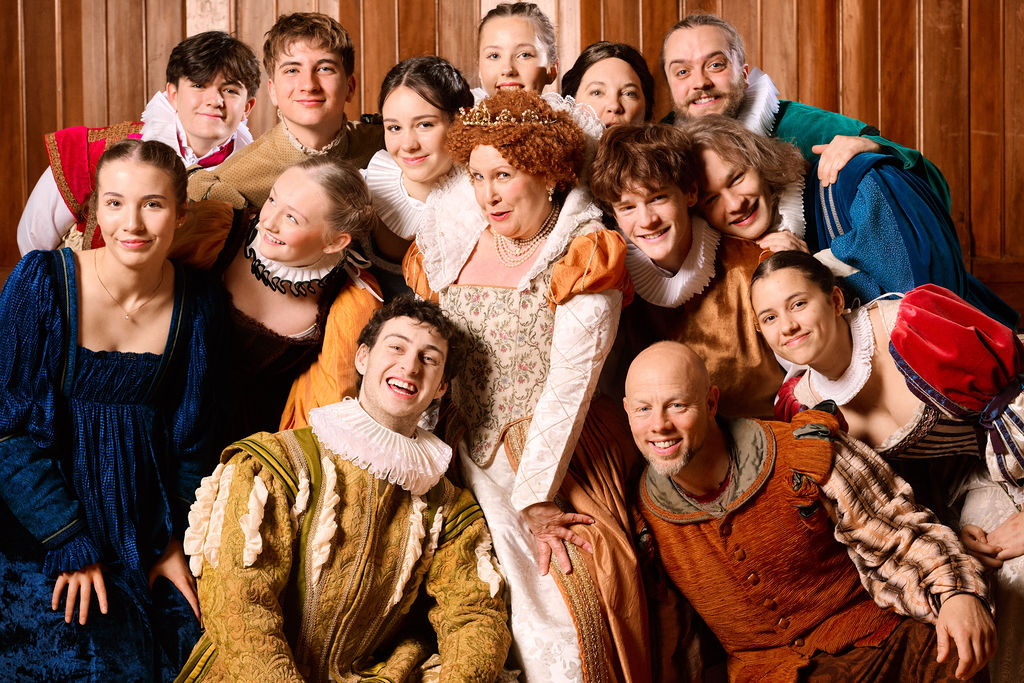
Charlotte Thornton reviews Sweet William or Born to be Bard, presented by Enchanting Productions, written and composed by Neill Pickard, directed by Louise Glossop, at The Piano, Friday 16 October 2026.
William Shakespeare is almost as popular a character as the characters he created. He’s beloved on screen: a romantic lead in the Best Picture-winning film Shakespeare in Love, the focus of the sitcom Upstart Crow, and a one-off companion in a Doctor Who episode which I suspect shaped his modern “playboy bard” reputation. He’s also had a good few decades on stage, with cheeky supporting roles in two popular musicals: the parody Something Rotten! and girlboss pop opera & Juliet. Both were recently performed in Ōtautahi Christchurch, now joined by a revival of sorts in Enchanting Productions’ staging of Sweet William or Born to be Bard by Neill Pickard.
Sweet William had an unusual journey to The Piano’s stage. It was penned in 1977 and performed at high schools for a few decades, until some of Pickard’s musical arrangements were lost following a Cashmere High School production in 1995. These arrangements were rediscovered decades later by a former Cashmere music teacher, thus enabling this new Enchanting staging, the first production with a cast of all ages. And this cast really does represent all ages, from primary schoolers up to older adults.
The framing device is a clever choice for a school-aimed script. We’re ushered into the story by a class of schoolkids on a tour of William Shakespeare’s childhood home. Two of them (Katherine Lord and Theo Thomsen, both utterly charming) break away to muse that they don’t understand why Shakespeare’s so important – surely a familiar opinion to English teachers and their students. Shakespeare himself arrives to tell the kids his life story.
Shakespeare is played with dorky everyman charm by musical powerhouse Nic Kyle. Kyle is a confident leading man, with considerable range in his roles at The Court Theatre: he had a notable turn as the titular Jesus Christ Superstar and recently played a violent bully in Let the Right One In. Thankfully his Shakespeare is much closer to the former.
Sweet William’s music, lyrics, and book are all by local composer Neill Pickard, the founder of the Christchurch Jazz School. The songs are uniformly excellent, with bouncy 70s melodies and knowing wordplay that frequently veers into the suggestive: “It’s a virginal, Master Shakespeare! / A virginal Master Shakespeare?” These songs are woven through the events of Shakespeare’s life, from his early years as a gifted oldest child (played with finesse by Ben Cumberpatch) to his young adulthood as a casanova glovemaker. The musical arrangement by Gabriel Baird is perfect in all styles, from barbershop quartet to samba to slow ballad. The entire band is exceptional, but for me the standout musician is Peau Halapua on violin, bright and full of character.
While the music and lyrics are neat and highly effective, the book gets busy and unwieldy as the show goes on. The 42-strong cast plays a character list of 64; characters are frequently introduced only to immediately disappear, particularly in the weighty second half. Act 1 lasts one hour, which is a typical length for a musical. Act 2 of a musical is always shorter, so Sweet William’s should last between 45 minutes and an hour. This is not the case: Act 2 lasts an hour and a half. It’s a heavily imbalanced show, with new major characters still being introduced past the two-hour mark.
Director and producer Louise Glossop handles the massive cast very well. It’s clear the many child actors feel empowered to deliver great performances. Harry Pringle, 12, breaks many hearts as the doomed Hamnet Shakespeare with his stunning rendition of “Greensleeves”. The Youths, while clearly far younger than Nic Kyle, are the strongest ‘rowdy male ensemble’ this side of Les Misérables. The duo of Cumperbatch and Billy Gyde deserve special mention for their slapstick number “Bubonic Plague Blues,” in which they use a mannequin arm to great comedic effect.
The female characters are less well-served by the script and music. Queen Elizabeth I (played with precision by musical theatre veteran Juliet Reynolds-Midgley) has a cheeky Blackadder II vibe but soon gets lost in the shuffle. There’s a revolving door quality to the temptress-slash-love interest role: Anne Whateley (Amy Potts, also choreographer) gets one song with Shakespeare before being replaced between scenes by the better-known Anne Hathaway (Eve Kelly Lyford), who herself is swiftly replaced by sonnet subject Emilia Bassano (Kimberley Fenton). On the page there is little way of telling these women apart, but their actresses do a terrific job of imbuing each with a personality and an inner world.
Sweet William probably works best with a high school cast, considering its vast number of named characters and musical styles. But its songs are clever, fun, and most of all memorable – the most important quality for a musical to possess.
Sweet William or Born to be Bard runs until Sunday 18 October, 2026.


