
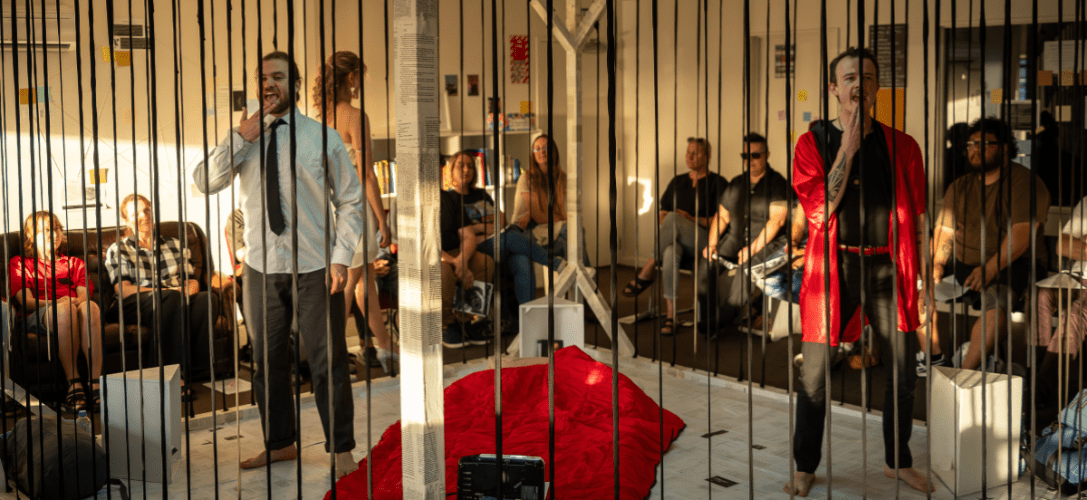
Daniel Allan reviews Faust on Trial, by Josiah Morgan, Stella Cheersmith and Jonty Coulson, at Cloisters Studio, Te Matatiki Toi Ora Christchurch Arts Centre, Saturday 15 August 2026.
Faust on Trial was initially developed as part of Hagley Theatre School’s theatre creation course last year – see the review of that iteration here. Word of mouth painted it as a low-budget wonder, and it quickly became a hot ticket, and one of the highlights of the Ōtautahi theatre scene in 2025. This return season is a more refined version at a more swanky venue and whether the show benefits from its gentrification could be a topic for debate among those who saw both versions. I had a newborn son when the first version landed, which prevented me from attending, but I swore to its creators that I would be first in line for tickets for a remount. On the day of a family excursion to Quail Island, the season’s midnight finale allowed me to sneak out of the house without disturbing the fledgling whānau’s slumber.
Fresh from one island of quarantined isolation, I step into another. Inside the form of an elegant gauze cage, suspended delicately from the Cloisters Studio ceiling, Jonty Coulson is prowling alone. This is the conceit of the show made manifest. Faust has been languishing in hell for 500 years with the demon he sold his soul to, but he is up for parole. Whichever character of Dr Faustus/Faust or Mephistopheles/Mephisto (Josiah Morgan) is deemed by the audience to argue the best during this ad hoc trial is freed from the cage at the end of the performance by our arbitrator Helen of Troy (Stella Cheersmith). The actor playing the losing character faces the real-life consequence of staying in the cage until the next performance. A projection of a timer on the wall, counting upwards, denotes 3 days, 13 hours, and 38 minutes of total captivity time for Morgan and Coulson. I take a seat at the rear of one of four sets of bleachers arranged around the cage, and am delighted to witness each of the 44 spaces filled by a young and enthusiastic crowd.
While the source material is Germanic, there is something quite Roman about the gladiatorial combat these two actors have committed to, and the audience, with their fateful thumbs at the ready, get to decide who wins this theatrical cage fight. It is immediate, connective theatre at the witching hour, a great antidote for the deadly, safe bets one street north, and Ōtautahi’s youth are up for it. They are told that the loser of this final show will stay for 12 more hours beyond the show’s conclusion. “If it’s a tie, you both stay!” heckles one audience member, clearly a frenemy of the actors, and keen for some joint suffering.
There is much ado in the programme about how the production received no funding amid a wider problem of CNZ cuts and Te Waipounamu receiving proportionally far less than our friends in the north. Unfunded though it may be, this version can only be described as professional in all ways you can slice a theatre experience, from the quality of delivery and camaraderie of the cast, to the tasteful set and technical aspects. This team’s trajectory from composited to composed and now potentially ‘tour-ready’, is a massive tick for Hagley’s new kaupapa as an incubator for developing theatre.
I said it was tour-ready, and I meant it, but the production team might like to consider a few further tweaks in subsequent seasons, asking continually ‘what are the essential elements?’ In a contest of ideas, we should be focussed on the arguments of the man (and demon) at its heart. Content-wise, this performance touches on a massive range of human issues, and a narrowing of its targets would be beneficial. Faust is framed, in both the programme and initial introductions as being white, with white problems, and using white solutions, which primes me for an examination of colonisation. But this theme of whiteness is not developed in the action that follows, and makes me wonder if its inclusion is an evolutionary remnant from an earlier draft. I do detect very strong feminist themes in the piece. The fact that Faust is a man who treated his love interest badly, and is now being arbitrated by a famously misunderstood woman is the source of much more of the tension than his whiteness, and perhaps this is the political basket that the production needs to put more of its eggs in.
In terms of staging the debate, I’m not sure that a selection of large triangular blocks that are variously perched on, tiptoed around, and used as sitting, cooking, and bedding surfaces are helping us focus on the arguments, especially in a tight arena where the actors are tasked with engaging in 360 degrees. I guess an argument could be made that hell is the Sisyphean routine of constantly grappling with abstract furniture so it doesn’t get dropped on your bare toes. Personally, I would eschew the blocks for a more Spartan cage that allows a flowing and direct contest and better access to the audience. And since I have gone into clean-out mode, I would also drop the intoned stage directions, as with one arbitrator in the form of Helen, another structural source of neutral information is gilding the lily somewhat.
Recommended adjustments aside, the hour goes by fast, proficiently segmented into several different set pieces that pit the combatants against each other in familiar ways. There is room for improvisation within the structures and both the physical and verbal dexterity from the actors are impressive and often very funny. There is a Bachelorette-style quiz, a picture identification section where the boys are forced to reckon with the fate of Faust’s romantic interest back on earth, a cooking challenge, during which Coulson’s chaotic experimentation while pouring a packet of powdered pepper threatens to condemn the entire show to a coughing fit, and a section in which Faust is subjected to being puppeteered via audience suggestions. The willingness of some to call out sadistic instructions so quickly suggests that they are repeat viewers who are looking forward to this opportunity again.
While Mephisto mostly sneers and undermines – Morgan inserting himself with excellent comic timing – it is Faust, as the appellant, who is the more proactive arguer. A highlight for me is when Faust calls us all to huddle round the cage and think about the various ways we create Faustian deals for ourselves on the daily, such as using Google to have the world of information at our finger tips, as long as we give away all our personal data. To condemn him forever is to condemn ourselves as unforgivable. It is this point that ultimately convinces me, ever the optimist, to vote pro-Faust at the conclusion.
Helen collects each vote and stores them in one of two baskets, each growing quite evenly as the tension builds. The final result confirms the fated anomaly, a 22 – 22 tie, resulting in a massive response of convulsions, elated cheering and finally, a chant: “Both of them! Both of them!” as the actors drop character and gawp at each other incredulously. Cheersmith’s Helen loses composure in this unprecedented moment, seemingly asking Coulson and Morgan with her eyes ‘Is this okay?’ as she deliberates that both actors must remain overnight.
The audience lingers long after it’s over. The result of the hour’s business was a thought-provoking divergence for us witnesses, free to return to our own beds. Yet for the actors, the fleeting minutes on stage where they are blessed by the communion of an audience, must appear as all-too-brief flares of neon brightness as they oscillate between performance intensity, and long stretches of confined mundanity. Before leaving, I press my hand to Morgan’s through the gauze, imitating how a mournful lover might farewell an incarcerated partner, but under the joke I feel genuine sympathy for the pair and the night that awaits them. Despite what’s been staged, they are still just a rat in a cage.
Faust on Trial played at the Cloisters Studio 11 – 15 August 2026.


