
Breeze Robertson reviews the Royal New Zealad Ballet’s Winter Season at the Isaac Theatre Royal, Friday 31 July 2026,
RNZB’s Winter Season triple bill was somewhat of a whiplash tour through the evolution of ballet – from the tutus and tights of the traditionally classical Birthday Offering, through the playful contemporary quartet Ultra Folly, and finally into the stark landscape of the stunning all-female, politically-charged Stand to Reason.
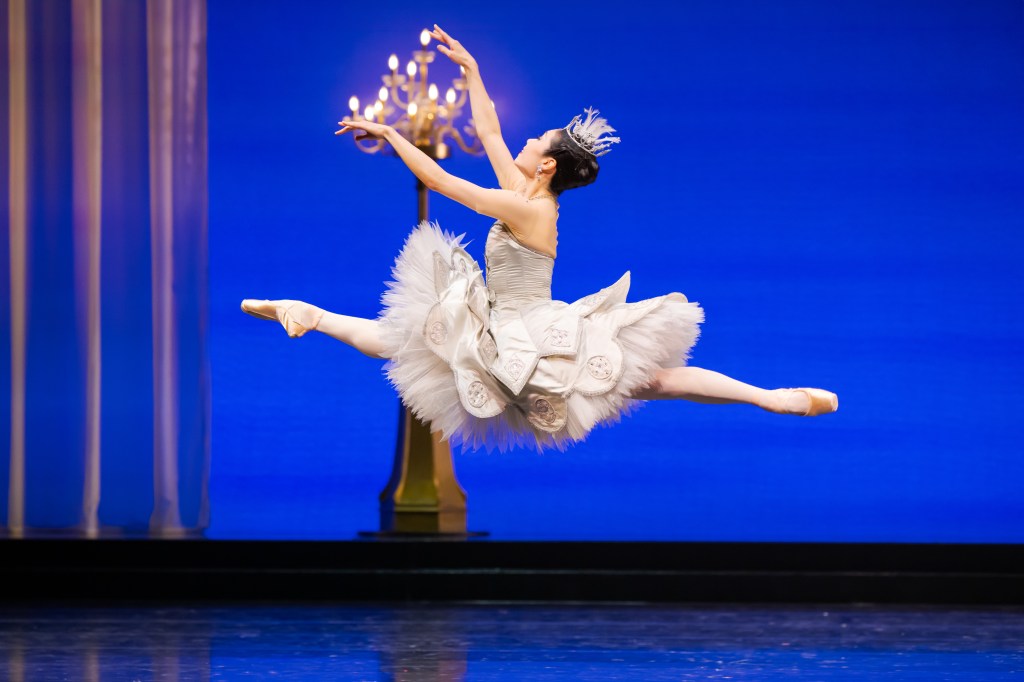
First up, Birthday Offering opened with a simple set of elegant chandeliers, setting the stage for a pretty balletic set piece of neatly paired couples dancing their way through ensemble, duos and solos. I’m not a traditional ballet fan it has to be said, however I could still appreciate the choreographic craft of this piece and the dexterity required of the dancers.
In many ways it was a brave choice given that esteemed English choreographer Sir Frederick Ashton created this ballet in 1956 to celebrate the company’s 25th birthday and show off the best of the Royal Ballet’s ballerinas – the cast included the great Margot Fonteyn. The solos are therefore quite delightful, each conveying the different personalities and technical strengths of the original seven ballerinas, with Kiwi dancers ably meeting the same challenges in this new restaging.
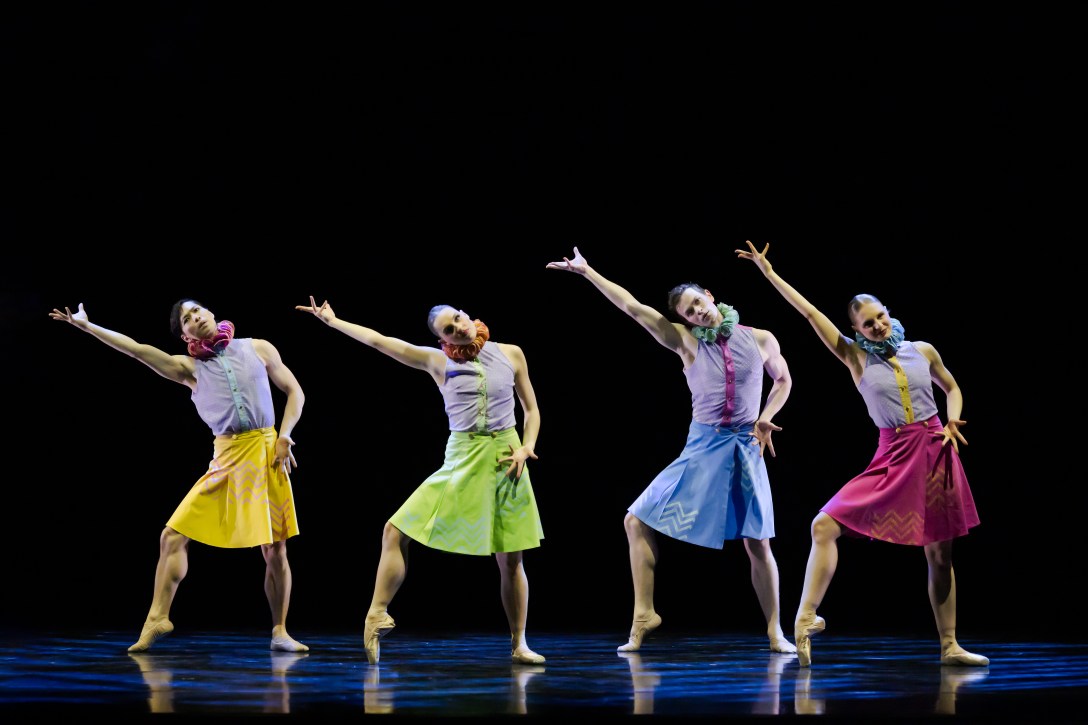
Next, Ultra Folly, a recent piece from 2020, but not performed until some years later, was created for the RNZB by Sarah Foster-Sproull. The opening picture had four dancers poised at the back of the stage reaching out for each other, but quite deliberately not touching hands, a position that they returned to periodically after exploring closeness and intimacy. The two female and two male dancers wore similar colourful costumes of skirts, vests and a big playful ruffle around the neck, with the women dancing in pointe shoes the only nod to gender. The stage was bare, but awash with colour in a brilliant lighting design originally by Daniel Wilson.
Posturing and posing, elaborately applauding each other’s solos, the occasional frustrated stamp of the foot, some moments of frantically swiping away at traces of contact as if brushing off invisible germs – this was a work full of mischief and fun, which the dancers (Jemima Scott, Gretchen Steimle, Zacherie Dun and Padraic Lum) seemed to relish performing. Setting the work to the 15th century music La Folia brought a sense of timelessness to the work, as if connecting elements of the human condition across generations.
The piece spoke to deeper themes of longing to connect juxtaposed with fear of intimacy, and was prescient in its reading of our modern lockdowns and changes to come. I don’t know how much the piece was adjusted when it could eventually be performed post-pandemic, but I’d argue it could be interpreted as a light-hearted take on the realities of how Covid brought a microscope to our relationships as well as to our fears and our need for silliness.
The final work, Stand to Reason, was simply extraordinary, an uncompromising exploration of NZ’s suffrage movement, commissioned for the 125th anniversary of this country being the first to grant women the right to vote. The lack of a set, stark white lighting and black tunic utilitarian costumes served to zero in on the movement of the eight impressive women dancers (Ana Gallardo Lobaina, Hannah Thomson, Rose Xu, Olivia Platt, Jemima Scott, Cadence Barrack, Mayu Tanigaito and Katherine Minor).
Stand to Reason, choreographed by Andrea Schermoly, begins with text from suffragette Kate Sheppard’s pamphlet Ten Reasons Why the Women of New Zealand Should Get the Vote projected onto a screen at the back of the stage. The audience, perhaps still giddy from Ultra Folly, tittered at the absurdity of some of the reasons as they appeared and stated, for example, that women had not been proven in fact to be equal in intelligence to children. Well, I bet they, like me, were in tears by the end.
The text hammered the message home, literally to the sound of old-fashioned type-writer keys, that women had to fight so hard for the right to vote and provide reasons to justify this. The movement picked up the theme, by turns militaristic with straight lines and angles, then supporting each other, advocating, then sinuous and struggling, but always driving on. It was extraordinary how the movement vocabulary conveyed so much in this short work and yet restrained itself from melodrama. For example, just two or three times, a woman ending up kneeling with her hands behind her back was liberated by another woman – strong (and heartbreaking) imagery that was more powerful for being so selectively used.
The work deepened our understanding as it progressed. The word ‘reason’ was projected onto the screen with a loud keystroke and increasing speed, until it escalated to remind one of bullets being fired – and of the very real personal dangers the suffragettes faced.

The performances were seamless; there seemed to be more than eight dancers, they owned the stage so well. In a perfect world, the work would reset and play again straight after the curtain call. One viewing was not enough.
If those ‘reasons’ highlighted at the start seemed ludicrous, the final projection delivered a heavyweight emotional counterpoint, as it listed the countries where it is impossible or near impossible for women to vote today. There were about 10 of them. Outright denial of the most basic form of civil participation. Naming them was a call to action, no doubt about that.
What a contrast to the first work where the women appeared smiling and beguiling, never showing the effort of their hard work, to the final work where women were strong, challenging and clearly determined as all hell.
From the pretty to the political, Winter Season was a rollercoaster ride. Bravo to RNZB for a programme that demonstrated where ballet has come from, and where it can take us.
Winter Season is performed once more at the Isaac Theatre Royal, Saturday 1 August 2026.


