
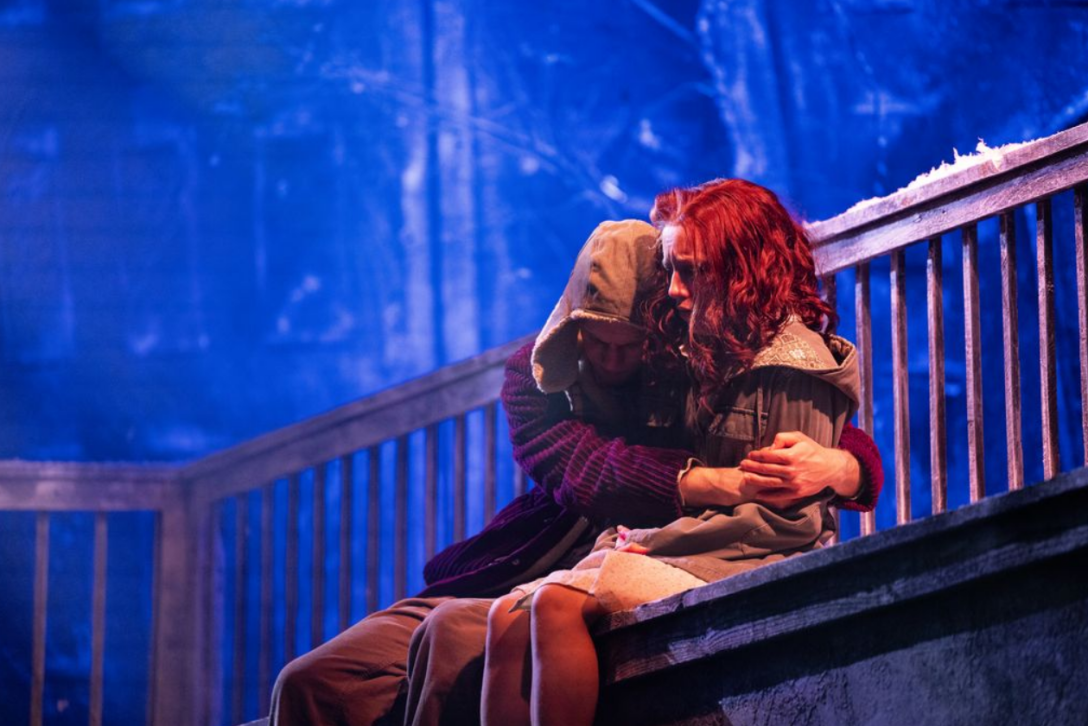
Erin Harrington reviews Let the Right One In, adapted by Jack Thorne from the novel by John Ajvide Lindqvist, directed by Dan Bain, at the Court Theatre, Saturday 23 May 2026.
The coming-of-age horror drama Let the Right One In is a real departure from the Court Theare’s usual programming. The play is based on Swedish author John Ajvide Lindqvist’s celebrated 2004 novel, and its two film adaptations, and adapted for the Royal Court in London in 2013 by Jack Thorne, a dramatist whose work (including Harry Potter and the Cursed Child and television series Adolescence) frequently focuses on young people. It’s a high concept genre piece that challenges the audience in its form and content, and that pushes hard on the theatre’s creative resources.
The play is set in an oppressive Stockholm suburb in the winter of 1983, where dark-windowed apartment blocks loom over a bleak little playground surrounded by birch trees. 12-year-old Oskar, played with a beautiful soft-voiced tenderness by Bruno Hart, is an awkward outsider who lives with his domineering mother. His naïve immaturity, pronounced stimming and cowed nature mark him as a target for vicious bullying. A strange girl, Eli (Sarah Clare Judd), moves in next door with a middle-aged man, Håkan (Adam Brookfield), who might or might not be her father. Eli smells strange, doesn’t seem to feel the cold, and can only come in if invited. She moves and speaks in an uncanny way. The pair hang out in the snow at the climbing bars, figuring each other out. The audience realises quickly that Eli is a centuries-old vampire trapped in the mind and body of a child. It takes Oskar a little longer.
The action follows Oskar as he is increasingly terrorised by his classmates, and Eli as she tries to sate her hunger without drawing too much attention. Things don’t go well; the community realises that there is a murderer among them. The police are called in. The fear and paranoia is thick, and Eli’s time might be running out.
From one direction this is a love story and a coming-of-age fable in which two marginalised people find something comforting in one another. Both Eli and Oskar crave release from their terrible home situations. They tap secret messages through the wall in morse code, finding safety in each other. It is also a thoughtful and effective meditation on abuse, and how bullied people become bullies. What do people do with the power that they wield over others? In Lindqvist’s work, rarely anything good.
Jack Thorne’s script is more a set of theatrical challenges than a conventional stage play. It is not particularly interested in the original works’ social critique, but it builds out Oskar’s world, moving sixteen characters played by nine actors quickly between dozens of episodic scenes across as many locations. It demands quick transitions that almost resemble cinematic montage; the play’s opening achieves this well. We are at school, in dank apartments, skating on a lake, on a train, deep in the forest. It asks that actors climb trees, scale the set, fight, bleed out in the snow, and float underwater.
Director Dan Bain’s tech-heavy production meets these challenges with maximalist gusto. Horror is a tricky theatre genre (and one of my favourites), and rarely produced. Bain draws on extensive experience with the genre, including the Court Theatre’s 2018 productions of Titus Andronicus and Misery, as he builds up the work’s ghoulish set pieces in creative and surprising ways, at times playing with the stage conventions of Elizabethan and Jacobean revenge plays. Chris Reddington’s imposing set is a twisted marvel, full of sliding panels and hidden features. It pushes at the capacities and limitations of the Stewart Family Theatre and requires the actors to get some serious cardio in. It nods to the visual language of classic German expressionist horror like The Cabinet of Dr Caligari (1920), in which distorted spaces reflect the psychological violence of the world. Andrew Todd’s audiovisual design is similarly ambitious, combining scored elements (with a distinct Trent Reznor flavour) and jittery, effective digital projections with stylised, spatial soundscapes that whip around and behind the audience. Hundreds of rapid-fire tech cues hit their mark; the technical and stage management team are clearly earning their keep and probably deserve a lie down.
Against this wave of sound and light I love small, human details in the costuming and props, from Håkan’s busted up blood-collecting supplies and the array of drab knitwear, to the jaunty but filthy outfit worn by a put-upon candy shop owner. This small but pivotal role, sketched beautifully by Ross Gumbley, helps unlock some of the production’s questions about violence.
Let the Right One In probes provocatively the relationship between love, dependency, violence and abuse. We’re grounded in Oskar’s limited child perspective, but Eli’s needs and motivations are a bit more ambiguous. The play’s conclusion holds us in tension, and requires us to be deep in the moment; is this a happy ending to a love story or the beginning of something more sinister? But Thorne’s script offers a contradiction. It wants to give us big spectacle that we sit back and appreciate, particularly in some of its bloody bits of ‘how did they do that?’ trickery, while it also needs us to be invested in small, emotionally complex human moments. I am not sure that this paradox is resolved.
In this production, I am left thinking about what it means for theatre to be ‘cinematic’, and what helps or hinders audiences to be immersed, especially in a play that relies heavily on the audience believing in the authenticity of a single relationship. I am drawn in by the oppressive atmosphere – winter inside as well as out – and small moments of intimacy that offer warmth. I appreciate elements of grim humanity, such as Adam Brookfield’s terrific performance as Håkan, who is both a possessive adult in charge of a child and a prisoner in love with his captor, and Kathleen Burns’ throaty take on Oskar’s brittle, alcoholic mother. Judd and Hart dance awkwardly to “La Mer” in an empty apartment in a moment of sad but beautiful vulnerability, kids sharing their toys and secrets. I appreciate the craft of some of the set pieces, including a spectacular bit of horror theatre stunt work in the first half, ripped straight from one of the most infamous works of the Parisian Grand Guingol theatre, that has the audience applauding.
And yet I am pushed out (as are some people near us) by some slippery accent work that veers American and Irish, and by the variety of dramatic registers across the characters. I also struggle with some long and disruptive transitions that conflict with the urgency of play’s rising action, even though the use of shadowy stagehands adds to the thematic sense of tension. I admire the physicality of the performances, especially Sarah Clare Judd’s gymnastic portrayal of Eli, but I worry for some of the performers’ voices, hers in particular.
I am left with a lot of conflicting feelings about Thorne’s script and this production, but as someone who loves genre, it is certainly affirming to sit in an audience of people who probably have less ghoulish tastes than I do, and to feel and hear them thoroughly embrace the work’s brutal yet beautiful approach to storytelling. Welcome to monster club! I do applaud the inclusion of the work in the season, and while I know this won’t be for everyone, I hope curious audiences will be open as they make up their own minds as to whether they want to come in.
Let the Right One In plays until Saturday 20 June 2026.


