
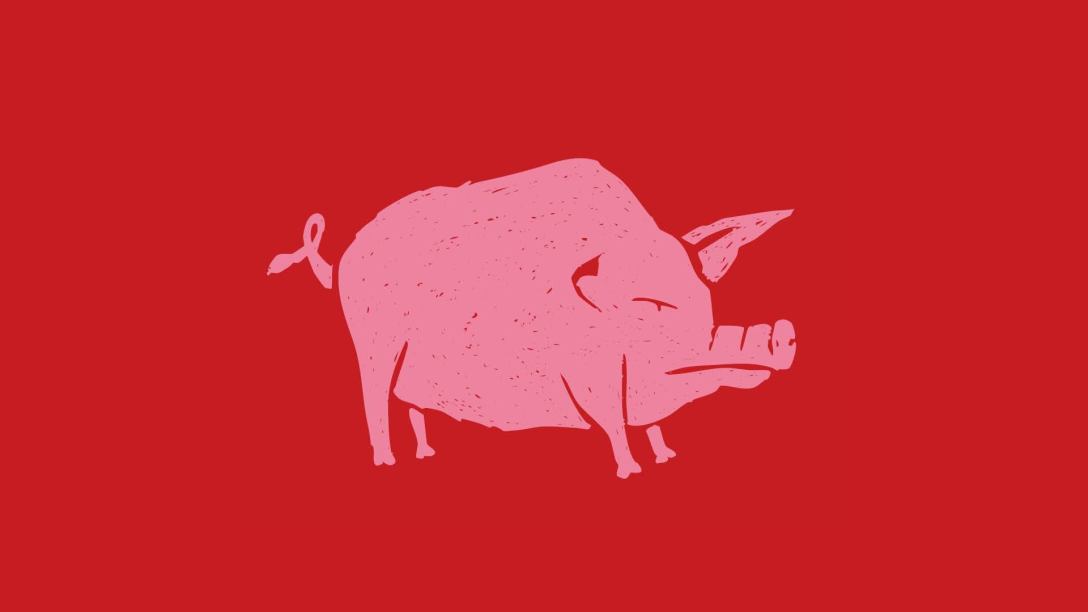
Ruth Agnew reviews Animal Farm, presented by Canterbury Repertory Theatre, adapted for the stage by Tatty Hennessy from the novella by George Orwell, directed by Dimitri Gibara, at the Elmwood Auditorium, Wednesday 20 May 2026.
What better way to escape the rising tide of corruption in a sea of political power play flooding the world than by spending a couple of hours lost in your imagination at the theatre? Animal Farm is the simple story of a some four-legged farmyard labourers attempting to end the system of humans profiting from a multi-generational indentured workforce. So if you’re a fan of uncomplicated plots featuring creatures feathered, furred and furious, this could be a relaxing break from the increasingly terrifying world of politics and power that we face each day.
However, anyone capable of recognising an allegory in sheep’s clothing, will not be able to avoid seeing that Tatty Hennessy’s play based on George Orwell’s 1945 novella is more than a tale of two species; it is an extended metaphor depicting the rise of Stalinism, written as a warning for future generations to avoid the same fate. These critiques apply to other political moments too. Watching the battling barnyard army in the current political climate is chilling, and the complex machinations of the porcine leaders highlight the potential path to even greater misuse of power by unscrupulous political leaders and their unfettered abuse of position and unashamed use of propaganda to manipulate their people. Animal Farm was written as a reminder that history will repeat itself if we allow it to, and that we must resist the masses marching towards global corruption.
Leaving aside the obvious parallels with present day situations, this is an ambitious undertaking by Repertory Theatre. Orwell’s characters are simultaneously representative of tropes and tyrants, whilst also existing as nuanced animals who the audience grows to love or fear. To tackle such a mammoth task, Repertory has rounded up some of the finest beasts in its herd.
Chasing the tail of the well-received Hound of the Baskervilles, Repertory has placed the reins in the familiar hands of Dimitri Gibara. While I question some of the choices made regarding key moments in the play, for the most part Gibara’s direction is solid, beginning with his solid casting of the lead roles.
Key to the success of the story is the role of Boxer, the beloved loyal workhorse, who lives by the oft repeated mantra of “I will work harder” doggedly saying to over and over until it becomes his epitaph. Sebastian Boyle is the perfect person to don Boxer’s hooves and mane, slowly and surely plodding into the heart’s of the audience until his tragic end. As the horse is lead to slaughter, you can feel our hearts sink. Boxer was the glue holding the farm together, and Boyle eats as the horse.
Another standout is Lance McBride, endowing his porcine pioneer Napoleon with a brilliantly executed character arc. From his emotionally charged flinging of the first rock in the first fight to bring down the human control of the farm to his ultimate acts of abhorrent betrayal, McBride presents a believable depiction of his bacon turns. McBride’s compelling voice demonstrates the seductive power of political oratory. His Napoleon is, undeniably, some pig.
While Emma McBride looks like the runt of the litter next to McBride’s intimidating physical presence, she brings a ferocity and fire to the role of Napoleon’s sow, Nutmeg, that reveals the folly of underestimating smaller players. Proving the power of the piggy pack are the always impressive Kat Forrester as Snowball, and Repertory regular Sydney Hogarth, doubling as Old Major with an opening speech reminiscent of former primeminster David Lange, and Squealer, the propagandist pig who will do anything to save his own bacon.
While they chant “Four legs good, two legs bad”, the actors are resolutely humanoid in stature and speech, perhaps to prevent us losing sight of the ever present symbolism. While I wasnt expecting adult actors to crawl about on all fours for two hours, I wanted to see more of the characteristics, personality and physicality of sheep, horses, birds and pigs reflected in the depiction of the barnyard collective, and in the evolution of the pigs becoming indistinguishable from people.
This lack of animal gait and stance does not prevent us becoming invested in the animals, thanks in no small part to the voice work evident. Apart from a couple of performers who would benefit from the more experienced actor’s advice on effective breath control to support projection and resonance, and clearer articulation, the vocal strength of the cast is used to capture the audience’s attention and emotional responses throughout. Given the obvious ability of the actors, and the opening of each act with a patriotic PSA newsreel (circa 1930s) firmly playing the farm in England, it is odd to me that no attempt was made at English accents, with each animal speaking in their native tongue.
At the risk of ruffling feathers, there was one aspect of the production I did not enjoy, at all. Instead of utilising drama conventions like tableaux or projected image or slow motion to show the big battles, the animal army squats on the sides of the stage and stare up at the projection on the backdrop which shows the fighting scenes from the 1954 animated film of Animal Farm. I can picture the battles becoming absolute climatic highlights of the show, choreographed to a choruses cacophony of snuffling, snorting and squealing, whereas watching scenes from an old animated movie was the opposite.
Reservations about directorial decisions aside, this production is well worth the ticket price. Perhaps this play will be the catalyst we need to rise up against corrupt pack leaders and self proclaimed alpha beasts in real life.
Animal Farm plays until Saturday 30 May 2026.


