
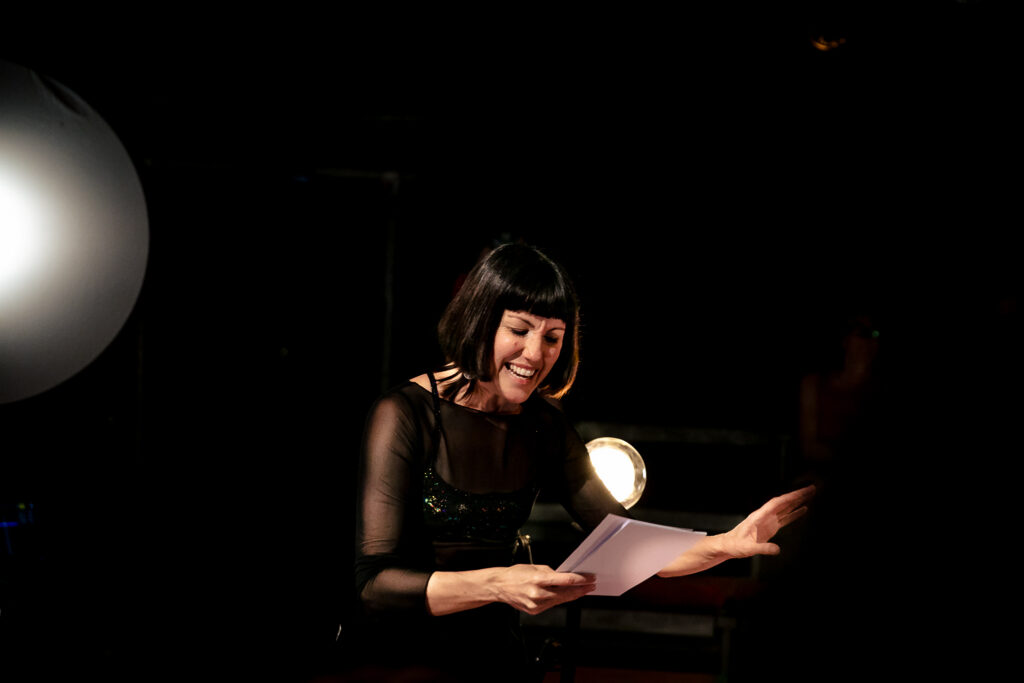
Erin Harrington reviews Selene, written and created by Alexander Wright and Phil Clive Grainger for Wright&Grainger, made with and told by Megan Drury, in association Theatre@41 Monkgate, with tour assistance from A Mulled Whine Productions, at Little Andromeda, Tuesday 24 March 2026.
There are different ways to have a moving and intense theatrical encounter. Sometimes you want giant shows with massive sets and appalling budgets and all the whizz bang fancy effects. Sometimes, more often I think, you want to sit in a small space as performer stares right at you, a smile in their eyes, and tells you a beautiful story. Selene, a brand new show from UK company Wright&Grainger, is this sort of show – an intimate experience that introduces us to a young Yorkshire girl, born Pandia but nicknamed Panda, who is obsessed with the moon. It leads us through the phases of her adolescence and early adulthood, from uncertainty and into hope. Like the company’s other works, it takes inspiration from Greek mythology, here the moon goddess Selene and her daughter Pandia, and other goddesses associated with different moon phases. Panda lives with her mum, Selene, a truck driver, on the edge of the moors within view of the Kilburn White Horse (‘stupid’, says Panda). Her father died young. She’s obsessed with the Apollo moon landing. Her life isn’t bad, but something’s not right.
Those who saw the company’s outstanding work Helios in 2024 will be familiar with the format; the works are framed as siblings, and having seen the first isn’t necessary but certainly enriches the experience. The front row forms a close circle around performer and show co-creator Megan Drury, who orbits around a microphone lit by a warm bulb. We’re surrounded by four soft round lights that fade in and out with the phases of the moon that structure the story. Drury’s storytelling is direct, with scripted cards for herself, and us, in her hands, for at points we’re asked to read as characters – mostly Panda’s collection of mates – or to cheer, chant, or howl at the moon. It’s a conceit managed very carefully. We’re all in it together, ready to lift each other up. Drury operates an evocative soundscape, beautifully timed, that expresses the shifts in the story world, but also Panda’s evolving sense of self. It’s simultaneously intimate and cinematic, tiny and massive, the close control of the environment supported with care and subtlety by Little Andromeda’s in-house technicians.
Selene moves through transition phases of Panda’s life – puberty, adolescence, adulthood. At 12 she is a girl at a school disco dressed like an illuminated moon, feeling weighted down by her body. At 16 they are a teen partying with their goofy mates, drunk on friendship and possibility (as well as port), watching a lunar eclipse. They are an unsettled young adult not celebrating their 24th birthday, trying on their ‘real’ name Pandia, literally “all brightness”, the “I” returned. Their frends have scattered, and they are stepping out from the shadow of their father, but are still unable to see the pieces of themselves out of view. They are perpetually angry, keeping a running list of all the things that they are not, the dark a line against the light. Throughout, their childhood friend Benzo, a sheep farmer voiced beautifully by a member of the audience, is a warm and steady reminder of the illumination of friendship: that we are more than we can see of ourselves. In the background, her widowed mum Selene, also voiced by an audience member, is quiet and gentle force, no less loving for her long absences on the road.
Helios ended with a bittersweet tragedy, flagged in its early minutes; Selene instead offers a revelation that weighs up the dark and the light. Panda (or is it Pandia?), is on a quest for identity, whether they know it yet or not. They must realise that that they can imagine something into being, to see the parts of themselves that are out of sight, and to make the impossible true. How do you take that ‘one small step’? They find a catalyst for this on the dance floor, where they can leave their body. Interestingly, this is the third work I’ve experienced this week in which the ego death of a rave is a way of loosening our bonds with the earth and discovering a truth that can’t otherwise be articulated. I don’t see this as derivative but as an acknowledgement that the DJs are doing something right.
There are some pretty specific ways of interpreting this work’s arc, but its strength is in how it keeps everything open, grounded in Pandia’s experience. I also appreciate one of the narrative threads, the description of a cult-favourite werewolf movie that makes a proper appearance in the work’s final phases. What is the true horror of those narratives – the moon-touched shapeshifting creature itself, or the possibility that it will never reach its true and most wild form?
This is all delivered with heart-stopping joy, and sadness, and then clarity by Drury. She is a compelling, charismatic performer with exquisite vocal and physical technique who brings us into the work with love. She jokes and cajoles, supports us through our readings, dips into sorrow, and then races with us to the end. We finish with full hearts, like half-drunk teens leaping into the moonlit lake together, the world open and full of possibility, and tears in everyone’s eyes.
There’s a problem: this impeccable work is probably experienced ideally as a small group, as close to the performer and as embedded within the performance as possible. And yet, it’s something that deserves to be seen widely. What to do? The show is touring Aotearoa then Australia, so perhaps tell as many of your mates as you can wrangle, but get in early so that you can be as near to the story, and the light, as you can.
Selene plays one more night at Little Andromeda then tours Aotearoa. Dates are here.

 Flat City Field Notes