
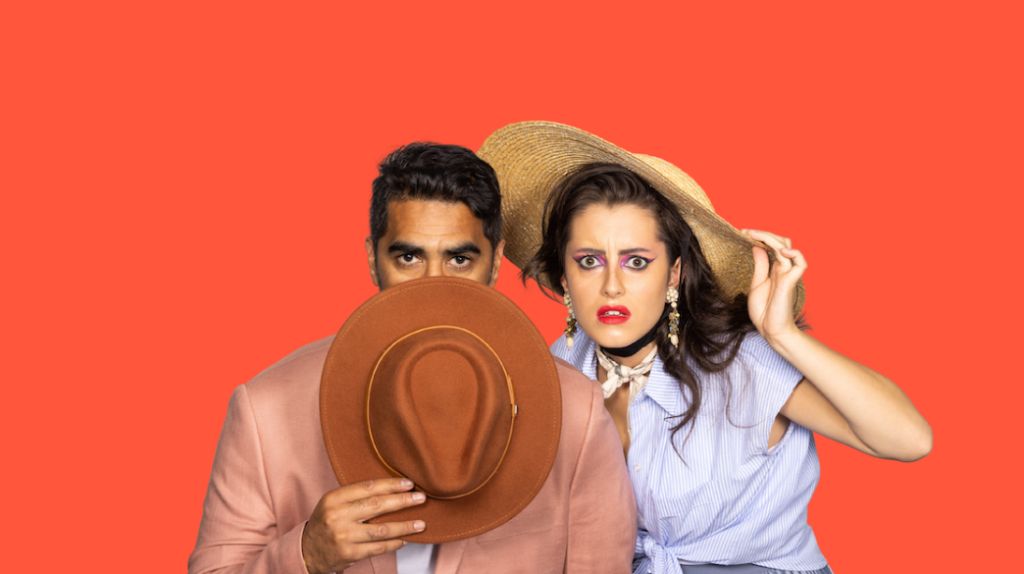
Erin Harrington reviews Ngā Rorirori, by Hone Kouka, presented on tour by Tawata Productions, at the Aurora Centre, Friday 4 October.
Hone Kouka’s new work Ngā Rorirori (or ‘the fools’) is a truly original piece of performance that combines dance and theatre to offer a comedic account of one family’s clash over whenua. Choregraphed by Kouka and Stela Dara, and with superb original music by Maarire Brunning-Kouka and Reon Bell, it’s as grounded in protest and politics as it is in comic traditions like farce. It’s a wild ride.
We’re in the wharekai of a rural marae; Mark McEntyre’s cleverly designed panelled set lets us see the sun move across hills in the background. Older brother Pillow Rorirori (Manuel Solomon) has arrived home after a stint in jail for ripping off his people (again). Younger sister Manuela (Mycah Keall) is an activist who’s been tending to the home fires. They’ve discovered that as the last two members of their hapū they are the owners of their rohē, and it’s a big day. Crown rep Rīpeka A. Goldsmithworthy (Stela Dara) is arriving with the official documents, but there are many complications, not least the appearance of Manuela’s secret boyfriend Rere (Sefa Tunupopo), the presence of a filmmaker Stacey (Nomuna Amarbat), and Pillow’s own idiocy. Greedy Pillow’s in it for the pay day, and Manuela’s in it for the whānau; cue a comedic interrogation of the relationship between family dynamics, capitalism, colonisation, and ancestral rights.
Ngā Rorirori’s innovation is that the five live performers are dancers, lipsyncing to pre-recorded dialogue, as if they are bringing a radio play to life. Someone with insider knowledge tells me it’s inspired somewhat by viral TikTok dance trends and overdubs; I can see that, and it’s a fascinating conceit on which to hang a show. It takes a bit of getting used to, but it’s effective, especially as it allows to performers to give a much more physical performance than if they were speaking. The symbiosis between each duo is fascinating. I particularly like how Solomon, as goofy fraudster Pillow, channels Regan Taylor’s sometimes pompous, sometimes pleading vocal performance, tugging at his pigtails, contorting his face like a sad clown, and acting out the script in literal terms.
Movement and blocking are silly, exaggerated. The solo and group choreography is terrific, marrying elements of contemporary dance, ballet, hip hop, clowning, and Māori movement. Characterisation borrows from the conventions of commedia dell’arte. The performers have the cheerful demeanour and slightly manic energy of children’s entertainers – something enriched by costuming (from Sopheak Seng) in soft denims and rainbow-coloured stripes and checks.
Another surprise: the dialogue in te reo Māori and Pākehā is frequently punctuated by the language of choreographic scripts – “5, 6, 7, 8, ball change, fouetté, jeté” – which, like the reo Māori, is flashed up on surtitles on a screen at the top of the set. The screen itself (credited as “Missy Surtitle”) sometimes talks back, a guide and frustrated observer. Surtitle’s pre-recorded voice is that of Mycah Keall, who performs live as Manuela (and is voiced by Rongopai Tickell), offering a bit of a wink to her query about whether the voice from the screen is her tūpuna.
All this contributes to work’s interest in farce: slamming doors, noises off, mistaken identities, chase sequences, knockabout physical comedy, misunderstandings, cartoonish escalating absurdity. I sit there thinking a lot of repetition, relationship and translation – about protocol, kawa and tikanga, and the relationship between words and action. Then there’s the embodied relationship between performers, sound, and choreography or direction, as well as the way physical space tells stories. The language of governance butts up against the language of performance, love and people. We’re left with the absurdity, perhaps impossibility of negotiating sometimes incompatible sets of rules; you need to make a choice about which rules matter the most.
The show’s core comic scenes and dance sequences are also punctuated by shifts in and out of a more lyrical, serious modes. These movement sequences act as transitions and breaks in the narrative, and bookend the work. Wearing grey hoodies, in more naturalistic character, the performers protest, push into the headwinds, come back to the marae, look to the stars, look to the future. The current coalition government’s anti-Māori, anti-Tiriti agenda is invoked in the opening minutes, with strong vignettes accompanied by chants from protests and hīkoi: toitū te Tiriti, toitū te whenua, toitū te reo. Throughout, the production reaches out to other struggles against settler colonialism in Palestine, New Caledonia, and Australia. As with the best comedy, all those jokes are pretty serious.
There’s an abrupt shift in tone at the end as the show looks to reconciliation and a happy ending. What the siblings’ narrative needs to do to resolve sits at odds with all the playfulness with form and tone. It’s also frustratingly sudden, the shift in energy, and stakes, jarring. For all the silliness and the satirical prods, the powerful final image is that of tangata whenua and tangata Tiriti, united in purpose under the Tino Rangatiratanga flag, with a final dedication to the late Kiingi Tuheitia Pootatau Te Wherowhero VII. After the production, and before we move out to the green room for kai, Hōhepa Waitoa from Mahi Mahi Productions (and the show’s kaiwhakamāori), gives a moving tribute to Kouka and Tawata Productions, which is celebrating its 20th year. A huge achievement.
Ngā Rorirori throws a lot at you. Do all these many and varied theatrical elements ultimately cohere, narratively and dramaturgically? Not always. In internet speak: I have several questions. There will also be people with far more skin in the game than (Pākehā) me, who have more nuanced thoughts about the show’s effectiveness and outcomes. I hope you seek them out.
Nonetheless, the show is dynamic, funny, very well-performed, and thought provoking; a couple of days later I’m still turning it over in my head. It’s designed well – it doesn’t have the sometimes lightweight feel of touring productions – and importantly it’s a really good time. It’s also a rare joy to see something properly original – something surprising that makes you rethink some of the parameters of performance, genre, and audience experience.
In a play about being Māori – about the past, present and what’s still to come – the final word can go to rangatahi Māori, that is, a friend’s niece. Her verdict: “so sick”.
Ngā Rorirori is currently touring. More information here.

 Flat City Field Notes