
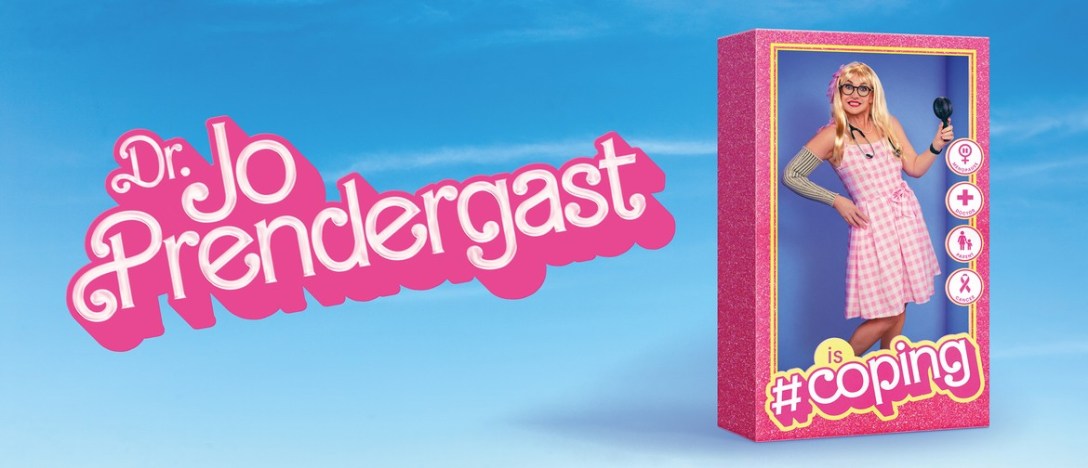
Rachel Williamson reviews Dr Jo Prendergast is #coping, at The Piano, Saturday 7 November 2026.
Part stand-up comedy, part motivational TED talk, Dr Jo Prendergast’s one-woman show covers the female mental load, motherhood and menopause with warmth and self-deprecating humour to highlight the toll of being a woman in today’s society. Playing to a sold-out crowd, Dr Jo Prendergast is #coping clearly strikes a chord with its predominantly female audience. While Dr Jo makes some effort to address the few “Kens and non-binary folk” in the room, the groans and gleeful laughter issuing from the female audience members are much louder, many of whom are attending in packs, several with babies or young children in tow. It’s evident that the sense of recognition these women feel is key to the show’s success.
Weaving together original songs and parodic archetypal Barbie performances with reflective social commentary, #coping draws from Jo’s personal experiences and 30+ years working in clinical mental health. Riffing off Greta Gerwig’s critically acclaimed box office hit Barbie (2023), Jo performs a series of skits to represent the many roles she adopts in her own life, appearing first as Comedian Barbie, followed by Doctor Barbie, Mum Barbie and, finally, Menopause Barbie. These satirical interludes function as a framing device wherein Jo – complete with blonde glossy wig and syrupy breathless voice – amplifies the codes of normative femininity to absurd heights in order to expose the artifice propping it up. Perfection, Jo tells us, is toxic. This is portrayed here in the various Barbies’ own failures: Comedian Barbie is uncomfortably not funny, exhorting us when and how to laugh, the vacuously subservient Mum Barbie finds solace scissoring her equally bored neighbour, and Menopause Barbie malfunctions entirely, flashing lights and alarms escalating her ordinary midlife crisis to full nuclear meltdown. At times these caricatures feel heavy handed, even unkind, oversimplifying the experiences of real women, a decision that seems at odds with Dr Jo’s intentions.
A soundtrack featuring original music and fake wellness advertisements accompanies the skits, offering further tongue-in-cheek commentary on the commercialization of perfect femininity. The parodic performances also inform the costumes and set design, which features a life-size Barbie packaging box centre-stage that Jo reenters each time she needs to don a new persona, at one point futilely trying to smash her way out.
While the Barbie device provides structural cohesion and offers some theatrically interesting moments, I notice that the audience is often quieter during these segments, waiting for Jo to remove her wig and engage with us directly. They consequently risk feeling gimmicky especially when contrasted with the real Jo’s more frank and intimate confessions.
Perhaps unsurprisingly, given the fact that Dr Jo markets herself as a keynote speaker and comedian, these sections shift between traditional stand-up and motivational speech. This can be tonally jarring. Jo dedicates time early in the performance to establishing her credentials as an experienced psychiatrist, commissioned author and award-winning comedian, as well as a mother, partner, cancer survivor and all-round “fellow life juggler”. This combination of roles not only invites us to trust her as an authority and expert, but to identify with her. Her admission then that she is “a bad mum” who is “failing at Barbie’s ideals” is met with recognition from her audience who are quick to laugh at Jo’s revelations. The jokes through here combine anecdotes mined from personal experience with pop culture references and clever word play to good effect. I attend with a female friend and, despite a comment that “perimenopause is NOT funny”, we are soon laughing with the rest of the audience during Jo’s menopause sketch.
Dr Jo Prendergast is #coping isn’t subtle in its intentions: “I want to use comedy to talk about tough stuff”, Dr Jo tells us. And the Barbie device feels overly familiar at times, if not outdated now. Nonetheless, the show successfully taps into the current female zeitgeist, leveraging shared experiences of failure to create an enjoyable – if fleeting – moment of solidarity and sisterhood.


