
Erin Harrington on the lack of South Island investment in Creative New Zealand’s Arts Organisations and Groups (AOG) funding round, including the news that South Island organisations collectively received less than 10% of the total funding offered, and that Christchurch theatre Little Andromeda and the Dunedin Arts Festival have been defunded entirely.
Hello, world
There’s a funny thing that happens when you head south across Cook Strait. It’s like passing through a reality distortion field, or a cloak of invisibility, and find yourself in a dome that is both a part of the rest of the country, but oddly shielded from it. News travels south, but not north. A North Island perspective is presented as the default in media and policy. You get kind of used to it, but recent arrivals, including the many people who are drifting south in search of quasi-affordable housing and functional water infrastructure, are often startled by it.
Usually, this doesn’t matter. In the arts, culture and creativity sector, people get on with running things and doing a good job for their communities. Events, galleries, festivals, orchestras, choirs, venues, gigs, theatre companies, wananga, educational and outreach activities, training programmes, community groups, concerts, comedy clubs, publishing houses, performances, dance companies, public art events, and so on – all the components of a creative ecosystem, from the grassroots companies running stuff out the back of a van through to top tier professional companies with multimillion dollar budgets.
Sometimes this is funny. Once, I was explaining Christchurch’s performing arts ecosystem to someone in Wellington and it felt like the time I had to reassure some family friend-of-a-friend at a Thanksgiving dinner in the United States that New Zealand did in fact have running water and electricity (not a joke).

Sometimes it’s kind of annoying, particularly when national media coverage, recognition, or even straight awareness of what’s going on further south is pretty slight. This is a byproduct, I think, of our media and political infrastructure being concentrated in Wellington and Auckland, and journalists’ contact books perhaps reflecting that. There are more arts organisations in the North Island, and publicists in Te Waipounamu have to work really hard to get even a modicum of cut through. This sits within the context of the wider collapse of the arts media ecosystem; this report, from Dr James Wenley and Rosabel Tan, was published four days ago and is sobering reading. Starting this blog was an attempt to signal-boost Ōtautahi arts in some small way, like a sonar ping, in the face of what sometimes feels like indifference.
It gets more frustrating when you run up against some embedded assumptions that what happens in the two big North Island cities is inherently of national significance, and that everything else is ‘regional’ with a capital R, a term that has a series of slightly sniffy value judgements embedded in phrasing about geography, and that I know frustrates those in other areas too. Ōtautahi is described as the country’s second biggest city, and also merely a souped up regional supply town – sometimes in the same breath. There can be some pretty stark comments about a presumed lack of expertise and quality just by virtue or your location, followed by the suggestion that if work was important enough then it would naturally get through. Ask anyone from the south who has gone forth, to the Performing Arts Network NZ (PANNZ) Arts Market, to national hui, for some choice examples of this, or talk to musicians and producers who have been told that if they don’t go to Tāmaki then they clearly dont’t take their work seriously. Ignoring our national companies, the NZSOs and NZ Operas of this world, this attitude is not really fair to anyone. Ordinary Tāmaki and Pōneke orgs who serve their communities beautifully shouldn’t have to shoulder that weight, and everyone else doing important work, albeit further from Molesworth Street, shouldn’t be written off. You could add to this list all day if you feel like a grizzle: ‘national’ tours that stop at Wellington, weird assumptions about audiences and audience development, barriers to relationship building.
Someone told me last week of a time when you’d be filling out CNZ forms and when faced with the question of which city were you nearest to, the drop-down menu only gave you two options: Wellington or Auckland.
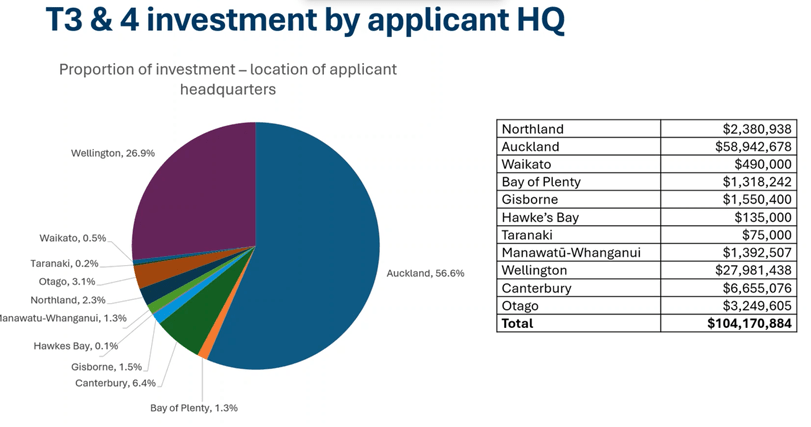
Where this really bites is funding, particularly Creative NZ funding. The recent announcement that South Island-based organisations received less than 10% of the funds granted in the recent tier 3 and 4 rounds of the Arts Organisations and Group Fund was confronting and upsetting. It made the front pages of The Press, and – in the context of the Dunedin Arts Festival being denied funding entirely – the Otago Daily Times. People are extremely unhappy. There is a widespread perception that the sector here is under-estimated, dismissed, and in some instances forgotten entirely. I’ve talked about this on the radio and in print, as have others, but there’s more to say outside quotes and soundbites.
How funding works, or doesn’t
Some context for those unfamiliar: our centralised funding environment is constrained nearly to the point of austerity following 20+ years of government failure to increase investment here, despite the sector’s impressive return on investment and contribution to GDP. Creative NZ | Arts Council of New Zealand Toi Aotearoa has lots of jobs, one of which is acting as our major central funding body for the arts. Their funding is important and supports things that change people’s lives for the better. The money that goes to CNZ from the government, by way of Manatū Taonga Ministry for Culture and Heritage, is roughly 0.01% of the government’s overall spend. More has been spent by the government in the last month bailing out a cement plant in Northland than has been allocated to CNZ in the previous three years. I am very pro strategic supply chain resilience, but it certainly puts it in perspective. The remaining 75% of CNZ’s funding comes from the Lottery Grants Board. That’s why you get all those cute ‘Kiwis helping Kiwis’ ads about your Saturday afternoon gambling habit supporting mixed ability dance troupes. That contribution has remained pretty static too.
Creative NZ, as the meat in the middle, is tasked with allocating slices of an ever-shrinking pie, to an ever-larger pool of people who are asking for more pie, and not just because of inflation – because the wider system of funding itself is very fragile. Do spare a thought for their staff as they are passionate experts who are also facing their own significant job cuts as part of a “change journey“. Arts organisations – which for the most part are charitable trusts that exist to do things for the public good – depend heavily on CNZ’s resourcing, which acts as a contribution to their overall artistic and operational costs. This sits alongside other forms of funding, including sponsorship, philanthropy, in-kind donations, and grants from local government and trusts. Box office (if you are an org that can sell tickets to things) cannot possibly actually cover costs, and any profits are fed back into the organisation.
It is true that there is a greater density of arts organisations in Wellington and Auckland than elsewhere in the country. Nonetheless, whichever way you cut it, collectively southern arts organisations have not been getting the same bite of the cherry as those elsewhere. It’s important to ask why that is.
There has been a bit of churn in funding models recently, as CNZ looks to evolve to meet what they call a “dynamic and continually evolving” landscape. Their stated intentions are pretty good in principle – click here and go to page 10 of the pdf – although there are big concerns about how things are going to shake out. This new AOG round, which is designed to offer multi-year support, was for organisations asking for more than $125K per annum, for up to three years, so our larger established organisations like arts companies, festivals, galleries, and venues. In principle, it offers higher levels of funding over longer periods of time, which is really good. 94 organisations nationwide were allocated $104 million collectively; you can see the full list here. $201 million was requested. 33 organisations, wonderfully, were supported for the first time, and now have some certainty. As discussed in a report-back online hui to applicants, three quarters (77%) of applicants asked for 120% or more than they had previously, which makes sense, not least because of inflation. More than 90% of successful applicants were granted less than they asked for – some by considerable amounts that place those organisations’ futures in question, especially in comparison to previous’ years investment. It is not clear how many organisations lost out entirely. Unsuccessful applicants, or those who have received considerably less than they applied for (or even have previously been granted) have generally reported the same feedback: great application guys, no money, sorry.
Much of this data is available and is being discussed / stripped / litigated online, and some other financial information is confidential until individual organisations decide whether they want to share their own positions.
‘Decide’ is an active verb
Under austerity, dissecting who got what and hypothesising why feels a bit crass, a bit like an un-fun version Spiderman pointing meme, when actually everyone is fundamentally in it together, and everyone is performing miracles, minor and major, with limited resources.
But under austerity, in a system explicitly built to support this sector, funding decisions are even more consequential, especially when you take a system-wide view, and when you consider the impact of a lack of funding on organisations that function as essential creative infrastructure. Those of us in the general population can’t know what discussions went on in the assessment process, which went through from application packets and panels all the way through various stages to final sign off from the Arts Council. We can see, though, where comparable organisations were offered distinctly different amounts of funding, including when one organisation has been cut while a similar organisation in another city received a rare increase. And we do see the outcomes of those decisions.
To me, the decisions to entirely defund indie theatre Little Andromeda in Christchurch and the Dunedin Arts Festival in particular are not just baffling, but damaging to the country’s creative ecosystem. I have been on panels before allocating funding, granting residencies, and generally making decisions that are financially and personally impactful, so I know that assessors are often grappling with spreadsheets full of ticky boxes and weird matrices, and colour-coded documents that ask how applications meet strategic drivers on a scale of 1-5. Those experiences can be profoundly difficult, even unpleasant (although obviously not as unpleasant for those denied support). Nonetheless, it is hard to understand the rationale here.
Both organisations are leaders, and both are anchors. Venues and festivals make things happen, and they make things possible. They are to the country’s cultural infrastructure what bridges are to the nation’s roading infrastructure, what schools are to local communities – rich centres of culturally-specific meaning, things that connect everything else up.
Dunedin Arts Festival is nearly 25 years old, and stages music, theatre, dance, workshops, performances, exhibitions and a schools’ programme. It brings national and international acts to Ōtepoti, and also provides for under-served communities in Invercargill and Oamaru. It pumps $4-5 million to the region’s economy, partners with the Wānaka Festival of Colour and various other festivals and organisations, and is able to use its CNZ support to commission work and bring overseas artists into the country. But no. I’d like to hear from those in Dunedin about what’s at stake, as I am mindful of the very big gap left here when the Christchurch Arts Festival came undone.
As an Ōtautahi local, I can speak in more detail about Little Andromeda. I’ve been hovering in its orbit since its owner, creative entrepreneur Michael Bell, was first ideating an ahead of its time space-themed cabaret called Andromeda for the post-quake central city from his then-base in Orange Studio in Ferrymead when I was there regularly for recordings of the comedy panel show The Nerd Degree. The theatre has had a few iterations, from a hypothetical ‘purple croissant‘, to a marquee on the gravel lot where the Court Theatre is now, to a bricks and mortar space (twice) in the central city hospitality hub The Terrace. Infinite thanks to property developer, patron of the arts and man ofmany delectable suits Antony Gough who has recognised, throughout, the value of the theatre to the wider economy and environment. It has persevered in the face of many financial and civic challenges, some of which I outlined here in 2018 during arguments about the future of the Performing Arts Precinct. In 2021, Michael was awarded a Civic Award for his services to the arts sector, acknowledging the significant impact of Little A on the city.
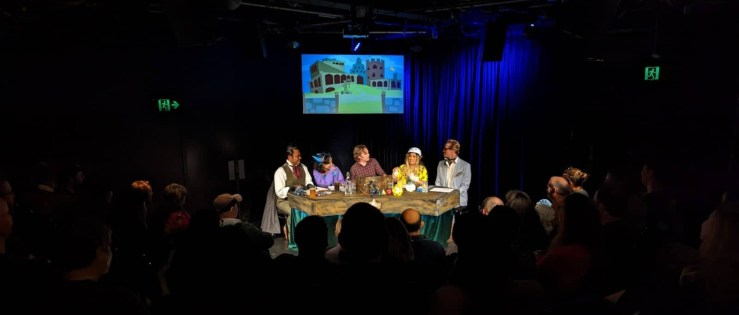
It’s a venue, a community space, a creative hub, a place that hosts monthly and bespoke ‘house’ shows that would never get made anywhere else, and a host for local and touring work that absolutely would not be staged here otherwise. It’s well known for putting artists first financially, and for bending over backwards to accomodate strange production requests other venues would say were impossible. The theatre’s team has spent years building a community (and some pretty nifty invisible stuff like a bespoke operational digital backend), and it does some weird and wild stuff. I read Little A’s application, and I offered a very long letter of support in which I outlined the theatre’s history and considerable social and economic impact on the city, as well as its essential role in the national theatre, performance, and touring ecosystem. Their application was quite something – a chorus of praise and a well-founded plan for the future. But no.
Priorities
Both the Dunedin Arts Festival and Little Andromeda have been told that they submitted excellent applications, but that they were not ‘priorities’. But what are those priorities, beyond the points outlined in CNZ’s recent broad Statement of Intent? Clearly not South Island artists and audiences, who can’t be served in these ways meaningfully by any other organisations, and whose organisations almost across the board seem to be underestimated. Clearly not artists or producers. Clearly not other partner organisations, across the South Island, who will find their place much more precarious with the loss of critical mass, and the loss of this support.
Clearly, also, not the wider Aotearoa arts ecosystem. In this country, everything is linked up. Big country, small dispersed population. People who make theatre at BATS in Wellington (funded to the tune of $193K per annum, a considerable reduction from previous years) or Basement in Auckland (funded for $438K per annum, a teeny tiny increase) need to be able to take that work elsewhere, and vice versa. Literary festivals partner to bring big names to New Zealand, and orchestras co-resource commissions. Everyone trains, houses, and promotes everyone else, and practitioners work or undertake activities across centres to maintain sustianable careers. It’s all well and fine to significantly increase funding for an organisation like PANNZ (the Performing Arts Network New Zealand, with a more than $600K per annum increase), who have taken on a wider festival commissioning role, if you then imperil the infrastructure that actually makes touring work to the South Island financially viable, and that facilitates the creation of high-quality art and performance here that can then travel north and then tour overseas. Whose priorities are these?
These are all links in a chain. They are part of the same organism. Add in other examples of underinvestment in the south, some of which are commercially sensitive so not mine to share, and (as a friend said to me today) this is like cutting off the blood supply to one part of a body and expecting the rest to thrive.
On (in)visibility
Out of curiosity, I made an OIA request a few years ago, looking at CNZ funding data from 2018-2022. A different set of funding rounds, but those beautifully presented documents full of impressive pivot tables and forests of tabs supported my gut feeling that at a macro level southern applications were doing less well than northern ones. If you want that data let me know. Interestingly, this data also indicated that there was not a particularly large pool of panel / application assessors in the South Island, which is significant. Assessor pools are a bit tricky to gauge, as people might not actually be available, and depending on your art form it might be a small enough community that the most qualified people might declare conflicts of interest. But assessors with knowledge of specific communities can offer essential insight that might need spelling out a little to people less familiar with one application’s context, and can challenge that accidental bias that forms when the overall lens mostly focuses in two conspicuous places.
I’m extremely mindful that it’s been unusual, over time, to see CNZ representatives in person at South Island events. The organisation doesn’t like paying for flights, and they have had very few staff based here, in terms of their overall workforce. Rare birds, not often seen in the wild. It’s worth throwing in there, too, that the Arts Council, the final decider, has almost no South Island representation at all. (One bit of anecdata – one arts manager here got so frustrated with this lack of kanohi ki te kanohi that they literally offered to pay out of pocket to fly people down. It didn’t happen.)
In the last week I have been thinking a lot about that cloak of invisibility. I have been wondering about the extent to which Creative NZ did, or did not, take a whole system view of this whole mess, and did, or did not, talk to people with an understanding of the southern arts sector. This isn’t anything we are likely to find out; I suspect otherwise some administrators might have to go into witness protection. Some of the CNZ’s comments to the media suggest that organisations were assessed on their own merits, while comments to applicants have indicated a more holistic view, which would fit with communication about ‘priorities’. Nonetheless, did anyone in any of the rooms say hey, let’s take a look at these communities on their own terms? Or that you need to really pay attention to the immediate and wider community impact here? Or that if we don’t fund these, they might go away, and they won’t come back? Or that if you cut South Island organisations off at the knees, everyone is going to have a problem? Or that organisations with Wellington addresses have been granted $18.04 per capita, compared to the Otago region at $3.92? (Thanks, Michael, for those numbers.)
The biggest question of them all: which communities are deemed more, or less, deserving of arts, culture and creativity, according to an organisation whose mandate is to support the arts for the “benefit all New Zealanders”?
Tier 1 and 2 rounds, for the many organisations with a smaller ask, are still underway. Creative NZ is also devolving some funding to regions as part of an organisational ‘reset’, and the implementation of a new 15-year strategy in conversation with the government’s optimistic Amplify strategy. By my reading this is really an attempt to umbrella an eclectic bunch of smaller useful policies, concerns and reallocations without offering any further investment, the policy equivalent of Just Right cereal (a bunch of different odds and ends leftover from other cereals popped in a box and branded nicely). It’s unclear what organisations will take on the role of ‘regional delivery partners’ (or even whether those organisations currently exist, uh oh), nor how the national pie is going to calculated then cut. I struggle to see how the current situation fulfils the goals of these strategies, or how it sets up favourable condiitons for true partnership.
As one civic arts leader said to me, it’s a bit ironic to talk about empowering communities as decision makers through this new mechanism after first thoroughly disempowering them. Perhaps some things will equalise a little in coming announcements, and as these new approaches roll out. For now, at the top level of the sector, those priorities are pretty clear, and down south it’s not good.
***
If you want to support Little Andromeda, who are looking to make it through to Christmas, find out more about their fundraiser on Saturday 9 August here.
Disclosure: I sit of the board of WORD Christchurch, which received funding in this latest round, and I coordinate the Ursula Bethell creative writing residency at UC, which is supported by CNZ funding through to the end of 2027. I’m not writing in those capacities, but from the position of a sad and frustrated South Islander.


[…] before they go to one of our excellent tertiary institutions (NASDA, Hagley Theatre, UC), but with only 10% of Creative NZ funding going to South Island applicants, and with venues and events that have played an integral part of creative career paths for […]
LikeLike
[…] before they go to one of our excellent tertiary institutions (NASDA, Hagley Theatre, UC), but with only 10% of Creative NZ funding going to South Island applicants, and with venues and events that have played an integral part of creative career paths for […]
LikeLike