
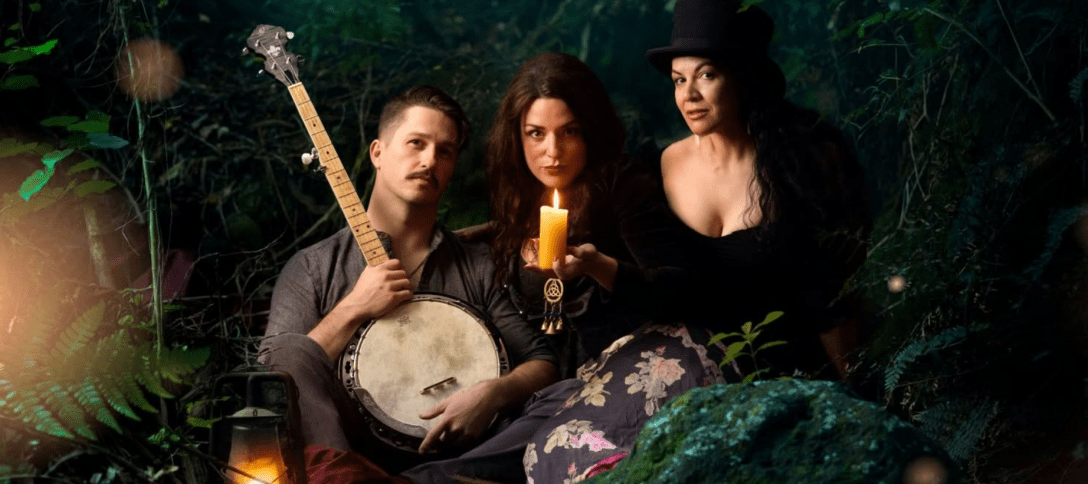
Charlotte Thornton reviews Folk Tales, presented by Rollicking Entertainment for the Lyttelton Arts Festival, at the Lyttelton Arts Factory, Sunday 19 July 2026.
Let’s talk about the apocalypse.
It’s hard to say if we’re properly in it now, or still dodging it Matrix-style, but this year has seen a distinct mood shift. Blues and folk music are becoming popular again – a sign that we are ready to talk about our pain, mourn the people we are still losing, and call out the establishment together. It’s telling that nearly every show I’ve been to this year has included an acknowledgement of the world’s current state of utter fuckery.
Folk Tales is no different. When musician Criss Grueber welcomes us, he says Folk Tales takes part in the thousand-year tradition of sharing stories to get through dark times and cold winters. Huddled together in a candlelit Lyttelton Arts Factory, Grueber and fellow multi-hyphenate performers Lizzie Tollemache and Kim Te Pairi Garrett tell us stories, myths, and even a fairy tale.
The atmosphere is tranquil. Little plants dot the edge of the stage and a large paper lantern hangs from the ceiling. The performers sit with microphones and large folders, which gives Folk Tales the soporific feeling of being read a story by your mum or your favourite teacher. Tollemache takes this further when she invites us to close our eyes any time we wish. Much of Tollemache’s work sits within this thoughtful kaupapa. In a 2024 interview for her show The NeuroSpice Girls, she told Flat City Field Notes about chill-out spaces which allowed audience members to respond how they felt most comfortable. Folk Tales continues this tradition of “[t]reating the audience as living souls not units of tickets.”
Tollemache’s tales come from Scotland, spoken in a mellifluous – even sultry – tone. Her chosen stories feature powerful, mystical women whose kindness is seen as defiance. Throughout Folk Tales Tollemache comments on the predatory vibes and troubling gender dynamics in many of these tales. She provides great insight into the lessons we teach girls – and only girls. Garrett’s stories come from Māori mythology, mostly from her iwi Tūhoe, and explore Garrett’s childhood curiosities alongside her grown-up interests like the geographical features of Te Urewera. Garrett delivers these tales with playful sweetness, using gesture to represent the physical labour of a long journey or the agony of a grieving father. She creates a moment of stunning harmony with the physical environment: as she begins the legend of Rona and the Moon, the paper lantern lights up with a lunar glow. The audience gasps a little at the sight of Mārama.
All three performers are wonderful singers and their voices mix gorgeously in the folk tunes and waiata which guide us from one story to the next. The audience sometimes joins in, delicately supporting the lead vocalists who seem to enjoy the shared experience just as much as we do. I didn’t expect so many people to have “The Bonnie Banks o’ Loch Lomond” memorised.
Personal stories are told too: Tollemache a hilarious and candid monologue about childhood titled “Swimming Lessons,” Garrett an eerie tale-within-a-tale from her primary school days, and Grueber a more recent story which closes the show. It’s one he’s never told before, so it is certainly not mine to repeat, but it shines in the safe and supportive environment created by Folk Tales. It feeds into a recurring theme of the selected stories: crossing between worlds and finding ourselves.
I sang Grueber’s praises in my review of Pierre & Randy’s Gameshow Roulette just yesterday, but his work here is deserving of additional acclaim. Once again, he is fully engaged with his fellow performers and attentive to the mood of the audience. Instead of his usual keyboard, here he switches between a banjo and two acoustic guitars. He whooshes his breath like wind, taps to mimic knocking, and makes an ocean wave out of a guitar riff. Folk Tales uses soundscape to the greatest effect I’ve ever seen on stage, becoming a kind of radio play in the style of Dylan Thomas’ Under Milk Wood. As Tollemache alludes to, Folk Tales works perfectly with closed eyes.
Watching Folk Tales I feel a connection to ancestors and forebears, who also spent much of their lives agonising over the apocalypse. They shared songs and stories while the world ended and it made everything a little easier to bear. We never know which apocalypse is going to stick, so we might as well gather anyway. If we have the same chilblains, is it not the same winter?
Folk Tales was performed Sunday 19 July 2026 as the closing show of the Lyttelton Arts Festival. The show tours nationally next June with support from Arts On Tour NZ.

 Flat City Field Notes