
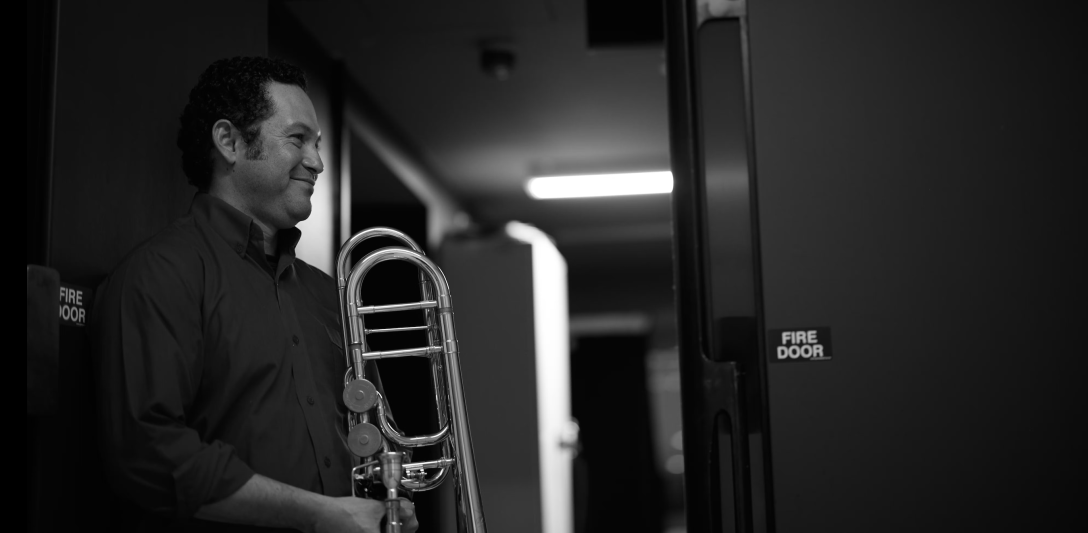
Nick Harte reviews Ravel, Morello, Mozart, presented by the Christchurch Symphony Orchestra as part of the Lamb & Hayward Curator’s Series, featuring Maurince Ravel’s Le tombeau de Couperin, Nicola Morello’s Bass Trombone Concerto No. 1 and W A Mozart’s Symphony No. 29, conducted by Leonard Weiss, featuring Pablo Ruiz Henao on Bass Trombone, at the Piano Pīpīwharauroa: Kui-kui whitiwhiti ora, Friday 5 June 2026.
The CSO were off to an upbeat start with a speedy, yet very tight interpretation of the opening bars of Ravel’s Le tombeau de Couperin (1914-17). Each movement of the suite is dedicated to a different friend, and in one case two brothers, who died during World War I. The version we experienced was Ravel’s own orchestration which omits two movements from the original solo piano composition. The dark yet luscious arrangements recalled Ravel’s influence on Alfred Hitchcock’s regular score composer Bernard Herrmann in the 2nd movement (Forlane), which swung wildly and determinedly in 6/8. Ravel’s sculptural writing is at once passionate and surgical, and the third movement contained a yearning quality I haven’t encountered live before. I did find myself awaiting Ravel’s slower movements as they consistently deliver what I hear as the true emotional core of the composer’s oeuvre. His Adagio assai from the Piano Concerto in G Major is one of the most devastatingly haunting movements in 20th century music. The CSO were in fine form tonight and the precise and sophisticated conducting of Leonard Weiss was akin to that of the captain of an exceptionally tight ship.
Who is Morello? Certainly not Nicholas Morello, one the first Italian-American organised crime figures in America. Nicola Morello hails from Italy and is clearly influenced, at least in his 2021 work Concerto for Bass Trombone No. 1, by impressionistic, Spanish neo-noir textures that would feel at home in one of Pedro Almodovar’s films. This is high praise given the depth of Almodovian collaborator Alberto Iglesias’s work. Morello also seems to have a thing for the bass trombone as he has written at least two concertos for the instrument, which is usually neglected as a featured soloist in orchestral works. Herrmann’s spectre is evident yet again, this time through the composer’s intermittent use of complex, tenebrous chords. Pablo Ruiz Henao performed the bass trombone parts, and while it’s not an instrument I’m fond of at the best of times, his mastery and subtlety of the serpentine solos magically allowed me to negate my bias for twelve minutes. The slower segments ached like the motions of a Billy Strayhorn ballad. Jazz infused classical music usually comes off as little more than a token gesture but Morello’s obvious love of jazz explains the intricacy of his writing and arranging. Henao’s spicy performance elevated the piece even further. The highlight of the evening’s brief one hour programme was Pablo’s huge childlike grin as he reacted to the meticulous abilities of his colleagues in the string section. His visible pleasure was infectious and absolutely enhanced our own as spectators. He made the night feel truly alive and received one of the most roaring rounds of applause I’ve witnessed at The Piano.
I’ve only truly understood the allure of Mozart’s music in the last decade. I initially found him stuffy, dull and far too traditional. I think I was depressed and recalled a moment in Hitchcock’s beloved film Vertigo (to continue the Hitchcockian theme) where Barbara Bel Geddes’ character tells a mopey Jimmy Stewart that she “had a long talk with that lady in musical therapy and she says that Mozart’s the boy for you.” How right she was. Further research into the musical climate directly preceding Mozart made it abundantly clear to me just how revolutionary his composing was. See his String Quartet No. 19, nicknamed his “Dissonance” quartet, for evidence, and remember that this was penned approximately 120 years before Charles Ives and Schoneberg wrote their first atonal works. This upbeat, major key Symphony (his 29th) was composed when Mozart was just 18, practically an old hag in terms of his brief lifespan. This will be a recurring theme in my writing, but Mozart’s slow movements are his most memorable. Thankfully with the 20th century’s transmogrification of form, we’ve largely dispensed with the imposed tradition of fast-slow-fast structures which dominated Mozart’s era. Though even in the composer’s more dizzying sprints there’s a mischievousness that is utterly infectious. Sarcastic semitones in the form of fabulously drooping violins linger in my head. The players were clearly having a wonderful time with these pieces. Mozart was also a master of scatological humour. Witness the following letter to his cousin Maria Anna Thekla Mozart:
Well, I wish you good night, but first,
Shit in your bed and make it burst.
Sleep soundly, my love
Into your mouth your arse you’ll shove.
Salieri would be writhing in his grave at such a flawless rendering of one of his rival / mentor’s breeziest works and I cannot recall a tighter performance by the always wonderful Christchurch Symphony Orchestra.
Ravel, Morello, Mozart was performed Friday 5 June 2026.


