
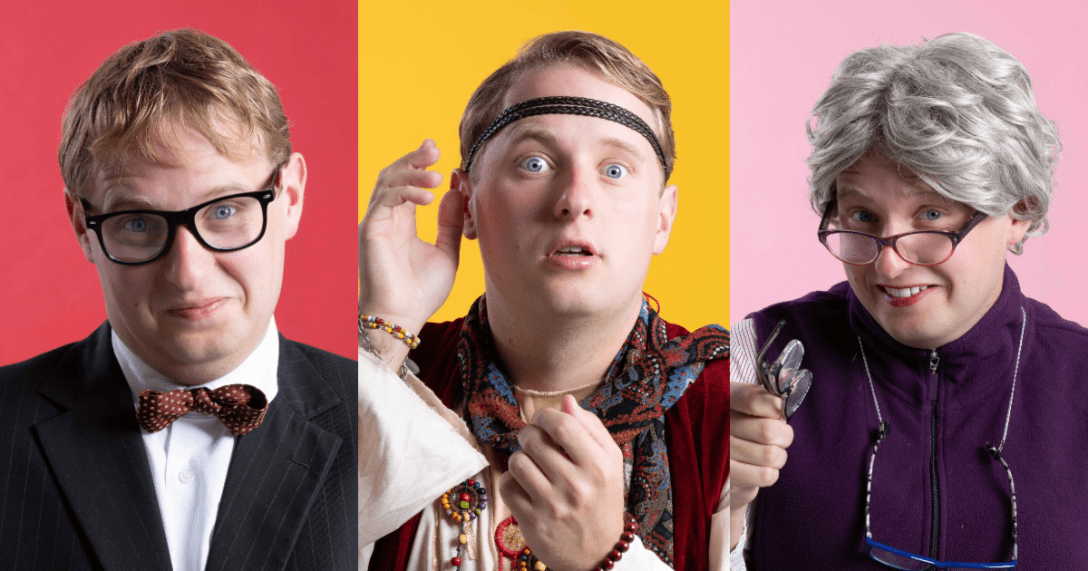
Erin Harrington talks with Ōtautahi-based theatremaker Will Burns about the history and development of three upcoming solo shows, each back for a return season in the next three weeks. Shit Finds Love is a chaotic, prop heavy show in which a silent character explores the world of dating and relationships with the help of the audience. An Intimate Evening with Peter Partridge is a chaotic magic and mentalism show hosted by Rangiora’s #1 (and bitchiest) psychic. The First Annual Parnell Croquet Club Facebook Live Telethon follows community stalwart Pat Stevens as she tries to raise enough money to save the club; chaos ensues. There’s a running theme… As a body of work, these ambitious shows offer insight into the process of indie theatremaking and artistic development in a time of few resources.
Will is a lifelong performer – “they built a stage for me at my preschool” – who came up through the Court Theatre Youth Company and Two Productions’ mentorship programme before working professionally in theatre and making his own shows. These performances at Little Andromeda, one of Will’s past places of employment, will raise funds for a new upcoming show.
***
Erin Harrington: You have three solo shows coming up in the next month, each of which are quite ambitious… that seems excessive! Could you describe what you’re doing, and why?
Will Burns: Yeah this was my decision. But I do keep asking why? Why have I done this to myself? It was just supposed to be having another look at my first show, Shit Finds Love but, then Peter Partridge came back into the conversation and then it felt wrong leaving the Parnell Telethon out. It had to be the trilogy. In some small way it feels like this is completing that chapter of my life and career.
The main reasons:
First, I have tried multiple times to get funding for a new (somehow even more ambitious) project and have failed. I was getting sick of the no’s so I thought what can I do to just raise this money myself. Looking back, I admire my earlier ambition – ‘if the opportunities aren’t going to be offered to me, I’ll make them myself’. In comes the William Burns theatre marathon.
Second, we all need a good laugh right now.
Third, and arguably the most important, I want to get my spark and confidence as a theatre maker back. I have had a few career knock backs. I’m finding it increasingly difficult to survive as an artist and I’m burnt out. Some would say the answer to burnout is not putting on 3 incredibly ambitious shows 3 weeks in a row. But these 3 shows over the last 8 years have brought me the most joy I have ever felt in my life. I just want to be on the stage. I want to have fun and the audience to have fun. The energy I get from these shows keeps me going in this incredibly difficult industry.

I wanted to talk with you about these shows and how you’ve developed them over time, as they are each really ambitious, and they clearly build on one another in terms of their scope and storytelling into a pretty interesting and very distinct body of work. It’s also really hard to make theatre, and you’ve clearly undertaken a lot of development and dramaturgical work yourself. I saw Shit Finds Love when you staged it back in 2018 at the Old Boys Theatre at Christ’s College, and I just remember it being so hectic – not just the escalating absurdity of this clown character’s search for a relationship, but also the sheer scale of it. What do you remember about coming up with this and putting this together?
I would love the confidence back of 2017 Will just boldly introducing myself to the theatre world with this massive show. I’m so proud that I did it. I just love how big, bold and crazy it was/is.
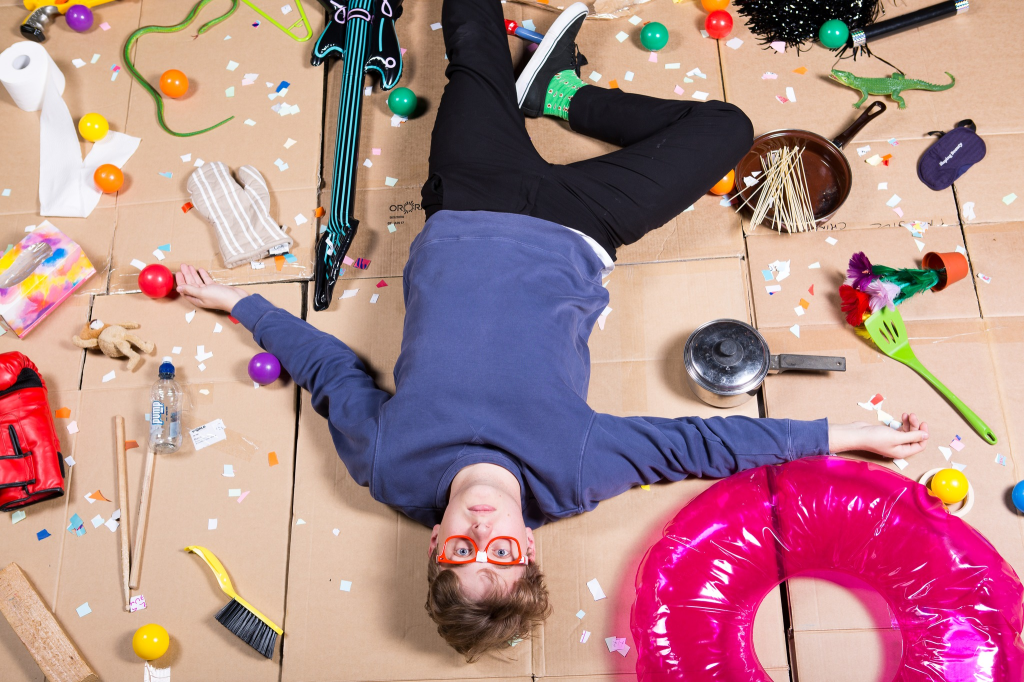
It began in the classroom at the old Court Theatre. Myself and my friend Ola were both making shows together as part of the Two Productions mentorship programme [run by Holly Chappell-Eason and Tom Eason]. I had a mop and I put sunglasses on it and made it sing to Stevie Wonder’s “Superstition”. I kept making famous people sing using stuff from around my house. There was Britney Spears on my hand with lipstick and spaghetti for hair and buckets singing Prince while a fan was strapped to my head blowing purple (rain) confetti everywhere. I was playing and trying all these gags with ‘shit’ I found in my garage.
Then one day I made a little showing where my character fell in love with an audience member and started using this household ‘shit’ in gags for that. Holly and Tom said to me, there’s your show! And that was that. Shit Finds Love. I booked the [Old Boys’] theatre [at Christ’s College] and just did it. I knew it was funny and I never thought too deeply about it and I think that was both a blessing and a curse.
I do remember the night you came in 2018 didn’t quite go to plan. I had done the initial season in 2017 and it had gone really well – watching the videos of them now I cringe a lot. But I cringe a lot less at the 2017 version. Word of mouth very quickly sold out this return season. I think perhaps that made me a little cocky? I just rocked up in 2018 to this sold out show, without properly rehearsing it, without any assistance and just did the show. What was I thinking!? I just remember my glasses broke, being thrown by that and then the whole set collapsed at the end.
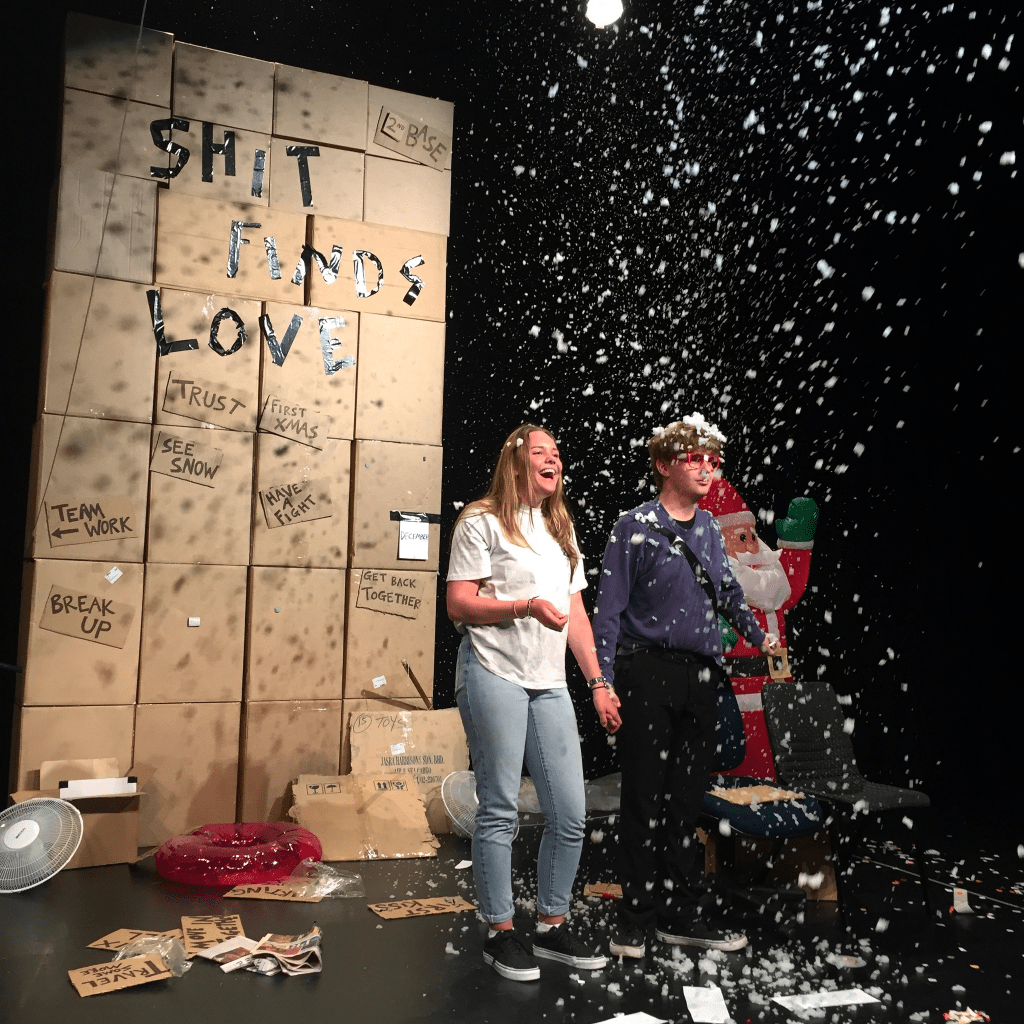
Yes I remember that, because there were cardboard boxes flying everywhere – I kept thinking, man, this is either a high concept metaphorical ending or he’s doing an amazing job of ‘yes and-ing’ the complete implosion of this show!
Everyone in my life who saw those shows always talks so fondly about Shit Finds Love. I think it’s a show that really grabbed the non theatre people. People have been asking me to bring it back for years. I am so excited to be having another look at it with a more experienced eye – and some help and some proper rehearsal this time!
I really admire the work that Two Productions were doing at the time with their youth mentorship programmes, as it seemed to be giving people permission to do creative things in a way that wasn’t really happening otherwise. Then you get the proof years later as you see those seeds become something bigger. As someone who has been through them, what do you think the value of development and mentorship programmes like this are?
The hardest thing about putting up original work is accountability. You have to be actively showing and receiving feedback to make progress. The Two Productions programme gave me that active accountability plus a reason and pressure to just try stuff. So many of my theatre friends tell me they want to make a show but have no idea what it actually looks like – they just need to be forced in a room and told they are showing five ideas in an hour.
Shit Finds Love wouldn’t exist without that mentorship program. Peter Partridge wouldn’t exist without Shit Finds Love and the Parnell Telethon wouldn’t exist without Peter Partridge. And I don’t think my career would be what it was without this trilogy. So yeah mentorship programmes do work and are essential.
So then you develop Peter Partridge later in 2018 – I remember seeing a proof of concept at a scratch night, and then a full show at the Little Andromeda pop up marquee. Where did he come from?
Peter Partridge came from a lifestyle block in Rangiora…
My obsession with psychics definitely began with watching Sensing Murder on TV as a teenager. Peter himself started in school with my mate. We filmed a Sensing Murder style skit in the principal’s office and got in a lot of trouble.
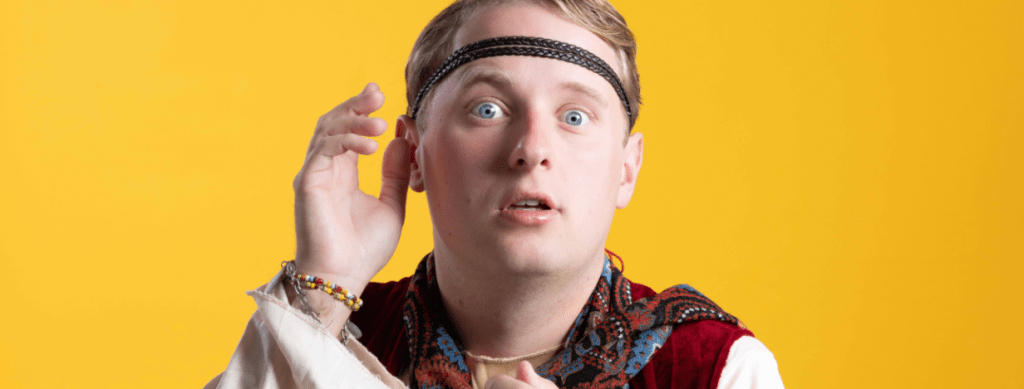
Peter is a heightened version of those NZ TV psychics. The psychics on Sensing Murder at times felt like characters that someone like Chris Lilley would write. I also went along to their live shows and just found them so theatrical. I remember an episode of Sensing Murder where a spirit had a crush on one of the psychics and they were flirting. I mean you cannot write that. I just love how extravagant they all are as people and the perfect mixture of mysticism and small town NZ. Peter’s that small town weirdo that everyone knows. Like if he was real I imagine people in Rangiora would go, ah yep, there’s that kaftan wearing psychic guy who is always walking about.
Peter is very camp, and I think in making him I was, in a slightly sideways way, exploring my own sexuality before I had admitted it to the world. At the time it wasn’t something I was consciously naming, but looking back it feels pretty clear that Peter was an outlet for that. I had also started watching drag shows and I loved the improv and audience roasting of that culture. Peter loves a cheeky audience roast.
So that and I really just wanted to make a magic show. I was that magician kid who forced my family into watching my endless magic shows. I find the form of most magic shows so boring and drawn out though so the psychic route felt like a great way in. This will be the third Peter Partridge show at the third Little Andromeda.
This seems like a show that is really a show with a show – you have the character and comedy elements, you’re working the room and hassling the guests, but that has to be underpinned by the dramaturgy of magic and mentalism, and ideally some stakes for the character. How do these arcs come together?
This is an interesting question. I think it has taken a few iterations to really land on what the strongest version of a Peter Partridge show arc is.
The shows deliberately begin in a place of pure comedy. Peter is an inept, overconfident psychic who keeps getting things wrong. The audience are laughing at him. It disarms people and lowers the stakes. Our expectation of a magic show is ‘impress me, do something I can’t figure out how it’s done’. Comedy, it’s ‘make me laugh’.
Slowly Peter starts to get a couple things right, and things start to tighten. The arc of the magic shifts from obvious failure to accuracy and I guess then that directly fuels the character’s arc. The audience goes from “this guys a joke to” to “wait… how did he do that?”
So to talk in magicians terms – the comedy isn’t separate from the magic, it’s the misdirect. Wait… has a magician just revealed his secrets? That’s not allowed.
… and then four years later we have Pat from Parnell! This character is so beloved, and telethons seem so ripe for exploitation – that combination of high stakes and grassroots.
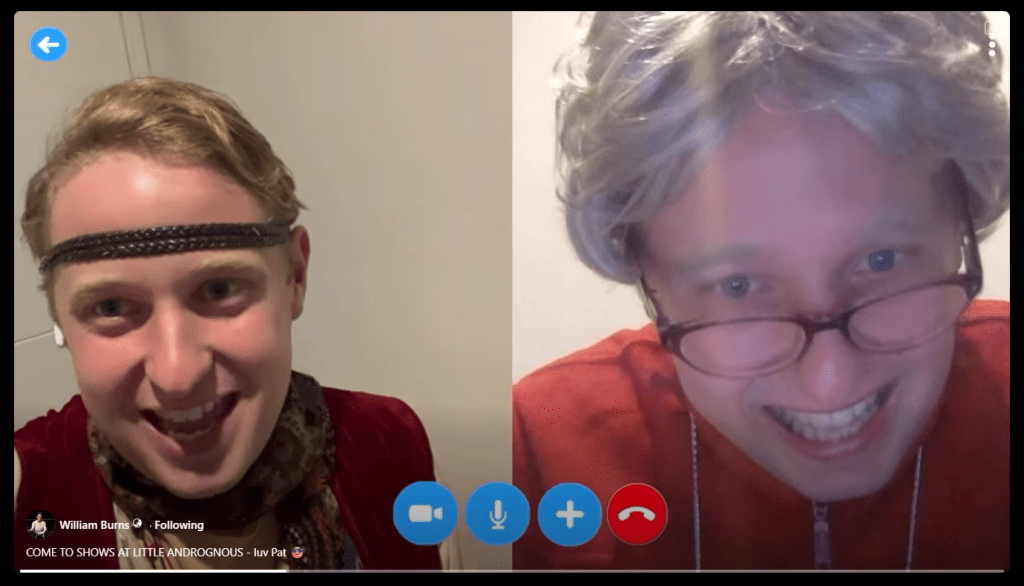
My dear Pat Stevens. It all began when I was at a show in Auckland and I eavesdropped on an older lady beside me who was talking about how she had set up a Facebook page for her sports club and she had started posting some me me’s to try get the young ones into the sport. I zoned out of the show I was watching and came up with the early idea of the Parnell Telethon right there. I still follow this sports club and her me me’s continue to delight.
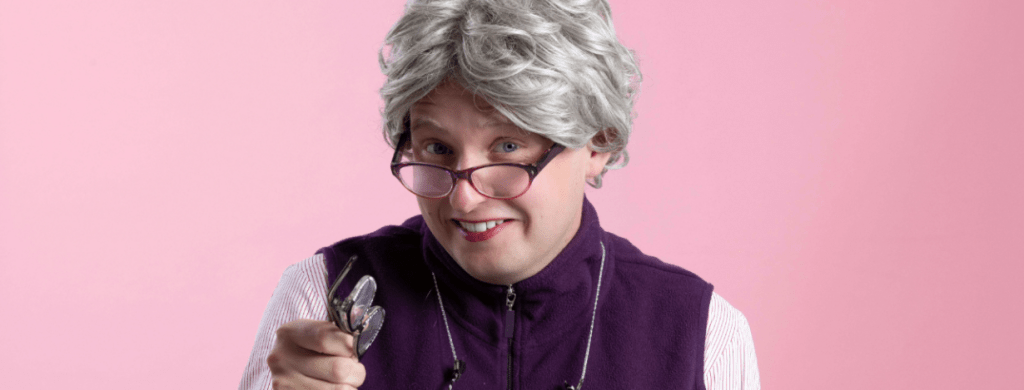
Then I was at the eco shop buying stuff for Peter Partridge and I saw a lady and I was like that’s her – that’s my character. I took a secret picture of her and that’s still Pat’s clothes today: the sleeveless polar fleece with shirt underneath, 3 quarter capris, slip on black shoes and glasses on the face and around the neck.
I also spent two years playing Pat at corporate gigs and Murder Mystery nights before I knew she was ready for the show.
That’s an amazing way to develop a character! How do you find that hones your character?
Well I can try things out with absolutely no pressure and fail as many times as I need to. Some nights I’d be in character for five hours – I got to know her pretty well! And if Pat can deal with a completely wasted and obnoxious business man, she can deal with anything.
The comedy here is rooted in its realism. The best compliment I can get from people is when they say “my grandma has multiple glasses” or “my grandma has a password book.” The show is also of course a love letter to my grandparents. I know they notice some things and are oblivious to others. There are so many nods to weird things my family do in this show.
I had also always admired the work that Mischief Theatre do with The Play That Goes Wrong and other spin offs but felt they were all gags and no heart. I wanted a Kiwi Play That Goes Wrong that had characters we care about.
I think the telethon is the epitome of New Zealand nostalgia. Those great telethons of the 1980s sum up everything we love and joke about New Zealand culture. Everyone in the country was watching and it was both hi-fi and lo-fi at the same time. The personalities were so iconic. The country stopped for a 24 hour broadcast – it feels so ambitious. I don’t think they’d be able to pull this off anymore.
Moral of the story is, if you are sitting near me at the theatre, be careful because I’m almost certainly eavesdropping on your conversation and you might be my next character.
This show has an even higher level of complexity than the first two – it’s really technical and well-timed, and a lot goes really wrong. This came about four years later – what had you taken from those earlier shows as you built this? Were there failures that made you want to do things differently?
This show absolutely wouldn’t exist without the other two. Obviously I learnt so many theatre making skills from just throwing those initial works up. I think my main learning from those first two though was to get help. Get other creatives on board. The contributions of Brynley Stent (my original husband Daryl and co-theatremaker), Holly Chappell-Eason (director), Michael Bell (many things – design, music, tech, venue), Nick Lowry (original set design) and Connie O’Callaghan (original operator) enabled that show to step up to another level of complexity.
It was definitely a choice that the form was less fringe style and more a full comedy play. I guess being more established enabled me to have connections to bring these people on board but also be more secure that it would work commercially so I could pay them. I think also Little Andromeda was in a more secure place as a venue where it could offer help find an audience. When Shit Finds Love premiered Christchurch didn’t have a fringe space.
I also think I have learnt a lot about audience safety, especially with audience participation which happens in all my shows. If the audience is uncomfortable it has to be a choice. They cannot feel like the show is actually out of control even though my shows often intentionally head there. This is one of the main reasons I am excited to return to Shit Finds Love because that whole show is with the audience. I can hold that so much better now.
The thing I really like about these as a body of work is that they are quite ambitious in terms of staging and concept, but they are still underpinned by these very tangible, very distinct characters who have strong wants and needs, and some pretty big blind spots. What is it that draws you to exploring these sorts of character-driven solo shows?
I think the ambition in form really works if there’s something human anchoring it. The character gives the audience a way in and if the audience loves the character, you can get away with a lot. Peter Partridge can be fully brutal on the audience, and they’re like ‘more more more’. I guess their wants generate the momentum of the shows and their blind spots are where a lot of the comedy lives.
As I have alluded to, I am just really fascinated by how strange ordinary people are. I am interested in very specific and real human quirks. Take a real person and just heighten their quirks slightly for the stage. We are so weird and it’s wonderful.
I love the ‘liveness’ of theatre and in all of these works the audience are active in the shows. They are figuratively – or sometimes in the case of Shit Finds Love literally – my scene partner. The relationship between these characters and the audience is very active and I love playing with it. Sometimes they sit ahead of the character or occasionally they’re implicated in the character’s logic.
I love the shared complicity where they’re not just watching the story, they’re part of how it unfolds. That is live theatre! I also just love creating shows that people can watch multiple times and have different experiences.
The characters spill off the stage too. Pat at times is very active on Facebook. That’s fun world building.
I’ve been asked a couple times why not change the name to Merivale Croquet Club? Sure that’s an easy gag that might sell a couple more tickets but the world building is so much more important. The Parnell Croquet Club Facebook page existed long before the show. I think before the telethon idea was even thought of. There are more people on that page who think it’s real than who know it’s a joke. It has gone viral on twitter a couple of times because people think it’s real.
Again its building into the real specific character work and building a realistic world around them. The realism is the comedy.
It also strikes me that each is a different experiment in form – like, you’re not just putting together a show, but you’re teaching yourself how to do a whole new type of thing in the process, from learning mentalism to the types of chaotic theatrical choreography required in the telethon. How does this inform the way you like to develop work?
Absolutely correct. It’s boring to just stay within a form I’m comfortable with. There are elements that have certainly carried over into each – the audience are always present and involved in the shows, there’s usually confetti (I love it!), they’re comedies and they are character driven but other than that what’s the point in doing something I’ve already done?
I think form is one of the earliest decisions that is made during my making process. The big decision pillars are form, content, process and purpose. I will never stop learning and experimenting – many theatremakers do and we get bored of them don’t we? I’d rather fail in a bold new form than be boring.
The new show I am going to put funds from this season towards I’m going to try being myself on stage. No character. William Burns. That will be fun, interesting, scary?
I’m also really mindful that you’re developing these largely by yourself, in an environment where there are so few resources, and that those earlier works really benefitted from development and mentorship programmes that are pretty thin on the ground right now. Some of your characters have come about because of years of experimentation. What do you think we need?
Yeah, it’s definitely something I’m very aware of. I had shows in 2017, 2018, 2019 and 2022 (which really was supposed to be 2020) and nothing since then. Is that a reflection of where we are sitting in the arts ecosystem right now? I think so?
Time, space and people are what’s needed. Time to make things without the immediate pressure of outcome, space (both physical and mental) to experiment and fail, and trusted collaborators or mentors who can challenge the work and sharpen it. Even just being able to show someone something incredibly rough and have a thoughtful response can completely shift the trajectory of a show.
Don’t shoot me, theatre critic, but I do think there’s a wider problem of theatre criticism and maybe just general theatre feedback in New Zealand where we are afraid to challenge work. I totally get it – the industry is so hard and one bad review can tank a show that is already scraping by but, I think we are lacking places for criticism, feedback and growth. In return I’m not sure us theatre makers in NZ are very good at receiving this feedback and criticism. And that’s where we grow. But it’s a very hard line because with such limited resources we are being so vulnerable to put our own work up.
But I see a lot of ‘first ideas’ on stages in New Zealand – the 10th idea would probably have been better. Has New Zealand theatre grown in the last ten years?
Yes, I agree. There is a big conversation brewing at the moment about arts writing and criticism and the fact that it’s at a point of real crisis in general, including here in Ōtautahi, but then there are other questions about how a critical ecosystem could and should work in a healthy manner. So maybe there’s scope to develop a critical ecosystem in a way that theatre is also developed and mentored… But I think you’re right about growth. It’s like there’s ground, I guess, but so little fertiliser across the whole sector, and so few opportunities for second versions let alone tenth ones too. So all that said what is driving you to do it?
My impulse to make work never goes away. If anything the limitations force you to get inventive about how you develop ideas and be really clear about what the work really needs. Strong work comes out of strong ecosystems, and there’s real value in investing in those. Almost every major international arts festival has innovative work from Belgium. They have some of the best arts funding in the world – just saying. The exciting thing about New Zealand is we have community and we have room for innovation.
If you’re reading this and going ‘man I’d love to make my own show’ then I truly mean it when I say slide into my DMs and I’ll help in any way I can. I always encourage young people I work with to make their own work and I always end with that offer and I mean it.
Everyone’s process is different, but what would you share about yours?
My process is often, think about shows in detail for a number of years and then the actual making and putting up of the show happens very quickly – usually after I have booked the theatre.
My shows have only ever been scripted after the premiere season is complete. No scripts, occasional bullet points. Maybe this will change one day.
The costume is so important. The character does not exist until it has a costume. I generally am always in character when in the costume – I know that sounds a bit like wanky actor talk but that authenticity is really important to me. I wasn’t sure if I still had Peter Partridge in me – then I put the costume on and he was back. I’m like Disneyland. Mickey Mouse can never be seen without his head on.
Set deadlines. Book in a showing to a friend or colleague. Or just book the show season in and then it’ll have work won’t it.
Ask for help.
Listen, eavesdrop, observe everyday people all around me.
Test. Show. Get Feedback. Reflect.
Music is so key in my making. The playlist with a working title is one of the first things to be made. I listen to music and dream. Neil Diamond was my top artist on spotify for 3 years because of the Parnell Telethon. Current playlists in progress include Cats show, Food show, PTA meeting and Movie show. ETA 1 to 10 years.
Be ambitious. Even if the show is ‘commercial’ a boundary must be pushed. Use technology in new and exciting ways.
If I’m having fun, the audience is having fun. Goal of the show – have the most fun I have ever had on stage.
I look forward to PTA Show in particular. That honestly sells itself. As you look towards the first shows this weekend, any last words?
First of all, come to my shows please. Second of all, make a show. Be bold, be courageous, ask for help.
***
Shit Finds Love runs at Little Andromeda from Thursday 7 – Saturday 9 May 2026.
An Intimate Evening with Peter Partridge runs Friday 15 May.
The First Annual Parnell Croquet Club Facebook Live Telethon runs from Thursday 21 – Saturday 23 May.


[…] Darryl with such fondness you just want to give him a hug. The character work is excellent. Burns has described this production as The Play That Goes Wrong but with more heart, and he and Moulder have so much affection for their daffy characters and their life-long […]
LikeLike