
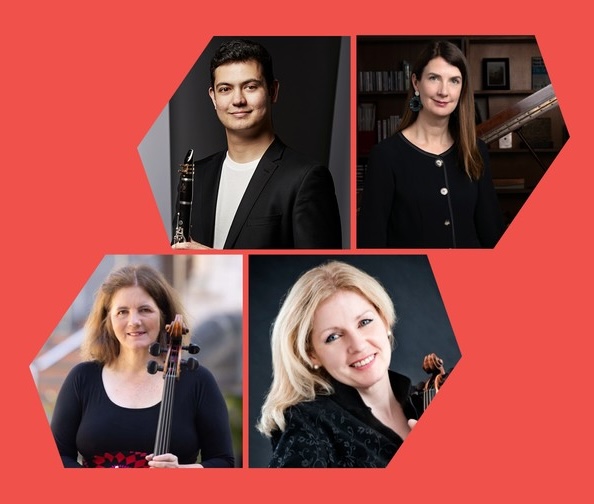
Nick Harte reviews Lumen Ensemble: Colours of Time, with works by Holly Harrison, Maurice Ravel and Olivier Messiaen presented by Christopher’s Classics at The Piano / Pīpīwharauroa: Kui-kui whitiwhiti ora, Friday 17 April 2026.
The Lumen Ensemble’s clarinetist Lloyd Van’t Hoff proudly proclaimed that his favourite thing about Christchurch is PAK’nSAVE, which was not the most promising start to what was otherwise a spectacular night of chamber music.
It’s very clear that Australian composer Holly Harrison’s brief new duo for clarinet and piano, Swivel and Swerve, was written by someone who has performed extensively within a jazz context. Harrison is also a rock drummer and her composition was joyously rhythmic. It was based on a few bars from the tail end of her Saxophone Concerto and the piece was transcribed with the aforementioned clarinetist Van’t Hoff. With syncopation galore, the jovial piece ultimately felt like a transcribed improvisation and was perhaps too uncouthly married to the blues scale, as it felt unable to break away and fully take flight. Still, it was refreshing to hear a piece written by someone operating slightly outside of the classical tradition.
Ravel’s Piano Trio was written when the first World War was imminent. In fact, all three of the night’s pieces were written on the verge of crisis: Messiaen wrote his Quartet for the End of Time in a prisoner of war camp in German captivity and Harrison’s new piece was penned during our current state of global catastrophe, which all points to some very timely programming. Having said this, the official and more digestible themes for the evening were ‘time, colour and light’, referring not only to the schedule but also the name of the group performing. Lumen Quartet gave sublime performances of not one, but two of my most beloved composers, via their uncanny interpretations of Ravel and Messiaen.
Ravel writes nocturnal music (as does Messiaen) and his slower sections include some of the most tenebrous, jazz-inflected chords in early 20th century music. The composer even travelled to Harlem, New York to experience the luscious sound of Duke Ellington in person. I count Ravel alongside Messiaen, Pierre Boulez, Jean-Phillipe Rameau, Gabriel Fauré, Gérard Grisey, Henri Dutilleux, Jean Barraqué and Michaël Levinas as one of France’s most idiosyncratic composers. The composer once said that “Music must be emotional, but only indirectly”; however, I find his music to be incredibly passionate, even if it is tightly controlled. In terms of performance, there were some false notes here and there, but this isn’t uncommon for such a demanding composer trafficking in extreme specificity.
The brooding third movement, a passacaglia, was the highlight and one can unmistakably hear its influence on the music of the (recently deceased) Ryuichi Sakamoto, who wrote more than one work based on Ravel’s Bolero. The unison playing of the cello and violin were particularly of note in this section and highlighted the exactitude of the composer’s chamber writing. Ravel said of the Piano Trio that “This piece is complex but not complicated.” The Passacaglia represents Ravel at his most Baroque, and also smuggles in some Asian influences in the form of some Malaysian folk music quotations. Sakamoto has spoken of the Japanese desire to aesthetically minimise everything, and Ravel’s obsession with precision comes from a similar place of reduction. Stravinsky infamously referred to Ravel as “a Swiss Watchmaker”. This was apparently meant as an insult but I believe the intense accuracy of Ravel’s compositions are one of his great strengths. His use of tonal colour suggests Claude Debussy’s influence, though his compositional tools are much tighter. Speaking of precision, the final movement of the Piano Trio had the performers wielding bows and fingers like surgical instruments and made for one of the most vigorous finales I’ve had the pleasure of hearing live.
What a rare gift it was to hear Messiaen performed in Christchurch, though it’s telling that the players consisted of three Aussies and a German. Perhaps Cantabrian programmers need to step up their game and take more risks, as we’re lucky to hear a dissonant or ‘challenging’ piece once a year (Schoenberg was great, if lonely, last year!). To hear Messiaen’s Quartet for the End of Time (Quatuor pour la fin du temps) performed with such conviction was a joy to behold and genuinely felt like the real reason these brilliant musicians had graced our shores. There was an air of palpable excitement emitted during the pre-concert talk.
Messiaen believed that birds were the greatest musicians on earth. He was a devout Catholic and preferred irregular rhythms, because, for him, God does not think or create symmetrically. No two tree branches are exactly the same. Neither is the birdsong the composer meticulously transcribed from field recordings he’d made. He wanted to dissolve rhythmic predictability and made sure that birdsong was prevalent throughout not only the work in question, but the majority of his oeuvre. Every decision the composer made was, in his eyes, in service of bringing him closer to heaven, nearer to a state of transcendence. While the work’s themes may appear bleak on paper (the piece’s debut performance was given by fellow inmates at the German prison in which he was being detained), they in fact refer to the biblical idea of leaving the abyss of time behind, not that of an oncoming apocalypse. It’s a very appropriate title for this work as there is something outside of time and hard to pin down about it, as there is with almost all of Messiaen’s compositions. As the filmmaker Andrei Tarkovsky once wrote, “Never try to convey your idea to the audience – it is a thankless and senseless task. Show them life, and they’ll find within themselves the means to assess and appreciate it.”
Messiaen is a creator of otherworldly and unique harmonic structures. Elizabeth Layton’s violin playing and Anna Goldsworthy’s piano achieved an almost ascetic level of focus and rigor in their adherence to Messiaen’s shards of splintered duration. Goldsworthy had such a gorgeous, light touch (even during the most thundering sections) that I have not experienced in any other performer using The Piano’s very same instrument. The work presents a suite of glistening miniatures and the venue’s wooden floors and lofty acoustics provided the perfect sonic backdrop for such haunted material. I was eagerly anticipating the 5th movement, which spotlights the cello soloing over a subdued piano accompaniment. Unfortunately, Edith Salzmann had some intonation issues which led the movement down some awkward corridors, though this was a small price to pay for an otherwise rich night of music.
Many of the night’s highlights arrived in the form of what struck me as antecedents to free jazz, particularly in the Messiaen piece. Anna Goldsworthy’s deft piano playing recalled the early recordings of Cecil Taylor. Lloyd Van’t Hoff’s clarinet playing contained the grace, agility and meticulousness of John Butcher or Evan Parker. The unison labyrinths of the 6th movement in Messiaen’s Quartet sounded so similar to Anthony Braxton’s MDD-3/63D that I had to pinch myself to remember where I was. I hadn’t realised what a huge impression these two French composers had made on the 60s and 70s generation of free jazz performers. Debussy’s influence can again be heard, this time through a more radical transmogrification. It’s fascinating hearing Debussy’s incandescent colouring converging with the atonal lessons of the Second Viennese School.
Messiaen’s impact on late 20th century music is indisputable, but his ethereal sonic corridors have remained vital to this day. There would be no score, as we know it, for There Will Be Blood by Jonny Greenwood, without Messiaen. Some of Greenwood’s writing for the film sounds so directly inspired by the Quartet’s 5th movement (“Louange à l’Éternité de Jésus”) that it verges on (albeit friendly) plagiarism. More recently, the incredible (and incredibly undervalued) Lucile Hadzihalilovic used Messiaen’s “L’eau à son maximum de hauteur” from his earlier suite Fête des belles eaux to sublime effect in her recent, and possibly best, film The Ice Tower. These connections underscore not only how cinematic the composer’s music is, but just how visually evocative it is in general. Ancient turquoise cathedrals fashioned out of glass, decorated with spectral birds are dragged across tumultuous oceans at dusk.
Even though Messiaen considered Saint François d’Assise his magnum opus, there’s a good reason why the beloved Quartet is considered his masterwork. It simultaneously guides us through its expression of deep anguish, yet enlivens us with its desire for transcendence, whatever that may mean for each of us. It is a truly universal work and to experience it in person made for an exceptionally memorable night.
The Ensemble is currently touring Aotearoa NZ and Australia.


