
Steph Walker reviews the first night of Electric Bodies, presented by Performance Art Week Aotearoa and TINYFEST, at the Cloiters Studio, Te Matatiki Toi Ora The Arts Centre, Friday 13 March 2026.
Performance Art is one of those forms that a lot of people haven’t actually seen, but probably have a view on. Like contemporary dance, there is an unfair assumption that someone will be naked at some point, and that you won’t understand what’s going on. Stereotypes, yes. Unfounded? Read on…
My experience of what is often called Live Art is much more nuanced. From my time as Executive Director at Performance Space in Sydney I grew to love the practice. The freedom to utilise any art medium, often blurred together, to explore themes, issues or truths you want to share can be exhilarating as an audience member. When it is good, it is brilliant. When it is bad, you wonder if the artist considered the audience in their work at all. In this experience-driven event era, Performance Art is the OG in unique experiences. I often wonder how our own performance art history in Aotearoa is so short and relatively unknown when compared to our next door neighbours. Is it about funding? The tyranny of distance? The need to be globally hot before the same can be said locally? Or perhaps we just don’t define our work in that way? Two works in this evening’s programme could be categorised into other art forms, depending on which way the curator might view the work, or how the audience responds.
The chance to head along to Performance Art Week Aotearoa (PAWA) X TINYFEST’s Electric Bodies, a weekend with a series of artists given the provocation of sound as body and body as sound was a treat, and I wondered who would be sitting with me (other than my trusty companion). Artists were in the majority, both those performing the following night as well as dance and visual arts practitioners. It was a knowledgeable bunch.
The evenings (there were two in Ōtautahi Christchurch, I only got to the first one) were touted not as performance art, but as performative experiments, which certainly resonated as I witnessed, and participated, in each artist’s mahi. I like that phrase, “performative experiments” – it gives a sense of more than simply cross-artform practice. It’s the grey area where forms mix together like a cocktail where you can’t quite taste the key ingredients. One dash more and it might spoil the whole thing, or make it too… well, too much.
We are becoming a city of poetry, regular performance nights of open mics, and featured poets bringing rhythm and lyricism on a weekly basis. With that in mind, it felt like a soft introduction to encounter Soft Mouths | The language of fffflowers by Antonia Barnett-McIntosh first – primarily a text based work with an occasional organic soundscape, some rock and ceramic ASMR, if you will.
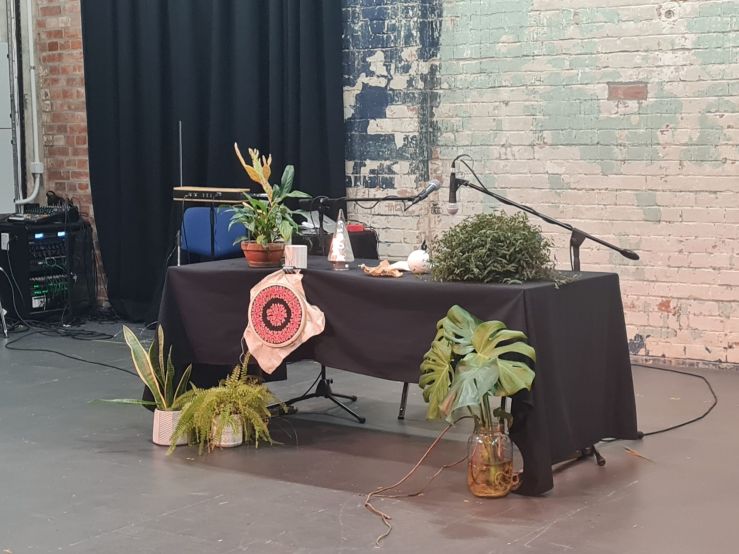
Antonia sits at a table with plants, a beautiful tapestry, some home decor objects in organic forms and two microphones on hand. She warms up into the collection of found sounds, a nervousness or stiffness giving way to really relishing the collection of words on her script, some sentences overheard, some musings, some corporate speak. The crunchiest moments were where hurried repeated words brought some satisfying wordplay. Flea–Flea-Flea turns into Leave-Leave-Leave. Each time, as I found the second hidden word, I was smug and loving the joy of words. I wanted more luxuriating over the text, more resonance. More voice work, I suppose. Perhaps I wanted performance poetry as that is the muscle I’ve worked more as an audience member? And more ASMR please. I want to be there on the bus, in the water, in the boardroom. Antonia had a lot on her hands, managing script and stones. I’d love to see another artist involved so each can really savour their role, be that the vocals or the ASMR. It would really bring out the lushness and enjoyment of all those great words.
I suspect the middle work would have scared away any newcomers to Performance Art. Stereotypes come from a place of truth, you see. Before Alan Schacher began his work, he gave us an introduction to his work and ensured we’d seen the signs about nudity. We then went out into the autumnal chill, bracing ourselves against the weather. Alan soon appeared in the pebbled space adjacent to the entrance to the Cloisters. He was unrecognisable – a maroon rain poncho covering his lithe body, a metal stick swinging like a pendulum from under the sacklike garb, partly seen through a semi-opaque clear plastic window. Gathering pebbles, he seems to battle with the elements, with himself. It felt very King Lear, battling age and a failing body, battling nature. Once we followed him back into the Cloisters more costumes, including a caterpillar-like tube, and more ideas coming to the fore. The soundscape, commissioned some years ago by Australian sound artist Rik Rue, leaned heavily on what seemed like bodily functions. Is this aging performer losing his control internally as well as externally? I’m just not sure. He ends, momentarily, in a black dress, in mourning for his own life… but then he gets naked again and puts his own clothes back on. Perhaps it’s the circle of life. Perhaps it’s all just an experiment with some fun items Alan found along the way. If you’d seen the brilliant Caterpillars from Kallo Collective you, like me, would have sorely wanted a knowing wink from Allan and a more tongue-in-cheek take on this prop play. But then again, think of performance art and you’d think that it is Very Serious Business.
We end with the most assured piece of the night, Violin Mantis by Sarah Elsworth and Anita Clark. Anita, aka Motte, is becoming well known across the motu as a much wanted multi-instrumentalist. Sarah has a strong dance and movement background, and her stage presence with knowing looks at the audience wins us over immediately as we follow her intimations and weave through an organic labyrinth to our seats. We are woven further with string, and gentle audience participation comes back to us at the end of the performance. Antennae are everywhere in this work, from the praying manti to the 50s and 60s space era, and finally into the future. The female Praying Mantis kills the male after sex, the woman is really in charge of the family home, and it is two women with conductors in charge of this mahi. There is electricity in the antennae, and in the theremin Anita deftly plays, with the combination of the two hypnotic as projections get psychedelic. The work gets more and more warped, but the two artists are always in control so when we’re called on to grow our own antennae and follow Sarah’s movements, we readily do so. The gentle power that flows through antennae strikes again.
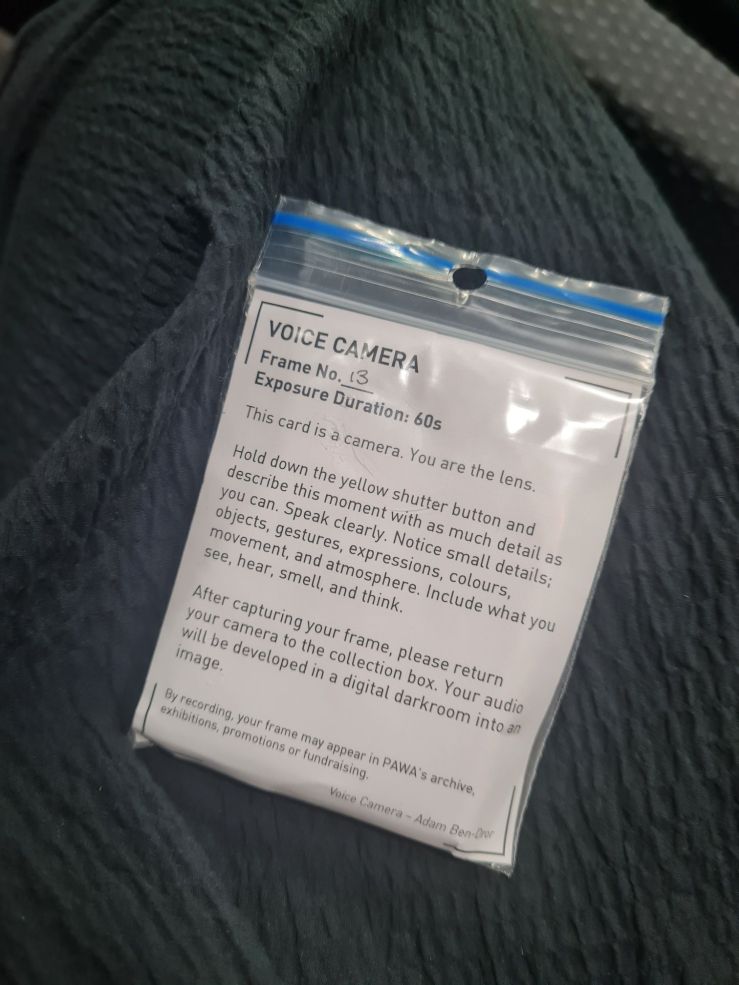
We were asked to leave the Cloisters between each performance, which really highlighted the sense of community around this work. A collegiality filled the air. Often a person wandered off by themselves to record their thoughts on what they’ve witnessed on a very cool lil gadget from Adam Ben-Dror, which will go on to make a further work called Voice Camera. I have no idea if I pressed the right buttons to record mine, so Adam, if you’re reading, this is for you.
Electric Bodies was a collaboration between Performance Art Week Aotearoa (PAWA) and TINYFEST, and presented in slightly different iterations in Tāmaki Makaurau Auckland (6-8 March) and Ōtautahi Christchurch (13 – 15 March).

 Flat City Field Notes