
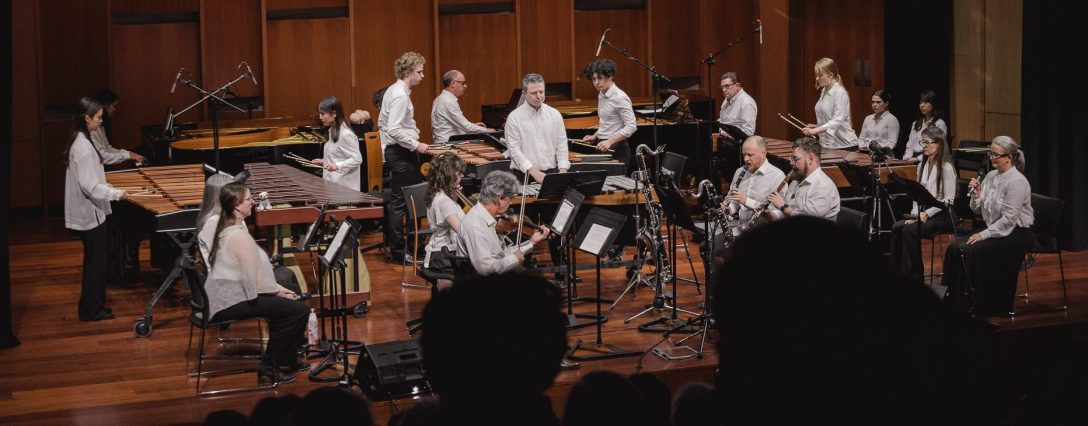
Hannah Kagawa reflects on the experience of performing in the New Zealand premiere of Steve Reich’s Music for 18 Musicians, at The Piano | Pīpīwharauroa Kui-kui whitiwhiti ora, Saturday 15 August 2026.
Fourteen seconds of absolute silence, followed by an instant standing ovation from a sold out crowd at The Piano. Words cannot describe how surreal it felt being one of the performers on stage that evening. This was the moment New Zealand saw its national premiere of Steve Reich’s Music for 18 Musicians on Saturday 15th August 2026, which also marked the piece’s 50th anniversary. Despite the name of the piece, the ensemble had 20 musicians, consisting of students and staff from the University of Canterbury School of Music and musicians across the city, directed by Justin DeHart.
When I first heard that we were going to perform Music for 18 Musicians, I already knew that this was going to be the start of something big. In 2024, as a first-year music major involved in the University of Canterbury School of Music, I was fortunate to be a part of the NZ premiere of another monumental piece by Reich – Drumming. To this day, as a third-year student, if I were asked, “What would be your most memorable moment at UC?”, this performance would be the answer. It holds so much significance in my life, and it opened me up to the world of Reich’s incredible minimalist music. Since then, Reich has become one of my favourite composers. However, Music for 18 Musicians never seemed to attract me as much as his other pieces. I knew it was one of the composer’s most well-known works, but I never understood the hype around it. Perhaps it was because I preferred Reich’s more experimental works, such as Piano Phase and Four Organs? I’m honestly not sure. “This music is far from minimalist,” I used to think as I spent my commute to uni listening to this piece; “so much is happening, yet so little is happening at the same time.”
Before the tight, five-week rehearsal period that was ahead of us, I first had to decide which percussion part to play for 18 Musicians. Perhaps I want to be Marimba 1, the main motor that carries the whole ensemble by playing steady on-beats? Or Marimba 2, the other half that plays off-beats the whole time? What about Marimba 3, which plays the rhythmic ostinatos that everyone locks onto? Or Xylophone 1 or 2, which highlights and pulses as it builds up the pattern? Or even the small yet mighty maraca part that everyone loves! In the end, I decided to take the Marimba 2 part. Unlike flashy, virtuosic passages from classical/contemporary music, being able to hocket (playing interlocking rhythms) pretty much non-stop for an hour required a whole different skill, and I was up for the challenge.
In the first couple of percussion-only rehearsals, playing every other beat of Keina Rollinson (Marimba 1)’s part was quite shaky. Even worse, when other instruments started coming in, I often got distracted and slipped out of time. I needed a great deal of concentration just to be in time. It was all about listening, listening and listening – especially since I had my back to almost everyone and couldn’t see what was going on. Nevertheless, after a few more rehearsals, I reached a flow state. Turns out that after playing the same thing for an extended period, your perception of what you’re hearing changes. You get into a trance-like state and discover new things within the music. This was something that I found unique to playing Reich’s minimalist works.
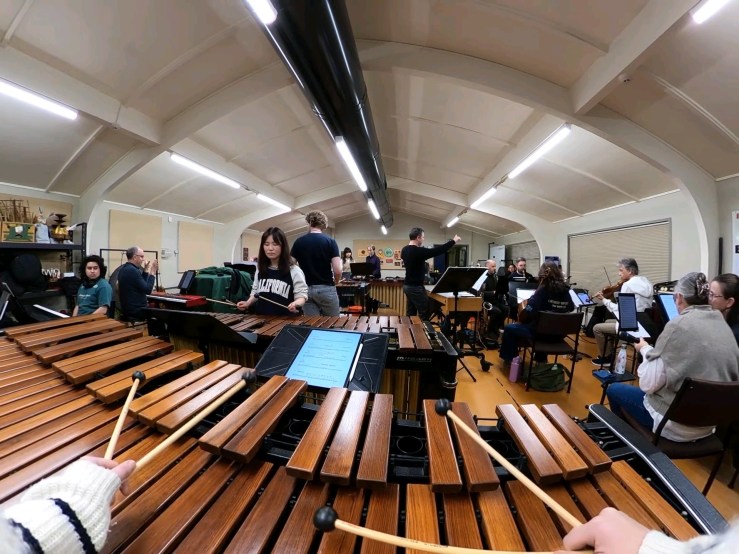
Admittedly, since I was busy around that time, I couldn’t prepare for this piece at all. Others also expressed that they were stressed because this concert clashed with the busy exam season at uni. Therefore, my experience during rehearsals was spent relying on Keina and following cues while being unaware of the overall structure of the piece. If there was one thing I regret, it was that I wish I had spent more time score-reading and getting to know more about the work. Even though the sheet music was sight-readable, knowing the structure would have elevated my experience preparing for this piece. Meanwhile, with his vibraphone part on one music stand, his written-cue sheet on another, and a massive full score on his side, Justin did a phenomenal job leading the rehearsals. I kept looking at him over my shoulder with great respect and admiration. In the final two weeks, we started having full tutti rehearsals with every player involved. From the ensemble, there was some decision-making, shaky transitions and even disagreements, but overall, I really enjoyed just being there, surrounded by great music and great friends. The concert was just around the corner, with sold-out tickets and lots of media attention building the anticipation.
The day of the concert came all too quickly, and transporting the gear from UC to The Piano made me realise how monumental this piece was. I mean, have you ever seen four grand pianos in a single room? As well as those massive instruments, we had three marimbas, two xylophones, and one vibraphone that we had to bring. Until the concert, we only played two full run-throughs of the piece. After the second run-through at the dress rehearsal, I thought of one thing: my arm hurts. That makes total sense, since Keina and I play for the longest – we only rest once during the hour-long piece. After a few hours resting our arms and breath, we got ready backstage, showing up with matching white tops and black pants. I personally loved this dress code rather than the standard concert blacks. Finally, after a pre-concert talk presented by Justin, the concert began.
The unison introduction, played by Keina and Piano 1 player Alec Mark, was so locked in. Let’s go! Then, Piano 2 player Kyle Hsieh and I started fading in with the off-beats. I wasn’t nervous at all – just eager to show this hard work to everyone out there. Perhaps all the dad jokes Justin cracked backstage were an icebreaker, too. As each section progressed and the instruments and voices built up the texture, the atmosphere felt so powerful. The first few sections did take some time to settle, but once we warmed up, we were on a roll. Even the scary sections that troubled us during rehearsals went surprisingly well!
My favourite section from the concert was definitely Sections V and VI. In Section V, Keina and I finally took a rest after about half an hour of playing and listened to the pianos behind us build up new interlocking rhythms. It was so satisfying to hear. After that, Keina and I built up a new rhythmic motif. For me, this was the first time I played on the beat, so I let myself groove with my entire body. Keina was doing it the whole time anyway, and she didn’t notice! Finally, after Justin’s vibraphone cue, the whole texture suddenly shifted, and the long-awaited maracas came in. This moment was the transition into Section VI – one of the greatest transitions I’ve experienced in my musical career so far. It was like a moment of clarity, like the feeling when you finally popped your ears after a long flight. Section VI itself felt like the “heart” of the piece. There was so much energy with almost everyone playing.
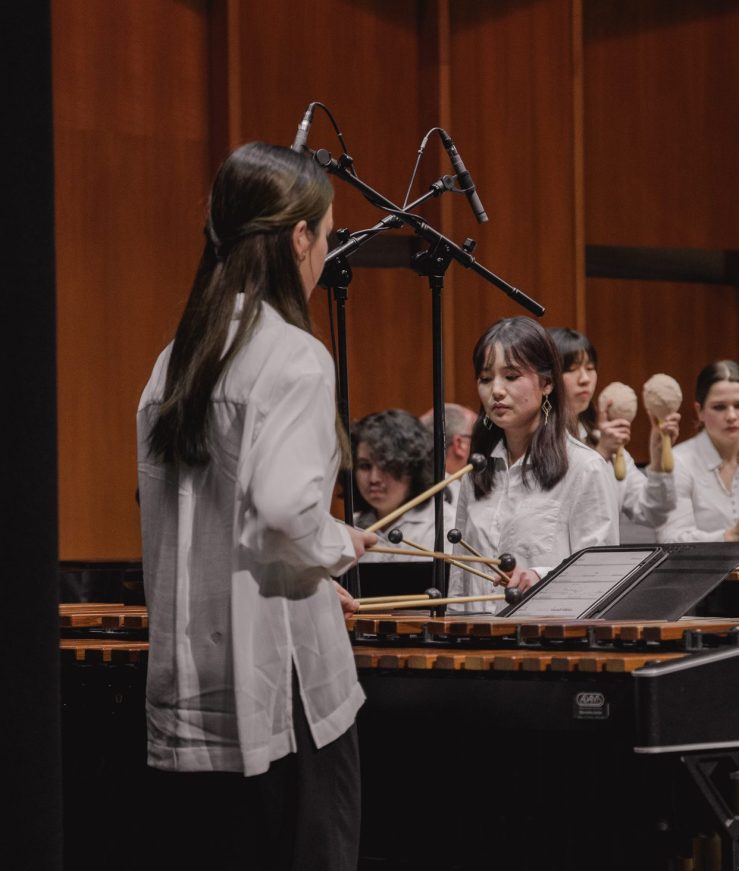
Remember how I said that I never quite understood the hype around Music for 18 Musicians at first? Now I believe that it was probably because I was looking at the wrong thing. I kept looking for logical reasons as to why people loved this piece so much. Was it because humans are hard-wired to favour repetition over change? Was it because of a specific harmonic progression (if you could call it that) or some textural feature specific to this piece? My classically trained brain tried to seek some sort of musical analysis to justify a positive/negative feeling towards 18 Musicians. But playing this piece made me realise that sometimes, art doesn’t need to have an answer. Maybe people liked it because it simply “sounds nice”. Hence why, at some point during the preparation of this piece, I finally stopped analysing and started listening. Instead of expecting something to happen, I started living in the moment. I finally felt liberated, sometimes zoning in and out while playing and discovering new things with every listen. In contrast to playing fast, virtuosic pieces where time seems to fly by, playing this simple part made time slow down, and I felt even more alive.
After the final notes played by the violinist Mark Menzies faded away, there was silence. Fourteen long seconds of complete silence from the full-house concert hall. The first true silence in a whole hour. Then, an instant standing ovation broke out from the audience. I had never seen people rise to their feet so quickly before. I looked at the audience, then to Keina, then to Justin, then back to the audience with a smile and slightly sore arms. We were so lucky to have performed this – a truly once-in-a-lifetime opportunity. We happened to be at the perfect place and the perfect time. Among the sea of applause, Naomi Kelly, one of the maraca players, presented a bouquet to Justin that we had organised earlier. I felt so grateful towards Justin for putting in countless hours of mahi to make this possible. After the concert, we celebrated by getting ice cream at Rollickin while listening to Justin’s post-concert dad jokes.
Music for 18 Musicians kept growing on me, even weeks after the concert. Even as I write this, I keep discovering more and more about the piece with every listen. Usually, I am against watching back recordings after a concert because it feels like it takes away the authenticity and changes my perspective of the raw feeling of the performance. But this time, I decided to watch the entire livestream of our concert. For the first time, I got to experience a version of our concert where I could see everyone all at once! Instead of only looking at Keina and focusing on one section at a time, listening to the whole piece holistically while looking at everyone moving like clockwork gained a new, panoramic perspective and appreciation for the piece. This concert will forever be a cherished memory in my life, and again, it is thanks to everyone who made this possible. I feel eternally grateful to have become one of the performers for its New Zealand premiere and 50th anniversary here in Ōtautahi Christchurch, with these brilliant musicians.
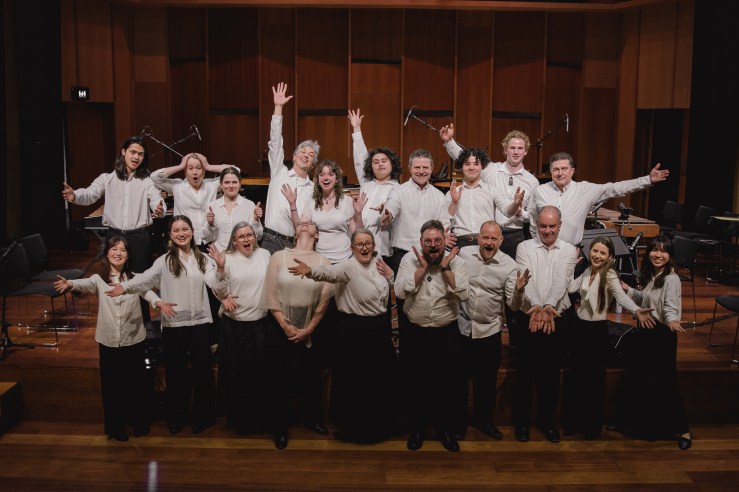
Music for 18 Musicians was presented by the UC School of Music and performed by: Mark Menzies – violin; Freya McKeich – cello; David McGregor, Reuben Derrick – clarinets; Sarah Besley, Nicola Holt, Shelley Liken, Jessica Adams – women’s voices, VoicesNZ; Tim Emerson, Hamish Oliver, Kyle Hsieh, Alec Mark – pianos; Keina Rollinson, Hannah Kagawa, Katia Ashmore – marimbas; Naomi Kelly, Quincy Lam – maracas/marimbas/pianos; Cameron Smillie, Sho Kubota – xylophones; and Justin DeHart – vibraphone and Musical Director. Photo credit: Marie Fox.


