
Charlotte Thrornton reviews Doomsday Comedy, at A Rolling Stone, Friday 6 February 2026.
Legacy stand-ups love to tell us that comedy is about taking risks and being unafraid to offend. Doomsday Comedy bravely takes on a completely uncontroversial topic: religion. All of the performers, and much of the crowd, once adhered to some form of Christian fundamentalism.
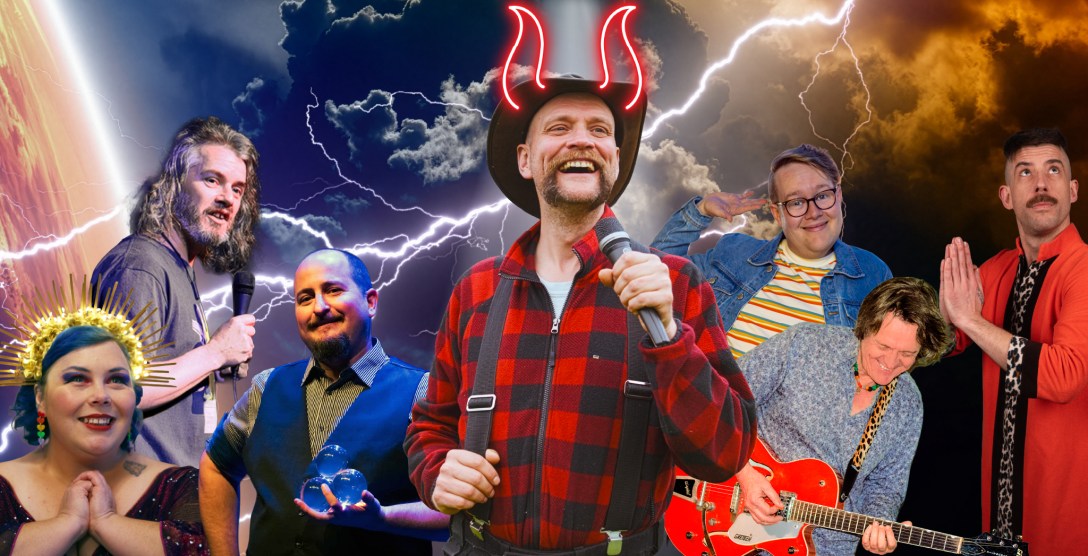
Doomsday Comedy is devised by ex-Jehovah’s Witness Jonas Skogstroll, a Norwegian goat farmer and comedian who’s in New Zealand to peacefully protest Jehovah’s Witness conventions. The Ōtautahi Christchurch show is the last stop on a four-date New Zealand tour. Thanks to the Decult network getting the word out to former cult members, this is a sold-out event filled with understanding people. I feel a little out-of-place – the only time I ever went to church, at age 10, I responded to “Peace be with you,” with, “Thanks.”
Our emcee is Snap, a seasoned pro who’s particularly at ease with political material. He opens the night with a Brian Tamaki jab and it’s clear we’re in good company. He is the only one on the lineup not from a “culty background,” though, ironically, his Facebook page describes him as “Comedian / Cult Leader.” Snap smartly takes this opportunity to do some crowdwork, since you’d be hard-pressed to find an audience with a better range of life stories.
Mark Darbyshire is the show’s Aotearoa New Zealand tour manager as well as its charming first act. He sets the tone for the night: vulnerable, witty material delivered with care. Next up is the charismatic Steve Wilbury, a magician and comedian raised Catholic, who stylishly blends all of his backgrounds into his final bit: a rope trick to get us thinking about free will.
Two of the acts are partially musical: NZ’s Troubadette, and Simon Thomas of Australia. A Rolling Stone is the ideal venue for blending music with comedy, so the transitions between speaking and playing are all seamless. Troubadette performs an original song about sex after divorce, her clever lyrics sung with a wink. They play on the crowd’s Church training to great success. Thomas has a unique perspective within the lineup, as he seems to be the only one to have moved from one religion to another. His songs – both takes on classic rock tunes – poke affectionate fun at his Buddhist leanings. He tells a joke about a cult-ish organisation which the rest of the room seems to understand, but he never says the name outright, and neither my partner nor I have any idea what he’s talking about. My only moment of cult survivor FOMO.
The Jehovah’s Witness ideology is explained by Justin “Rusty” White, a master of his comedy craft who emerged from stand-up retirement for this gig because it was created by fellow ex-JWs. He relishes the opportunity to call out the practice of door-knocking from the other side of the door. His set appears casual, but it’s deceptively precise. His stand-up persona is fully realised; both easygoing and outspoken, gruff yet sharp, like Michael Shannon playing The Dude. The living manifestation of “do no harm, take no shit.”
The final performer is show devisor Jonas Skogstroll, who contrasts his past life as a Jehovah’s Witness with his current life as a comedian and human rights activist. Skogstroll’s set is the longest of the night and probably the most chaotic – fair enough, as much of his material focuses on his recent ADHD diagnosis. He is delightful, basically a one-man Muppet Show, proof that suspender-pulling can still be a hilarious character choice. Skogstroll deconstructs his upbringing with great confidence. Like all of the other performers, he conveys an overwhelming sense of freedom. Each one has the “fuck it” vibe of someone who once had a strict lifestyle imposed on them and now thrives in the life they chose.
And what a variety of lives they’ve chosen. Magician, activist goat farmer, musicians, manager, and “sex, drugs, and rock n’ roll.” One of the gifts of gaining freedom is getting to find out who you are. It’s a pleasure to see a room full of people with similar backgrounds, using humour to lighten the load, finding out who they are.
Values systems are a recurring theme in Doomsday Comedy. The comedians tell us about how their values systems once came from religious systems – so where do they come from now? From what I can tell, the answer is ‘within’. There’s a lot of tragedy in their backstories, but these comedians navigate a hilarious night with joy and tact. They share and they listen. Does a values system get better than that?
This is the tour’s last stop but you can find out more about Jonas and the Doomsday Tour in this interview on RNZ National.

 Flat City Field Notes