
Creon Upton reviews The Passionate Puritan, devised and directed by Peter Falkenberg, presented by Free Theatre, at The Pumphouse, Thursday 16 October 2025.
Every postcolonial people is unhappy in its own way, rent between a present no-one can correct and a past the settlers wouldn’t return to if they could.
One feature of the unease of the settler society in this country is its banal refusal to look back — more than, say, fifteen, twenty years — at least without the obfuscation of some bombastic alien romanticism that makes colonial New Zealand about as familiar as the swamps of Dagobah, and just as inviting. We are talking about The Piano, obviously.
This is why the most a tourist in Northland might be expected to learn of the great slaughter of kauri forests from the 19th and 20th centuries are some giant saws and fairly hideous gum souvenirs at the Kauri Museum at Matakohe. The sheer barbarism of both industries seems a little harder to grasp as a historical reality.
As well as that temporal dichotomy, there is also of course the spatial one. While possibly less keenly felt over time, its location on the globe makes the basic proposition of settler New Zealand only marginally less ridiculous than that of tweed-wearing, English-speaking sheep farmers gadding about on the Falkland Islands.
But I digress (slightly).
The principal voice in The Passionate Puritan is Jane Mander’s — colonial novelist, daughter of a Northland kauri miller, and inspirer of The Piano (by way of her first novel, The Story of a New Zealand River; her second was The Passionate Puritan).
Marian McCurdy plays Mander, and the play opens with a fairly lengthy, discursive monologue in which McCurdy gives free rein to her taste for ham.
The real mark of the colonist is their accent. Moored together on some unforgiving and isolated shore, the settler society shapes itself around whatever common phonetic ground it can find, inbreeding its various accents to arrive finally at, in this case, our dull, flattened vowels that only modulate moderately on their journey from Gore to Khandalla to Manukau — some variation along the way, but never enough to peg us as anything other than what we are.
It’s an interesting choice for McCurdy to render Mander’s accent as a kind of corrupted RP. Its prim histrionics do a disservice to Mander as a serious historical figure, but the manifest battle in McCurdy’s voice (whether intentional or not) between her accustomed accent and the demands of sounding “proper” sets up the world of dichotomies that the play explores (first indicated in its title).
Mander’s monologue, too, is all about binaries — here vs there; disenfranchisement vs suffrage; conformity vs rebellion; passion vs puritanism; past vs future; performer vs her audience. McCurdy’s Mander is both ridiculous blowhard and monomaniacal boaster; but she is also objective, self-aware and funny. As with any character prone to monologuing, she has the charm to hold her audience even while at times appalling them.
The play is cleverly structured. Just as Mander’s monologue is becoming tired, we shift to a performance of The Story of a New Zealand River, with Mander playing her protagonist Alice Roland, Aaron Hāpuku playing Alice’s love interest David Bruce, and Chris Reddington her silent husband, Tom.
This is where the work comes into its own, suddenly energised, and the long and slightly tortured lead-in via Mander’s auto-hagiography pays dividends — having set up the theme of the unvoiced colonist grasping across temporal, spatial and epistemic binaries, seeking improbably to find some solid ground on which to stand.
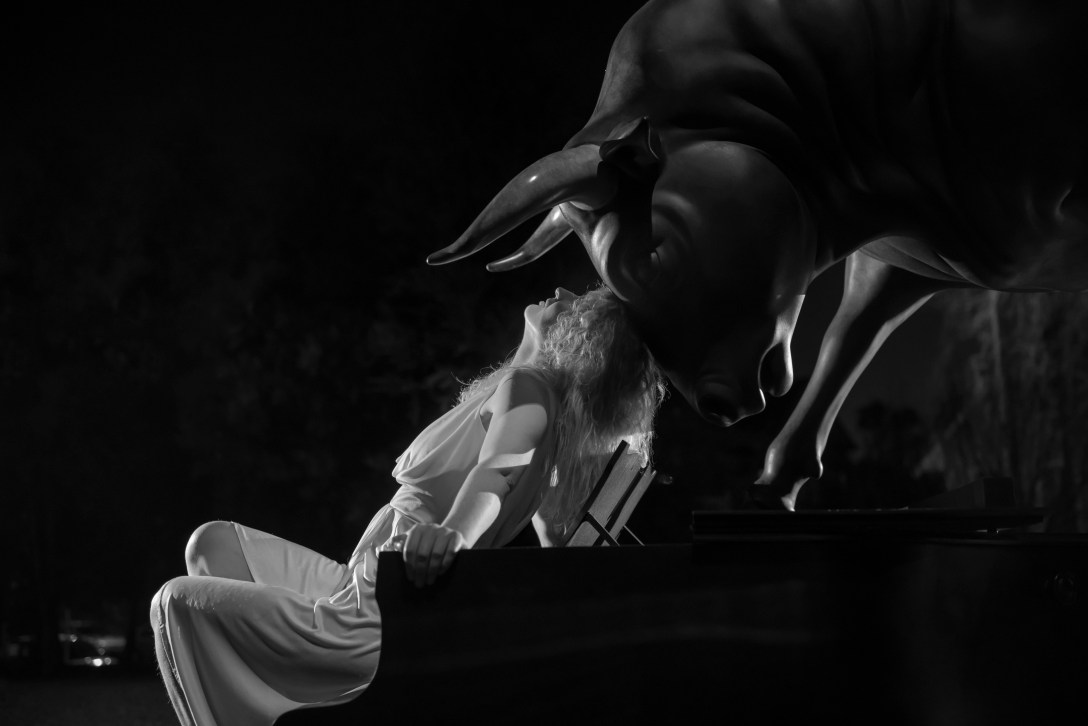
McCurdy, Hāpuku and Reddington do incredibly effective physical work around a deceptively simple set. The thematic dynamics that were only conceptual through Mander’s monologue now manifest in space and sound, as the three bodies array themselves variously around and upon the piano that holds centre-stage — Reddington playing it, and other less traditional instruments, to create a meaningful soundtrack of playful agony against the dumb silence of colonial New Zealand’s famed speechlessness.
Increasingly through the performance, Mander takes on the role of literary critic (as does the play itself), responding to her own critics, and then to the more famous rendering of her work — Jane Campion’s apparently unassailable film. Naturally, Mander is (rightly) scandalised by the latter.
In all of this, the play doesn’t shrink from the wider duality implicit in its colonial backdrop: the relationship between the settler society and Māori. Hāpuku’s David Bruce foregrounds that relationship and insists his people not be portrayed as exotic forest scenery, as in The Piano. In this regard, the play also employs the conceit of the “treaty” — an attempt to bridge the gap between the various poles that the play evokes. And it closes out with McCurdy and Hāpuku singing a duet of Leonard Cohen’s “Treaty” — a song that strongly suggests such a bridge is a hopeful impossibility.
Stacked with ideas, and endlessly self-referential, The Passionate Puritan risks being a sanctimonious bore of a play, but in fact it is anything but. Its ideas are embodied; they take risks; they balance precariously on the top of a piano; and most importantly they find dynamic expression in human form in front of us — they are played out.
An original production by Free Theatre, The Passionate Puritan is riveting, its dramas real. These are not the dramas of love and lust in an untamed forest, but rather the dramas of disconnection and distance, of recrimination, missed meanings and regret — and of historical injuries that continue to hobble us while remaining unnoticed in our quotidian distractions.
Free Theatre deserves more credit than it gets for the contributions it continues to make to cultural life in Ōtautahi with productions like this, which are at once thoughtful, entertaining, provocative, accessible and fun.
The Passionate Puritan runs until Saturday 18 October at The Pumphouse, 544 Tuam Street.

 Flat City Field Notes