

Erin Harrington reviews Giacomo Puccini’s La bohème, presented by NZ Opera with the Christchurch Symphony Orchestra, directed by Bruno Ravella, conducted by Dionysus Grammenos, at the Isaac Theatre Royal, Wednesday 2 July, 2025.
Puccini’s story of artistic optimism and doomed love La bohème is a certified crowd-pleaser – the sort of canonical work that has seeped into the popular consciousness, and that features heavily within programming worldwide. NZ Opera’s latest touring production is both inspired and accessible. Directed by Bruno Ravella, and led beautifully in Ōtautahi by Maestro Dionysus Grammenos with the Christchurch Symphony Orchestra, it offers an engrossing and poignant take on the work that honours the story’s melodrama while keeping things grounded in the everyday.
Ravella keeps the action in Paris, but places us in 1947 amidst the shock and dawning optimism of the post-war period. It’s a lean and brisk production that brings the characters of the cheerful but impoverished bohemian artists to the fore. You cannot help but fall in love with writer Rodolfo, played with immense charm by tenor Ji-Min Park, as he meets and falls for Mimí (soprano Elena Perroni, exhibiting exquisite musicality), a seamstress with a very suspicious cough. They spend time at a café with their friends, philosopher Colline (baritone Hadleigh Adams) and musician Schaunard (baritone Benson Wilson), where painter Marcello (baritone Samuel Dundas) is reunited with sultry past lover Musetta (soprano Emma Pearson). Mimí’s illness develops, and relationships fray as the artists do their best to find her care. The performers render the relationships vividly and sympathetically, with strong physicality and a fine eye for character detail.
This space of fragile post-war transition offers some terrific design opportunities. The marvellous set design (Tiziano Santi) takes us from the artists’ grungy yet spacious garret apartment and the vibrant café Momus to bitterly cold streets through some clever transitions and sculptural lighting design (care of Paul Jackson) – although I do find the need for an extended scene transition between acts 3 and 4 jarring. These designs make very good use of the depth of the Isaac Theatre Royal’s stage, of darkness as well as light, and give the players ample space. Bold artistic dreams, sometimes expressed through abstract projections on canvas screens, sit against the dark poverty of the winter. Some of the work’s best-known sequences are given particularly fine staging. In one, Pearson offers a stunning and very funny performance of Musetta’s waltz, the risqué and crowd-pleasing aria “Quando me’n vo”, perched on a swing that conveniently falls from the ceiling of the cafe. It’s a real delight, its lightness offsetting the work’s later tragedy.

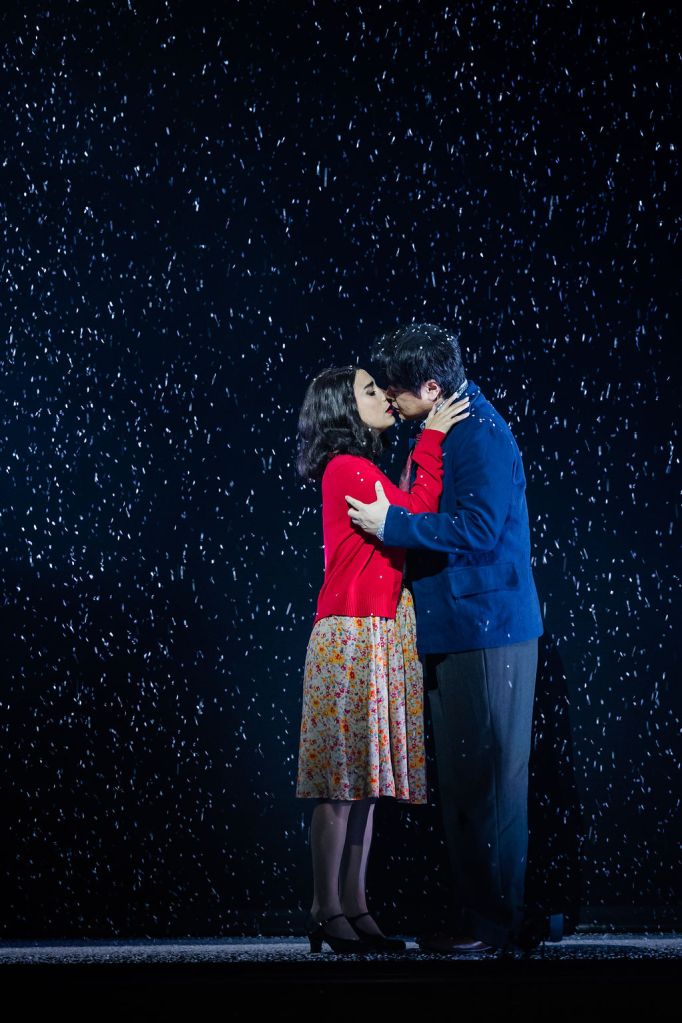
Gabrielle Dalton dresses the large chorus in beautifully textured, conservative and monochromatic garb. This sits in contrast to the bohemian artists’ more creative and fashionable apparel, which combines bright pops of colour – a stunning red Dior-inspired dress for Musetta, a striking cobalt blue flared coat for Mimí – with eclectic flea market treasures, like Colline’s beloved coat, here a decades’ old shaggy fur. The specificity of the era makes the relationships feel concrete, the immense buoyancy and pain of love pushing against the grime of the everyday. The straightforward tone of the digital surtitles, displayed on either side of the stage, helps with this too.
This is a thoroughly engrossing production; the sold-out Christchurch audience loves it. My companion and I talk afterwards with a woman who has come to the opera for the first time and who is floored by the whole thing. Nonetheless, where I am sitting there are moments when the orchestra (who are very good) threatens to overwhelm the singers – not just when the men are clustered upstage mucking about in their apartment, but also as Rodolfo and Mimí stand nearly on the edge of the stage, declaring their love at the end of Act I (the soaring duet “O soave fanciulla”) as snow drifts down on them. This creates an odd push-pull effect between intimacy and distance, although talking to others this balance seems to have been more consistent elsewhere, so perhaps it’s a quirk of the venue. It doesn’t undermine the production’s emotional clout, though, nor its artistry. Highly recommended, for opera die-hards and newbies alike.
La bohème plays twice more in Christchurch, on July 4 and 6. Information here.

 Flat City Field Notes