
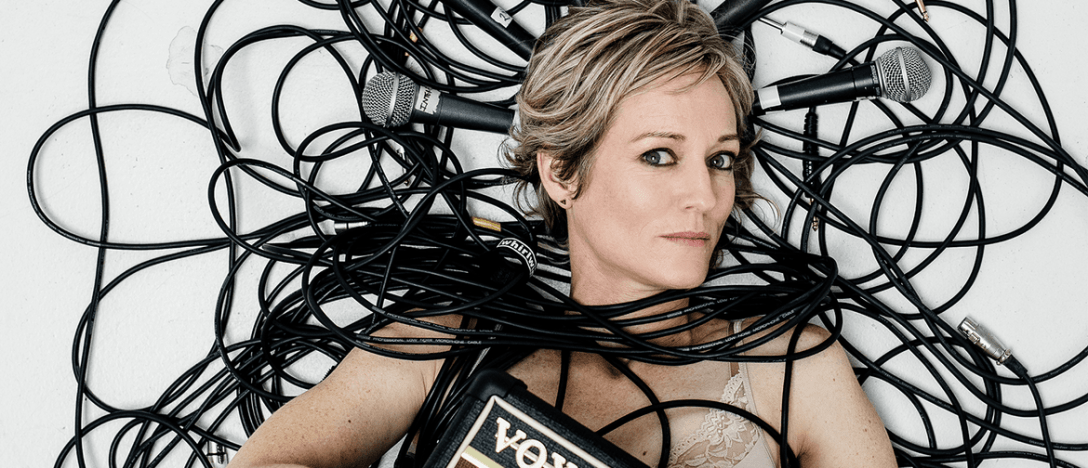
Erin Harrington reviews We’ve Got So Much to Talk About, created and performed by Sally Stockwell, directed by Julia Harvie, at Lyttelton Arts Factory, 20 October 2023.
Sally Stockwell’s excellent We’ve Got So Much to Talk About is one-woman multidisciplinary tour de force that grabs tightly onto the messiness of motherhood and maternal identity and refuses to let go. Microphones hang from the ceiling of the deep black box of the Lyttelton Arts Factory. Upturned tour cases, which act as tables and plinths for domestic items, suggest transition, the gap between gigs (and selves?) past and yet to come. Stockwell, directed by Julia Harvie, stands front and centre and sings us into the show. She loops her lovely textured voice, and music played on a little Korg synth, into an insistent and yearning chorus that’s perhaps a group of storytellers, perhaps a fractured sense of self. From the outset of the show, and the titular opening number, there’s a juxtaposition between the rage (“and the rage and the rage”) and the silent, softened parameters offered (or insisted upon) by dominant cultural expressions of femininity. It’s all cleverly signalled in Stockwell’s costume, a terrific hot pink suit and a black t-shirt with a starburst motif.
In a city where performance tends towards conventional pro work or cheap-and-cheerful weird stuff, I appreciate seeing such well-produced experimental work. The show combines original song, movement, scripted elements, confessional monologue, cabaret, burlesque, soundscapes (designed with Chris Marshall), and sympathetic lighting (care of Tim Jansen, as well as operator Calvin Hudson). Stockwell is both vulnerable and charismatic as she talks directly to us, braiding highlights (and lowlights) of her rich career as a professional actor and songwriter with her experiences as a mother. Sequences variously explore the shock of motherhood, the domestic grind, the demands of children, our culture’s limited view of women’s capacities, and the restrictive boxes that female actors find themselves in. The audience laughs and groans as a baby’s squall bursts from a small handheld amp, and as Stockwell is patronised by casting directors who put women out to pasture once they hit 30.
The backdrop to these narrative elements is a defiant search for identity that attempts to reconcile the contradictions in one’s sense of self, from erotic sexy body and lover, to professional, to friend, to anxious caregiver and lonely shit-smeared milk-provider. Perhaps reconcile is too strong a word for the mess of it. Perhaps bring into coalition? Some of these threads are more strongly developed than others, and as much as I enjoy the show I sometimes feel like I want a little more synthesis across the hour’s arc. The production design has a distinct point of view; I am particularly taken with the imagery offered by a tangled scribble of sound cables, which come to stand in for many of the show’s anxieties.
Stockwell’s work fits clearly within the ‘maternal turn’ – a shift, over recent years, towards mother-led, mother-centric work across art, film, literature, performance and more that foregrounds mothers’ voices and the complexity of maternal experiences and identities. Such work uses the capacious artistic registers of these art forms to bring noise into silence, and to disavow sanitised, saintly accounts of maternal identity. They traverse joy, fear, rage, helplessness, power, love, ambivalence.* This is vital work, in the dual sense that it is necessary and that it is lively, full of energy.
And it’s a great show. Stockwell owns the space and this narrative, owns her many art forms. It’s so great watching professional women performers just be excellent at what they do. The songs that pepper the show cover multiple genres, from brooding indie confessional to furious rock opera. They touch on recurring themes. There’s rage, uncertainty, hunger, and vulnerability, but also the way art making, communication, experience, and embodied relationships might be webs of information, nests, hammocks, things greater than their parts. Even the nested way I feel compelled to describe this reflects the show’s many points of connection. A
s she uses the metaphor of performance to cycle through maternal roles, and cultural scripts, you can feel the mothers in the audience shift in their seats, whisper to one another and lean forward. There’s a power in recognition, but also a hunger I feel across many shows right now to see more women in mid-life, more mothers’ bodies, on stage. I feel touched by the work’s final, gentle call for self-compassion. My companion, mother to a young boy, says afterwards, “everything in that show is true”.
* My friend and colleague Rachel Williamson has just published an excellent book on this, if you’re interested.
We’ve Got So Much to Talk About plays at LAF from October 20-22 as part of a national tour.

 Flat City Field Notes