

Erin Harrington talks with Brendon Bennetts, the creator / producer / co-Dungeon Master of Dungeons and Comedians, about the show’s development and production, and what’s special (and challenging) about producing a live, improvised theatrical actual play series in the era of digital content. D&C has been running since 2018, and live recordings are also available as a podcast and on YouTube. The current season has played to sold out audiences at Little Andromeda each month, and this year’s arc comes to a close this weekend – a few tickets are still available here.
Can you describe Dungeons and Comedians, for those who don’t know the show?
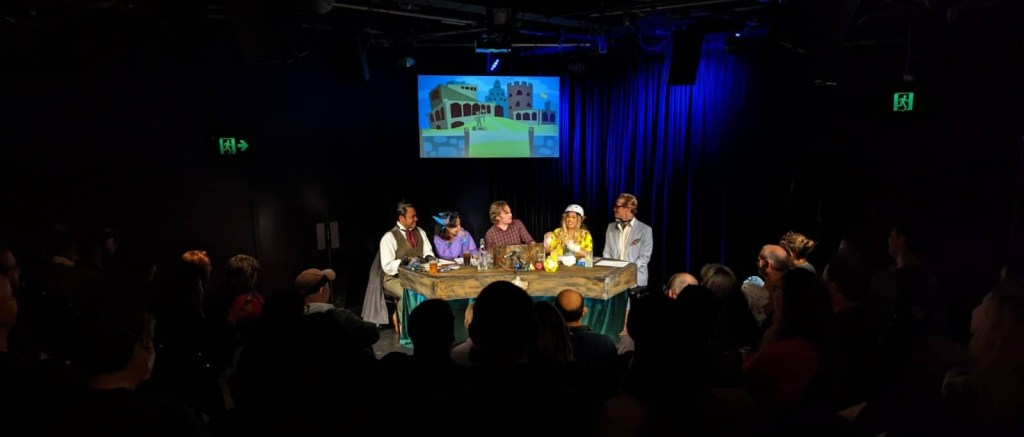
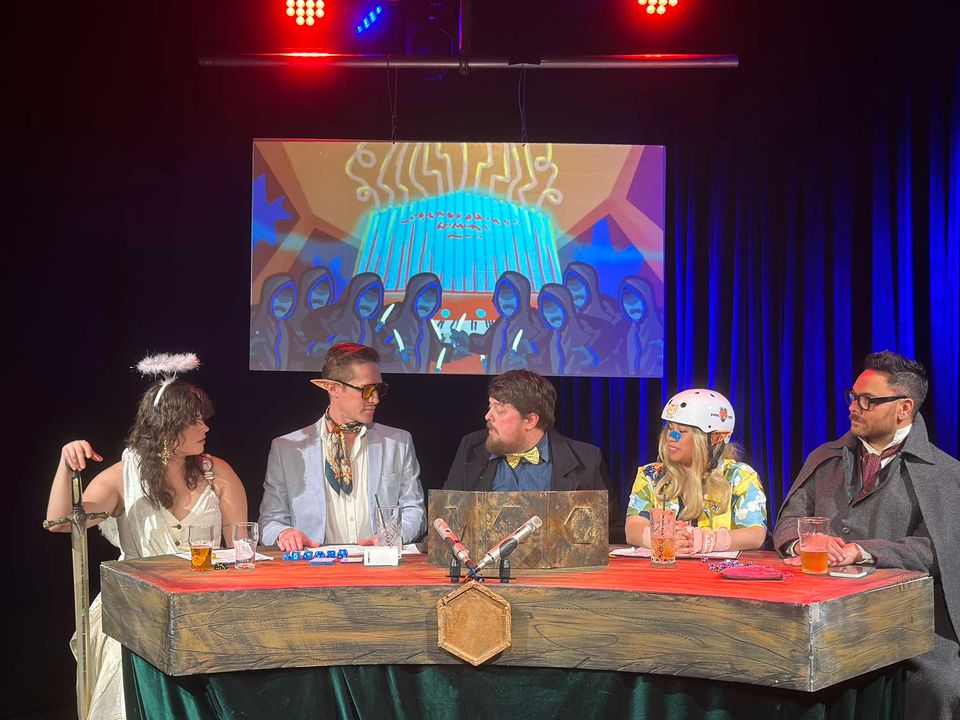
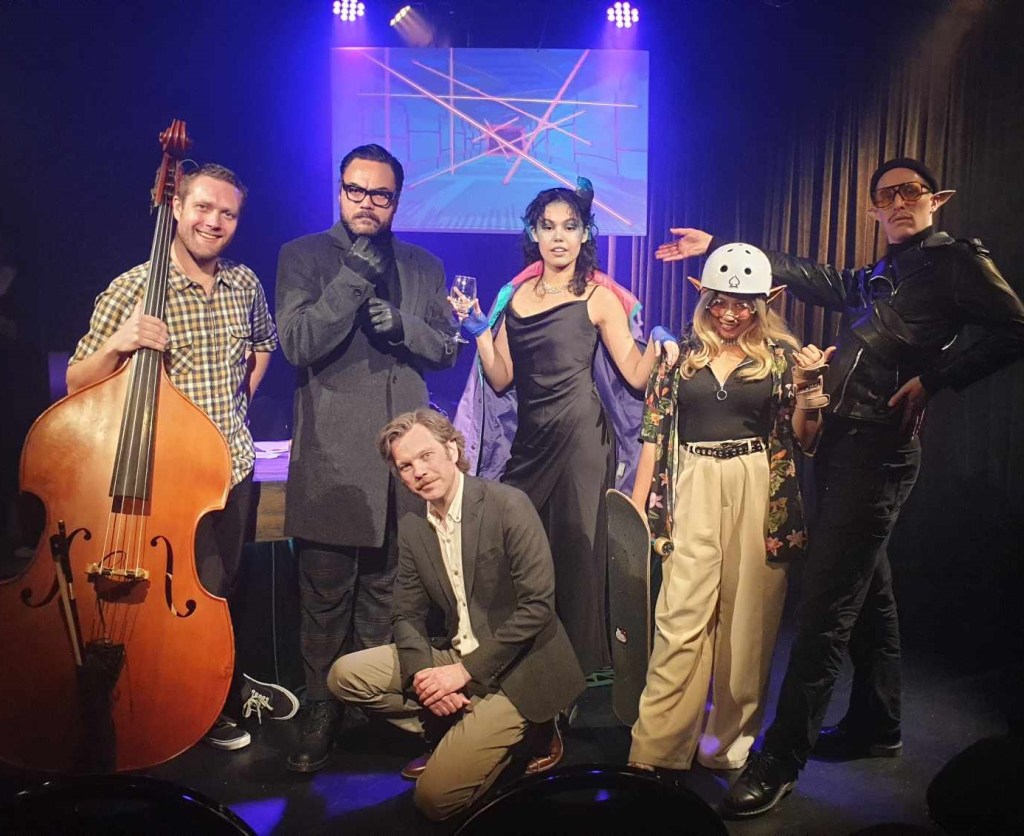
It is a live theatre show where comedians* play Dungeons & Dragons** in front of an audience. If you come to a show you’ll see five of us onstage sitting at a table. The Dungeon Master (me), will describe the scenario I have planned out, the other four will improvise what their character wants to do, and we work out what happens by rolling dice. What sets it apart from playing a game at home is the music, the lighting, the costumes. There are also real-time illustrations from animator Andrew Kepple, who is up in Auckland watching the livestream, which are projected onto a screen behind us.
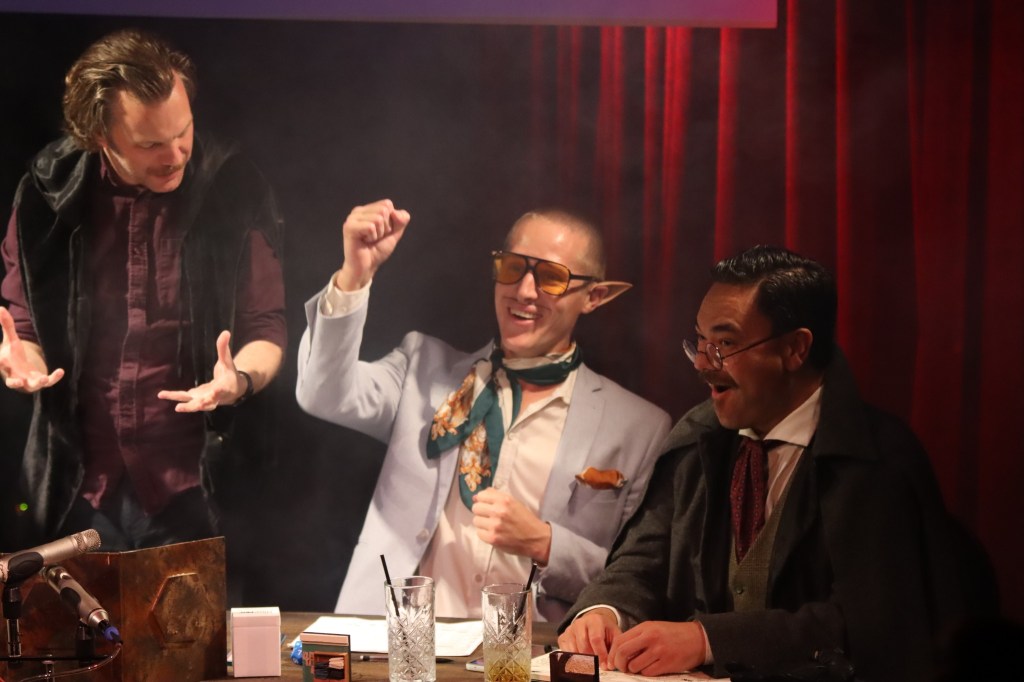
The current roster is me, Ciarán Searle, and Trubie-Dylan Smith taking turns as Dungeon Master. James Kupa, Krystal O’Gorman, Reylene Rose Hilaga, and Tom Eason have been the regular players this year and last, as we’ve been playing a consistent campaign. Michael Bell also provides live music.
* Now expanded to include actors and musicians
** Quite a loose interpretation of D&D
Actual play podcasts, live events and series have been having a massive moment over the last few years – and have become in some cases a considerable multi-platform industry. Has that shaped your approach at all?
Back in 2018 when I started D&C, there was a lot of actual play, but not many live shows. So my original intention was that it would only be a live show and not a podcast. I assumed (incorrectly as it turns out) that there were already more than enough D&D podcasts. It was quickly pointed out to me that there needed to be a way for people to keep up with the story if they miss a show. So we started recording it as a podcast, and then later as video, but I still think of it as primarily a live experience. I can’t compete with Dimension 20 or Critical Role as a recorded medium (shout out to Dice Legenz who are doing just that), but they can’t compete with us as a live experience here in Ōtautahi.
I really like that Dungeons and Comedians, in its various iterations, has been perhaps the most consistent part of Little Andromeda’s programming, from shows at the theatre’s first season in October 2018 in a large drafty marquee on the site of the new Court Theatre, to its current bricks and mortar home in The Terrace. I remember seeing the show there, and at Orange Studio out in Ferrymead. What were those first shows like?
Thrilling. We were packed into that little space. Everything was being held together with gaffer tape (especially Ben Allan’s shield, which was just a serving dish taped to his arm that would clatter to the floor unexpectedly). We were sitting so close that the audience could read our character sheets and explain the rules to confused players.
I think everyone is looking for a church-like experience: Being in a room with like-minded people, experiencing something together, and if you’re not into religion, or sport, or concerts, then it can be hard to find that, so I think there was an audience that wasn’t being served, and they really wanted something to get invested in.
My memory of the second or third show was that people were already dressing up as characters and chanting – like there was this amazing, obsessive fandom for the show, and that initial cast of pro improvisers, that seemed to come out of nowhere.
I think part of it is that we were quite endearing in that first year. None of the players had played D&D before, and the experienced players in the audience enjoyed seeing them discover in thrills of the game in real-time (“Oh, so that’s why you never split the party!”).
And as roleplayers themselves, they took on the role of fan.
It’s a slightly different show now, so how have your seasons developed since that first campaign?
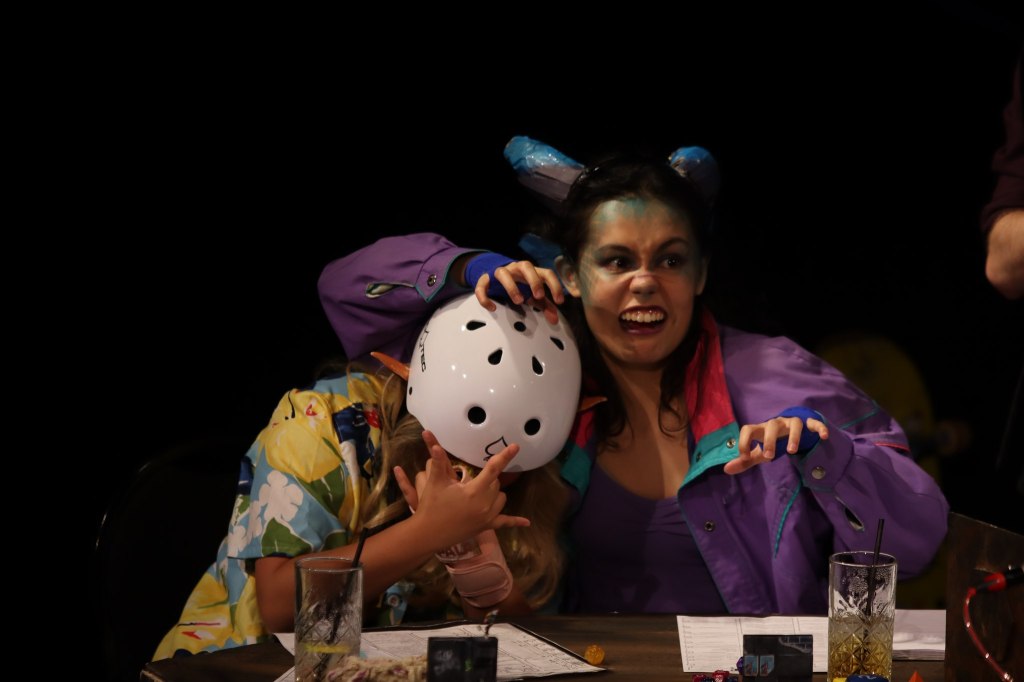
There have been lots of experiments over the years: musical episodes, different roleplaying systems… The main change over the years is that, after doing this for seven years, we can’t pretend that we don’t know what we’re doing anymore. I’ve tried to shift the focus from ‘look at these clowns mess things up’ to ‘let’s elevate the D&D experience’. What are things that you probably can’t have in your home game? So the costumes have got better, and the set dressing has got better. Michael Bell has been composing genre-specific theme music for each episode as well as playing live. Then there was the introduction of our pictomancer, Andrew Kepple.
Andrew’s contribution is legitimately mind-blowing, and I think a huge contribution to the show’s success. He becomes an extra player who is both invisible and hyper-visible, and he makes it look so easy. People also get so excited about the bespoke themed animated title sequences each month. Do you know of anything comparable anywhere else?
I used to wonder why no other shows copied this idea, because it adds so much. But I think the answer is simply that no one else can do what Andrew does. I first met Andrew 25 years ago in the UC Comedy Club, and he has been animating non-stop ever since. He is a brilliant comedian with excellent timing and he knows his tools inside and out. So if the heroes are battling five skeletons, Andrew will draw a skeleton, quickly duplicate the image then start moving them round the screen in response to what the heroes are doing. Then the way he’s drawn something might feed back into how I describe the scene, or how the players react. [You can check out one of Andrew’s animations here.]
Let’s talk about the last year (or two). The show is just really good on its own terms, and is clearly benefiting right now from an ongoing narrative about four key characters, who’ve each developed considerably and who together have a really wild dynamic, and the relationship you all have with other technical and creative staff. I’ve been particularly interested, though, in the way you’ve planned and programmed shows across the year.
There’s this interesting tension – on one hand, improvised comedy and tabletop roleplaying games are both formats that celebrate spontaneity, strong offers, interesting choices, and so on – there’s a lot of yes-and-ing. On the other hand, in planning the campaign, you’ve clearly thought through not just a rough arc, but also how each ‘episode’ can sit within different genres, which shape individual episodes. Can you talk a bit about that?
I remember when I was planning the second ever episode (“Battle of the Bards”), I came up with an idea that I was convinced was the best idea I was ever going to get. I was trying to decide whether I should save it – should it be a big finale or something. But in the end I settled on a policy of never holding anything back. It is exciting to find out what you get after your best idea, and I’ve more or less stuck to that policy ever since. If I have a great idea, I will put it in the next possible episode. It is a relief to find that even after all this time I’m still getting new ideas.
For the long term campaign, I do a lot of pencilling in. For the current season, which started last year, we settled on a strong opening: our four heroes discover they are all the children of the land’s greatest hero, and she has just disappeared. I pencilled in an idea for what would happen when they find out what happened to her, and in the faintest pencil I’d jotted down what might happen after that. As the adventure goes along some parts of that get inked in, and other parts get replaced with something else.
In the most recent season, the idea to specify a particular genre each month was largely a marketing decision, but it has turned out to be more narratively flexible than it appears. So we recently did a Gladiator themed episode – obviously there was going to be gladiatorial combat in the episode, but we didn’t have any idea where it would happen or what the stakes were until the month before which ended with the heroes being carried up to heaven. So it was a gladiatorial arena in heaven to win favour from the gods, but if things had gone differently the heroes could have been battling for their freedom in the capital city.
You’re sharing DM roles too – how has that shaped play?
As much as I enjoy doing the show, I was starting to get a bit burnt out. I have an unfortunate habit of coming up with shows that require huge amounts of preparation work from me (see also comedy podcast The Nerd Degree), so bringing in some other people to help has been revitalising. Ciarán, Trubie and I have a chat every few months about where we think the overall story is going, and what previous elements should be brought back in, but I often won’t know what is going to happen in one of their episodes until I see it live. So there have been a few times when another DM has dropped an unexpected bombshell – in the last episode Ciarán declared that one of the player characters would die in the final episode. The worst part is when a DM introduces a character with an accent that I can’t do, knowing that I’ll have to play them in the next episode.
Over the years I’ve been lucky to have built a small network of other DMs who were attempting similar things in other parts of NZ. Ryan Knighton had a show in Palmerston North (Saturday Knights), and Morgan Davie in Wellington (Diceratops). They are both more knowledgeable about D&D than me, but I maybe had more experience with the live show aspect. So we’ve been able help each other problem solve a lot of things.
How have these different genres, or formats, offered space for different types of storytelling and character development?
Dungeons & Dragons, as a game, holds in the world of tabletop roleplaying games a position similar to Marvel in the media landscape. It tries to offer you its version of everything, so that you won’t look anywhere else for entertainment. I have mixed feelings about that. On the one hand, the tropes are well-known and are ripe for parody. Audiences know what to expect with D&D, so even though an episode might be a Love Island-style dating show set in hell, the trappings of D&D – rolling 20-sided die, classic D&D monsters – give an audience something to hold onto. But, in my home games I tend not to play D&D.
Yes – I’ve really enjoyed playing some not-D&D games together, like the Homer’s Odyssey-themed Agon and its Wes Anderson-inspired offshoot Odyssey Aquatica, which you GMed, and also an accidentally quite long game of Brindlewood Bay (old ladies solving crimes and encountering a Lovecraftian conspiracy), things that aren’t at all combat focused but offer different play-based structures for character interaction and narrative development. The actual play media I enjoy, like the absolutely genius Canadian podcast Spout Lore, seems to skew towards the Powered by the Apocalypse system, which incentivises much different forms of storytelling and player collaboration to D&D.
Over the years I have morphed the D&D we play onstage using influences from other game systems. The way that Powered by the Apocalypse generates forward momentum is brilliant for stage performance RPGs. Essentially, in D&D if you fail a role then it means the thing didn’t happen – I don’t pick the lock. In PbtA games, failure means that something bad happens to the heroes – I don’t pick the lock and the noise alerts the guards. Succeed or fail, the story keeps moving forward. So I’ve brought that into D&C.
There’s a wonderful steampunk heist game called Blades in the Dark which lets players narrate flashbacks to show how something that seems to be going wrong is actually part of their masterplan. I love that mechanic so much, so when we did our heist episode, “Potions 11”, I introduced a version of that to the game (and which James used it to astonishing effect). In our soap opera hospital episode Trubie got them to play Operation instead of rolling dice when doing surgery. For our Stranger Things episode, Ciarán invented a whole new game so that the players could play D&D inside the game of D&D.
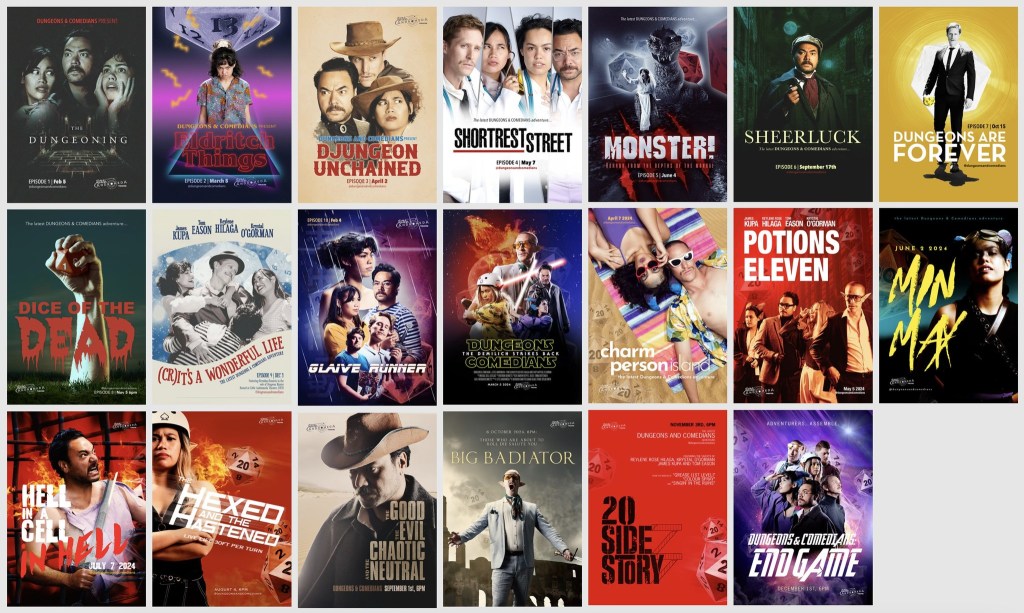
And then there are the posters! They are stunning, and very funny.
At the start of each year we sit down and brainstorm genre ideas. Then Emma Brittenden takes some photos and makes these incredible movie posters for us. Just the presence of those posters demands that all of us raise our game to match that quality.
This year’s arc is ending later this week. Will D&C come back next year?
We will be back! We’re going to take a couple of months off before we relaunch, but I’ve already started working on the next season. It will be mostly the same team again, but something I’ve missed from the last two years has been guest characters, so I’ve shuffled things around to make room for more or that.
I have some ideas about some changes to the tone – I’m interested in the idea of adventuring parties as a metaphor for the gig economy, so I think we’ll explore that. And I’d like to keep the adventures contained into a smaller area (rather than journeying to a new place each episode) so that we can really build up the places and characters around them.
Is there anything else you’d like to add?
In 2018 I introduced a recurring antagonist who was a parody of Elon Musk. I really feel like that characterisation has held up incredibly well, and was in fact kind of predictive as this character was so desperate to be viewed as a hero, and so desperate to be liked by the adventurers, that he ended up siding with the villains. So, I guess I’d just like credit for that.
This year’s final episode, Dungeons and Comedians: Endgame, is on at Little Andromeda, 6pm, Sunday 1 December. Get tickets here.

 Flat City Field Notes