

Erin Harrington talks with the Artistic Director of The Court Theatre, Alison Walls, about the release of the theatre’s 2025 programme – the first that will be staged in the organisation’s new home in the Performing Arts Precinct.
Kia ora Alison – congratulations on the launch of the 2025 programme. How has it gone?
Thank you! It has gone well. It can feel a little strange. The launch is a big deal but also this little piece in a process that we’ve been living with for a while; it is really great to be able to actually share what we love about each work though! And it’s interesting to see what people are drawn to.
I wanted to talk to you about some of the process of programming, because it’s really interesting. We the public end up with a nice glossy programme, but there’s a whole, really long and complex artistic, organisational and commercial process that is largely invisible to the public. I know it takes a long time – what goes into it?
Oof, it’s both quite methodical and super organic and messy. It’s very much an iterative process. We begin with a few “heart” choices–those pieces that we’re just in love with and excited by–they might be ones that we’ve just picked up, that we’ve had in mind for a while and haven’t been able to do, or that we’ve always loved. And I say, “we” because it’s very much a discussion. Associate AD, Tim Bain, and I have that continuous thread and essentially shape the pool of works for consideration, but other people also contribute hugely–both in dedicated regular meetings with other Court folx, and in more informal, investigative chats with others.
Then there are those pieces that ground the season; some of the bigger works usually. And in and around that, we fill in the missing pieces. There’s some pretty important practical considerations. We need to know the rights are available and we also have to consider if we can do a work justice. Every little change shifts the whole picture.

Because I work in education, I often wonder if the artistic work of putting together a season is like creating a new syllabus: you need some older or classic stuff, something that expands people’s horizons, interesting new things, works that amplify the voices of those who have been under-served and under-represented, stuff that celebrates our Aotearoa context and voices. Then you’re trying to maintain a clear and coherent point of view, which might also be a statement of intent. How do you think about a season?
So much like a syllabus! And with a lot of the same challenges! Every theatre has its own guiding mission, of course, and for The Court Theatre it is about balance and variety – that was one of its founding artistic principles. It’s not always that easy to achieve, but I feel the responsibility of it.
Your list very much aligns with mine. We also have to think about what will draw people in and what their experience will be. On a teaching syllabus, I would always hope that my students would be engaged, but that might be from a critical perspective, or specifically historic lens; I might include a canonical work, for instance, and then also a piece that “speaks back”. I had a good time teaching adaptations in the U.S. and the pairing of Dion Boucicault’s The Octoroon with Branden Jacobs-Jenkins’s An Octoroon was especially fun. But no one wants to “hate watch” theatre!
Another important difference is that students experience the whole syllabus, whereas audiences might only come for one or two pieces–and we don’t expect every piece in the season to speak to every audience member–I think we would have a deeper problem in that case. And there’s an artistic duty to, as you say, broaden people’s horizons, as well as extend the possibilities of the art form. Sometimes, it’s about sheer enjoyment–and that too, is a great thing.
Yes! That’s the big offer really – the joy of a live, collective encounter – reading something on page and thinking about how to turn it into an experience.
It really can’t be underestimated, can it? I love the solo pleasure of losing yourself in a book or TV show too, but it’s kind of amazing to laugh, or gasp, or cry at the same time, in the same place with other people. It can be fascinating too when a piece prompts quite different responses within an audience. Some playwrights deliberately disrupt the cohesion of an audience and that’s a really powerful experience too.
But yes, thinking about a script becoming an experience–sometimes that’s the test of a script–the theatrical potential it holds. Sometimes you need to ask the question, does this need to be theatre? There are some pieces that embrace the medium so well that there is no question.
There’s the whole collaborative piece too. The script (assuming you are working from a script) has to be both robust enough and open enough for other people to bring their artistic vision and process to it. Which is also the joy of it, of course. When you get the right people together who fire off each other and every piece makes every other piece stronger–the whole being more than the sum of its parts thing.
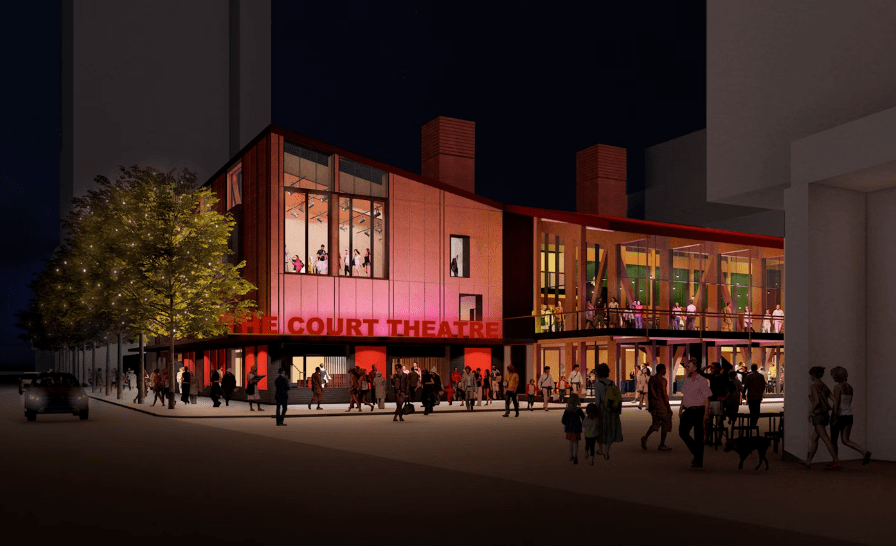
Then there’s the added layer that this is a really big deal – the first season in what will be the newly completed theatre in town. How has that sense of occasion, and I guess the logistical challenge of moving into town and settling into your new home, been a part of your discussions?
It’s been huge! There’s so much emotion tied up in The Court’s story for so many people. We definitely felt that the first show in the new building had to have some symbolic significance. It had to be an Aotearoa work [Bruce Mason’s “The End of the Golden Weather”]; that was one thing we decided very early on. Being able to program for two different spaces has been a gift. It opens up artistic possibilities in a really fantastic way and also, I think, helps clarify that the experience of each work is going to be different.
I’m curious – what has it been like programming work for spaces that aren’t completed yet?
Um – it’s been interesting (a little terrifying)! We’ve been able to tour the building a few times though and that has helped a lot. It’s one thing to look at a floor plan and another to stand where the stage will be and think, oh this is the performer-audience relationship (at least for me)!
Part of the excitement, I’m sure, is about possibilities. What are some of the things this new space will be able to do that the current space can’t?
The smaller theatre–The Front Room–really changes a lot for us. There are great intimate works, or works that just call for a different relationship that wouldn’t work on the stage at The Shed. It’s more flexible too, so there are a few different staging possibilities (thrust, end-stage, traverse…) so that will be something for creatives to play with.
The Stewart Family Theatre also changes the audience-relationship. It’s still a large theatre, but with the different levels and the way the audience wraps around the stage a little more, it’s going to have quite a different dynamic for some shows–much better for Shakespeare, I expect!

I know you have to love all of your children equally, but is there something you’re particularly excited about?
Haha, of course! Kind of suitably, I’m particularly excited about Wolf Play, which is an adoption story. Hansol Jung is a brilliant contemporary playwright. She was inspired by journalism on unofficial online adoptions. At first, I was worried that it would be too self-consciously topical, but it’s so driven by the characters, and has a really winning warmth to it, so instead, it exemplifies how the personal is political and vice versa. It also has this ingenious device of the child, Jeenu, being embodied by a puppet and voiced by his alter-ego Wolf. It’s a great example of a piece of theatre that can only be theatre.
I’m also excited to have Shakespeare in there (as you know, I’m a Shakespeare nerd from way back). And it’s great to be able to do Victor Rodger’s Black Faggot in the new theatre too.
I agree – I reviewed Black Faggot at the Christchurch Arts Festival in 2015, and even in the weird space of the spiegeltent it was incendiary. I was really, really excited to see it programmed.
Finally – how are you going to say goodbye to the old space?
We don’t know yet! I love to imagine some amazing performance art event that involves graffiti and generally getting wild and chaotic, but that’s probably (definitely) unrealistic. There’s quite a bit that will still be going on at The Shed before the move, but we’ll have to do something special. It has carried a lot for a lot of people. It’s quite beautiful to think about the ghosts of every performance in The Shed.
It will be emotional, I expect. But oof, it’s going to be good to get into that city centre theatre!
The 2025 season is live on the Court Theatre’s website here. The new theatre opens Saturday 3 May, 2025.

 Flat City Field Notes