
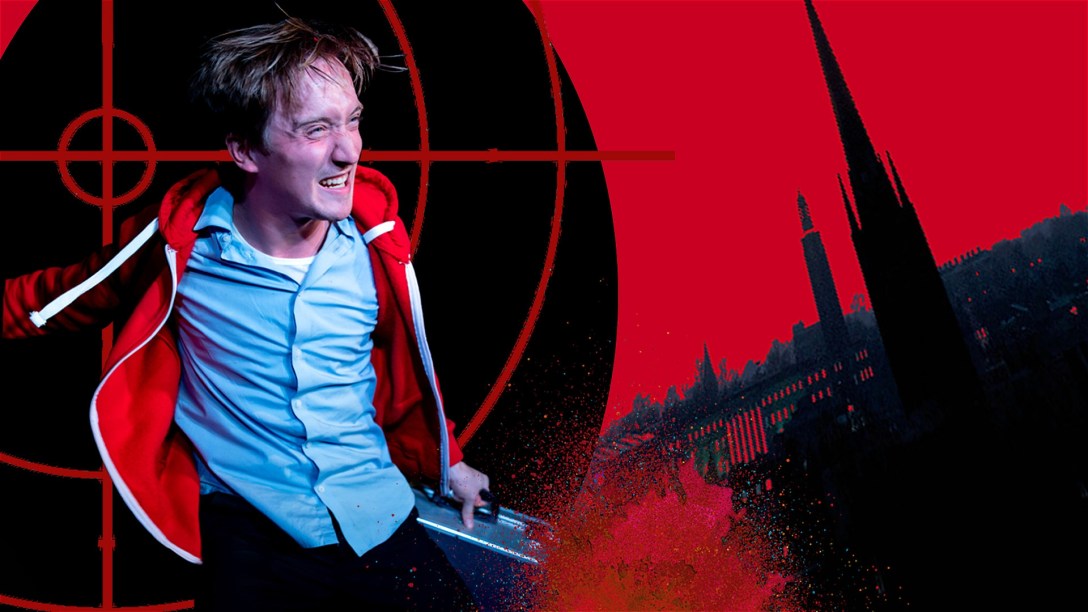
Erin Harrington reviews The Night Ali Died, presented by Raising Cain Productions, at Little Andromeda, Friday 6 March 2026.
British performer Chris Sainton-Clark’s crime thriller The Night Ali Died is an absorbing piece of solo theatre that combines sharp storytelling and cinematic tropes in a very satisfying way. Ali is just some late-20s guy from Norwich who has drifted from school to uni and into adulthood without much of a plan. He’s now got a partner and a kid, and he’s working a tedious job in a pharmaceuticals lab with his childhood best friend, bobbing around in a sea of quarter-life discontent. Ali accidentally discovers that his mate has been up to something very illegal, and he’s suddenly dragged into an encounter with a dangerous criminal network. Actually, that’s not correct – he actively involves himself, sticking his nose in and putting himself (and his family) in danger. He’s enjoying feeling like an everyman protagonist in a gritty crime film, trying to chase away his everyday dissatisfaction while ignoring the growing danger.
And then [redacted] happens and things peel off in unexpected directions. We know Ali dies, but the show’s pleasure is in finding out how and why, and in figuring out this death’s place within a very chaotic series of events. The familiar genre beats of the crime thriller drive a story in which small choices have big consequences. Everyone’s just a cog in the machine; everyone’s working for someone else; everyone’s just a piece in a someone else’s game.
Sainton-Clark is a strong performer and a compelling storyteller with a great, deadpan sense of humour. I can see why he’s been scooping up awards at fringe festivals across the UK and Europe. Through relatively understated but very specific characterisation and movement he ably paints a picture of small-town malaise and gangland disagreements. Everything’s driven by very human impulses, which grounds the big action in small, relatable choices (even if those choices are deeply regrettable).
This touring show is also designed very economically – there’s just a chair, a suspicious-looking suitcase and a few bits of costume. The world is fleshed out with an effective, thoughtful soundscape and some smart lighting that contribute to the show’s interest in how the languages of film and theatre might interact, both on stage and in the imaginations of the audience. Indeed, Sainton-Clark has framed this show as a cinematic concept for a film in solo theatre format, designed to act as a writer’s calling card. Career aspirations aside, applying cinematic tropes to theatre, through story structure, pacing, point of view, address, sound design, and characterisation is also just really smart dramaturgical thinking. Genre storytelling is satisfying because we’re all literate in these tropes, but we love seeing how they are variously fulfilled, manipulated or subverted. This means that the agreement between performer and audience is already there.
And you can feel it in the room. It’s Little Andromeda’s opening weekend for 2026 and the theatre is sold out, and the audience is so hot people are cheering even as the lights go down, and then in some of the scene transitions. It’s quite something. As things progress, we come to learn how the story is structured and why, and all the beats land. Even sitting right up the back, in the least good seats in the theatre, I find the whole thing totally gripping. The Night Ali Died is currently touring across Te Waipounamu – a night in Ōamaru, and runs the Dunedin and Nelson Fringe Festivals – and it’s highly recommended.
The Night Ali Died played at Little Andromeda, Friday 6 March 2026.

 Flat City Field Notes